Friday, September 29, 2006

Build a Ghetto Solar Cooker

Using crap we had laying around the homestead, SurviveLA fashioned a solar cooker based on plans from Backwoods Home Magazine, the Dwell of the Ted Kaczynski set. We just substituted an old cooler for the cardboard boxes, and we finished it off by using one of Los Angeles' ubiquitous abandoned car tires as a cradle to keep the cooker oriented towards the sun. It ain't pretty but it works. In our first test we reached 160º inside the oven, but we think we can do better with some refinements such as finding a black pot with a lid.

Yesterday we cooked up a somewhat disappointing batch of "chocolate pudding" which ended up with the consistency and taste of warm cake batter. We'll test out some other recipes in the next few days, sun permitting, and keep you, our loyal readers, informed.

For more information on solar cookers check out the superb Solar Cooking Archive. You can also purchase a commercially made solar oven called the Global Sun Oven, but why do that when you can make one with cardboard, aluminum foil, and a black pot?

Monday, September 25, 2006

Crapper Livin'


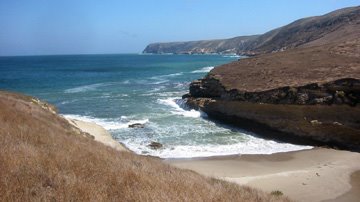
Your house should be like this National Park Service bathroom. Located on remote Santa Rosa Island, forty-six miles off the coast of Ventura, this handsome building features a solar water heater and a 12 volt electrical system to power the lights. Built of durable materials such as cedar and recycled plastic decking, this building should see many years of service.

SurviveLA advocates the virtues of living small. Why not, for example, live in the Santa Rosa Island campground bathroom? The average American house has been super-sized to a gut busting 2,400 square feet and living in a structure the size of this bathroom would probably violate city codes in many places which mandate a minimum square footage for habitable dwellings. The nice thing about a small house is that it discourages the accumulation of crap and requires a lot less energy to maintain.

Sure, there is less convenience with a building like this. With a very simple solar water heating system showers need to be taken at the end of the day and the very modest solar panel would not be able to power any major appliances. But these are minor sacrifices compared to the enormous benefits of self-sufficiency, namely one's freedom.

An aside here - SurviveLA encourages a trip out to beautiful Santa Rosa Island to enjoy the natural wonders and to visit this bathroom of the future. Unfortunately the vile and corrupt San Diego congressman Duncan Hunter wants to restrict access to the island so that fat cats can continue to go on $16,000 trophy hunts while drinking beer on the back of a truck. Read more about his plan to turn Santa Rosa into a retreat for disabled vets (an excuse to keep the fat cat hunt going) in the Washington Post. Please fax Hunter at this address ASAP and tell him that Santa Rosa Island belongs to the people, and should be run by the National Parks Service: Rep. Duncan Hunter, 2265 Rayburn HOB, Washington, DC 20515-0552. Fax is 202-225-0235. Let's give Duncan the flush!

Thursday, September 21, 2006

Escape from LA

Sometimes in order to survive LA you've gotta escape it, which is why we are headed to Santa Rosa Island, part of the Channel Islands National Park, tomorrow for a weekend of backpacking and general self-sufficiency. We're going in part to experience what the landscape of Southern California would have been like had it not been fucked up by freeways, strip malls and Spearmint Rhino billboards to name just a few of the many indignities we face each day.

We're also going to Santa Rosa to experience a place which was home to the Chumash Indians who lived for 13,000 years off the bounty of the land and the sea without needing to load up the kids in the mini-van and head to the 99 cent store.

Santa Rosa Island is also a land of mystery that once was home to the paradoxical combination of pygmy mammoths and giant prehistoric rats.

Sadly, in order to commence this journey we will be commemorating World Carfree Day by . . . driving, as we have to get to the Ventura pier early in the morning to catch the boat. We suggest that those of you who are stuck in LA this Friday to consider not driving if you can, and attending the vigil for Ilia Pankin, a cyclist who was killed earlier this week by a hit-and-run driver.

Tuesday, September 19, 2006

Garden Like a Pirate

"Damn ye, you are a sneaking puppy, and so are all those who will submit to be governed by Laws which rich men have made for their own security, for the cowardly whelps have not the courage otherwise to defend what they get by their knavery."
- Captain Bellamy from A General History of the Robberies and Murders of the Most Notorious Pirates by Captain Charles Johnson
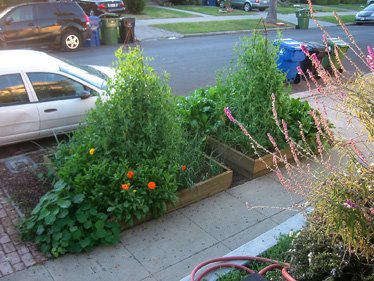
In honor of International Talk Like a Pirate Day, we at Homegrown Revolution would like to introduce the concept of Pirate Gardening. Pirate Gardening involves claiming unused land that does not belong to you for growing food crops. The first bit of land we hijacked was our own parkway, that bit of dirt between the sidewalk and the street that technically belongs to the city, but is the responsibility of the homeowner to maintain. It's yet another space, like the vast asphalt hell of parking lots, garages, freeways, car lots, auto repair shops, and junkyards in our car-obsessed city dedicated to the needs of the personal automobile.

We decided to flaunt the city's strict rules about this space which dictates the kind of things that can be planted (basically nothing that would inhibit someone from getting out of their Hummer), and plant a vegetable garden instead. The idea was twofold: to provide vegetables for ourselves and our neighbors, and to do it in a way that would be aesthetically pleasing. Now, if we lived in some tight-ass place like Beverly Hills or Glendale some bureaucrat would, no doubt, have busted us by now, but in the City of Los Angeles, where code, building and traffic enforcement are non-existent, nobody seems to care. If we were Republicans we could probably have dug our own open pit mine or built our own miniature coal fired power plant without any City of LA official giving a damn.

For our piratical parkway garden we built two six by six foot raised beds, filled it with quality garden soil, and stuck in two matching wire obelisks for growing beans and tomatoes. Much to our surprise it has been a big success - we had a bumper crop of carrots, beans, turnips, garlic, onions, and beets in the winter and our summer crop was cherry tomatoes. Currently the beds are empty as we wait for this incredibly hot summer season to cool down (thanks for the global warming everyone!) and we are just about to plant an assorted winter crop of beans, broccoli, and assorted greens.

We've encouraged neighbors to help themselves to vegetables from the parkway garden, though few have. What has been nice has been the conversations We've had with neighbors while watering and tending the space. Several neighbors have said that it encouraged them to plant their own vegetables, albeit in their back yards. With more people growing vegetables our neighborhood becomes more self-sufficient and a wasted space has been reclaimed.

If all such marginal spaces, parkways, freeway embankments, vacant lots, and median strips were claimed by piratical gardeners and used for growing food, nobody would ever need to buy crappy supermarket produce. It's time to seize all unused urban land matey and remember the words of Captain Bellamy as you do so, "I am a free prince".

Monday, September 18, 2006

A Close Shave Part II

Shaving authority and SurviveLA Toronto correspondent Nicholas Sammond sent these handsome pics of a unique shaving system called the "Rolls Razor". It looks like a safety razor, but instead of using disposable blades, the blade is permanent and re-sharpened on two stones contained in the case. One stone is used for occasional re-sharpening and the other stone is a "strop" used to sharpen the blade after each use. A detailed description of the operation of this unique razor can be found on this web site.

In effect the Rolls Razor is a compromise between a straight razor and a safety razor. We say it's time to bring back the Rolls Razor so we all can stop handing Gillette and Schick, who have the same business models as crack gangs any more money, and stop filling all those landfills with more plastic.


Saturday, September 16, 2006

La Alternativa

Today's Wall Street Journal (paid subscription required) has an article on the Cuban equivalent of Martha Stewart, Margarita Gálvez Martinez who writes a column for the Pinar del Rio dioscecan bulletin Vitral and if tough times are coming, SurviveLA would rather have Margarita on our side than Martha. While Martha is out fretting over terry pillows and Halloween cupcakes, Margarita is surviving.

Cuba has faced some very tough years since the fall of the Berlin Wall and the loss of trade (oil for sugar) from the former Soviet Union. Gálvez's advice falls under what Cubans call la alternativa, or alternatives for the luxuries we in the US take for granted. As the Wall Street Journal article notes, Gálvez's advice has included everything from salad dressing that doubles as hair conditioner, beauty treatments that consist of soaking in bread crumbs and warm milk, a flan made with fruit or vegetables rather than scarce corn starch and eggs, and laundry soap made from the jaboncillo tree. What we like most about Gálvez is that she is a strong proponent of urban gardening, maximizing every available space for food, a contrast to Martha Stewart's useless pesticide and fertilizer drenched flower gardens. See the the film Power of Community How Cuba Survived Peak Oil for more on Cuba's inventive urban gardening.

While we hope that the US does not face a Cuban style economic crisis, we at SurviveLA believe that it's time for la alternativa for other reasons, namely reducing our environmental impact and rampant consumption.

If you speak Spanish, please enjoy Gálvez's recipe for vinegar made from pineapple rinds or banana peels. There is an recipe in English (not quite the same) here.

Thursday, September 14, 2006

Moringa!

One of the big inspirations for starting our front yard urban farming efforts at the SurviveLA compound is a Philippino neighbor of ours who has turned his entire front yard and even the parkway into an edible garden featuring fruits and vegetables from his native land, most of which we have never seen before. This morning, while walking the dog, I found him cutting hundreds of long seed pods off of a small attractive tree. He didn't know the English name of the tree, but he told me that he likes to slice the seed pods and cook them with chicken.

Thanks the the "internets" I was able to figure out that the tree is the "Moringa oleifera", a truly miraculous tree that, in addition to producing edible seed pods, is also used by indigenous people for regulating blood pressure, dealing with joint pain and treating inflammation. The seed pods can be pressed to produce a high quality cooking oil. The leaves are also edible and the plant is drought tolerant and will grow in poor soil. Native to the southern foothills of the Himalayas, the Moringa tree is cultivated in many parts of Asia as well as Mexico and Africa.

Here's what Wikipedia says:

The immature green pods, called “drumsticks” are probably the most valued and widely used part of the tree. They are commonly consumed in India, and are generally prepared in a similar fashion to green beans and have a slight asparagus taste. The seeds are sometimes removed from more mature pods and eaten like peas or roasted like nuts. The flowers are edible when cooked, and are said to taste like mushrooms. The roots are shredded and used as a condiment in the same way as horseradish, however it contains the alkaloid spirochin, a potentially fatal nerve paralyzing agent, so such practices should be strongly discouraged.

The leaves are highly nutritious, being a significant source of beta-carotene, Vitamin C, protein, iron and potassium. The leaves are cooked and used as spinach. In addition to being used fresh as a substitute for spinach, its leaves are commonly dried and crushed into a powder, and used in soups and sauces.

The seeds may be crushed and used as a flocculant to purify water. The Moringa seeds yield 38–40% edible oil (called Ben oil, from the high concentration of behenic acid contained in the oil) that can be used in cooking, cosmetics, and lubrication. The refined oil is clear, odorless, and resists rancidity at least as well as any other botanical oil. The seed cake remaining after oil extraction may be used as a fertilizer.

The bark, sap, roots, leaves, seeds, oil and flowers are used in traditional medicine in several countries. In Jamaica, the sap is used for a blue dye.

The flowers are also cooked and relished as a delicacy in West Bengal and Bangladesh, especially during early spring. There it is called Sojne ful and is usually cooked with green peas and potato.

Some organizations are promoting this miracle plant as a way to deal with malnutrition, since its ability to tolerate drought while still producing edible leaves makes it highly desirable.

We like plants like this that have multiple purposes, since in addition to food and medicine the attractive Moringa tree also provides shade. The goal that we have set for the new SurviveLA landscaping is that every plant must have multiple uses with priority given to stuff that is edible. We suspect there may be a Moringa Tree in our future.

Sunday, September 10, 2006

Block Party Weekend


"Los Angeles is an army camped far from its sources of supply, using distant resources faster than nature renews them . . . Our region today is so dependent, so uninhabitable, yet so inhabited, that it must transform or die. Sooner or later it must generate its own food, fuel, water, wood and ores. It must use these at the rate that nature provides them. It can . . ."
-Paul Glover
Los Angeles: A History of the Future as quoted in the LAEV Overview

SurviveLA dropped in this weekend on a block party thrown by the apartment homesteading pioneers at the Los Angeles Eco-Village. Founded in 1993, the Los Angeles Eco-Village is a so called "intentional community" of folks who, basically, give a damn and are interested in improving our forlorn, polluted, and abused city.

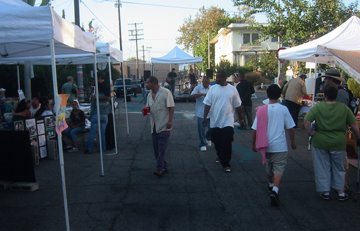
The block party featured ecologically savvy and self-reliant touches such as solar ovens to cook the vegetarian buffet and photovoltaic panels to power the amplifiers of the bands entertaining the crowds on Bimini Street. The fine folks at the Bicycle Kitchen had a repair stand to fix people's rides, while at the other end of the block the smell of spray paint filled the air as kids got to go nuts making art on some old sheets of plywood.

But what impressed us the most was the booth touting LAEV's participation in plans to improve humble Bimini street with such things as trees, park benches, traffic calming measures and public art all made possible with a grant from the city and the MTA. Called SNAP, or Station Neighborhood Area Plan, this initiative provides grants to make the streets along a corridor around the congested and decrepit Vermont and Hollywood Boulevards, more pedestrian friendly. The reason the MTA is involved with this is the hope is that with these improved pedestrian amenities more Angelinos will abandon their Escalades and take public transit. SurviveLA wishes the best of luck to the Eco-Villagers in implementing this plan and we hope that the SNAP concept will spread to the rest of the city.

It's time for all of us to follow the lead of the Eco-Villagers and throw our own block parties and make our streets fit places to meet each other face to face. Community building, i.e. breaking the walls that stand between us, is the first step in the transformation of ourselves and our neighborhoods.

Saturday, September 09, 2006

Secure your Ride Part II

In an earlier post we discussed pro-wrestling scholar and Toronto bike outlaw Nicholas Sammond's controversial bike locking strategy. Nic wrote us back to say that we got it wrong - he hose clamps his back wheel and locks the front, not the other way around. We stand corrected.

We'll be looking at some other locking strategies later on. In the meantime this video demonstrates the frustrations of the ever evolving locking strategy problem as well as dissecting the social dynamics of crowds, specifically the fact that the more people who are around the less likely it is for anyone to intervene when something goes wrong:

Wednesday, September 06, 2006

Essential System #4 - Illumination

It's all about LEDs my friends. LEDs are the way to go, lasting nearly forever and using very little battery power (make sure, of course, that you have batteries on hand). We have LED headlamps in our grab and go bags, but we also are looking into a new generation of LED bulbs for our Urban Homestead's interior lighting.

As far as house lighting goes, while LED efficiency is rapidly advancing, compact fluorescents are still better from an economic perspective even though there are concerns about the trace amounts of mercury that compact fluorescents contain contaminating landfills. Still, compact fluorescents are far better than incandescents since they consume less power and hence create less greenhouse gas. Remember that power plants are America's single greatest producer of greenhouse gases. And as far as conservation goes, it's estimated that if every American replaced one bulb with a compact fluorescent it would be the energy equivalent of taking 1.3 million cars off the road.

But back to LEDs. For emergency purposes it might be wise to have a Forever Flashlight that requires no batteries. You shake the thing back and forth to run the light, with no batteries ever needed - the device's only real disadvantage in fact is that the charging gesture, which uses Faraday's principle of electromagnetic energy, is really lewd and may lead to crass comments from bystanders.

Tuesday, September 05, 2006

Dwelling Portably

Dwelling Portably is one of the finest publications we have ever come across. Produced on a manual typewriter in a yurt in an undisclosed location in a forest in Washington State, Dwelling Portably is a how-to guide to living without a permanent roof over your head. In short, this is a guide by homeless folks for homeless folks. Holly and Bert Davis have been putting this collection of tips and anecdotes out for decades. Formerly known as the Message Post, this zine has evolved from multiple pages with a staple to just a single sheet or two with incredibly small type, so as to save paper.

Content ranges from cooking and bathing out of your car, to edible weeds, to improvised bicycle pannier bags, to musings on 12 volt microfiche readers and the practicalities of nudism. The advice, written in a consistent and factual manor, is interspersed with letters from readers who are also living the portable life. These stories offer a glimpse into a lifestyle most of us have not lead, and offer a perspective on and compassion for those who don't have a place to call home. Even if you do have a roof, the practical advice in this publication should be a part of the library of every Urban Homestead.

Holly and Bert Davis don't have much nice to say about computers or the internet and as a result the only way to receive this fine periodical is by mail at $1 per issue 2 for $2, or 6 for $5, or 14 for $10 with back issues available. The P.O. box, which Bert and Holly check when they are away from the yurt is:

Dwelling Portably
POB 190
Philomath, OR 97370


DPc/o Lisa Ahne (just the initials of dp, ie, NOT spellled out)
POB 181
Alsea OR 97324

Via Kevin Kelly's Cool Tools blog here is an excerpt from Dwelling Portably:

Legality of salvaging from dumpsters. Amy Dacyzyn, who phoned several police officials, said (in The Tightwad Gazettte, July 1993), "Dumpster diving is generally considered to be legal with the following exceptions: -- If the container is on CLEARLY MARKED private land, behind a fence or locked up. However, most dumpsters in 'semi-public' areas such as parking lots are fair game. -- If the discarded items are outside the dumpster they should not be taken." A deputy district attorney in Santa Clara, CA, where many people rummage for high-tech discards, told Amy: "By putting items in a dumpster, the companies have abandoned ownership.... The idea that people are stealing is not a prosecutable case."

Monday, September 04, 2006

Transcendental Taggers


"I believe in the forest, and in the meadow, and in the night in which the corn grows."
- Henry David Thoreau, "Excursions"
We found this amusing graffiti on our morning Xtracycle ride to the market. Which gives us a brief opportunity to clarify the SurviveLA mission. No, SurviveLA does not take responsibility for this high-brow tagging. In fact, while we believe in the forest and the meadow, we believe in growing the corn in the city. Unlike HDT, we like cities and we enjoy the amenities that go with urban living, mainly a critical mass of creative and interesting people living in close proximity. They'll be no heading off to a remote cabin. We have no Walden Pond here, just Echo Park Lake.

That being said, it is our goal to bring Walden Pond to the city, that is to bring the amenities of rural life, i.e. nature and agriculture, to our lives here in this somewhat ugly but interesting place we call home, the City of Los Angeles. In short, we intend to put the Urban in Urban Homestead.

By the way, to the transcendentalist gangbangers who did the tagging - nice handwriting - you are obviously not the product of the same public schools we are.

Saturday, September 02, 2006

Grow Italian!

It's almost time to start planting seeds for the most productive growing season in Southern California - winter. While our friends in the cold parts of the country will be freezing their asses off we'll be picking gourmet salads (sorry to rub it in). Since the climate here is like southern Italy, we like to plant Italian varieties. Which brings us to the source of many of our seeds at the Homegrown Evolution compound, Seeds from Italy.

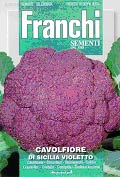
Italians dig vegetables, and the offerings of the Franchi Co., which the folks at Seeds from Italy import, show a tremendous diversity of species and varieties. Why grow the same boring vegetables supermarkets carry anyways? Also, Italy and California both have similar climates. We've been growing Franchi vegetables for several years now and have enjoyed everything from sweet beans to powerfully bitter weed-like greens. The purple Sicilian Cauliflower we grew last year was a revelation - fresh cauliflower is a billion times better than store bought cauliflower though, along with broccoli, it can be challenging to grow and it takes up a lot of room. It was still worth it, as was the somewhat less difficult to grow quick maturing broccoli rabe Seeds from Italy caries.

Our seed selection committee is meeting this week to decide on what we'll be growing and we'll get more specific in subsequent posts. We're intrigued with agretti, and we'll be looking at more perennial vegetables after the multi-year success of our artichoke plant. We're also jumping on the permaculture bandwagon this year with an experiment in the backyard. And look for more root vegetables in our illegal parkway garden.

Lest we come across as Eurotrashy, here's two domestic seed companies that have interesting varieties:

Seeds of change.

Native Seeds which sells Native American seeds

By the way, for us in L.A. the back of the seed packages have no connection with our climate. You need a book like Pat Welsh's Southern California Gardening to set you straight on what to plant and when to plant it. Now get out there and plant some seeds.

Friday, September 01, 2006

SurviveLA Visits Simparch's Utah Compound

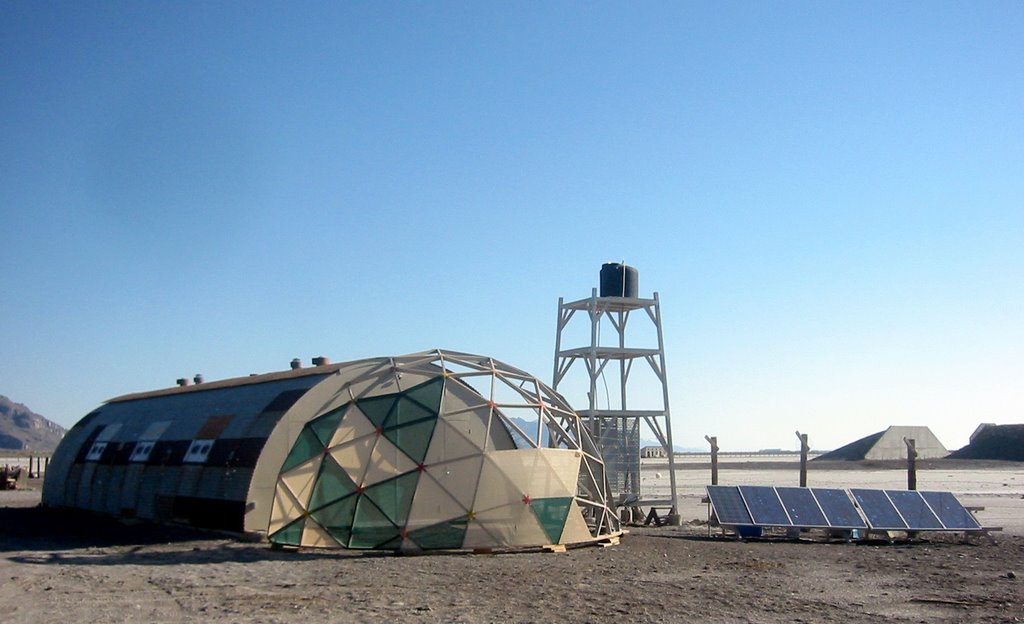
SurviveLA is in Wendover, Utah this weekend on business and it's here, in this hallucinogenic landscape of salt flats and casinos, that the artistic/architectural thoughtstylist collective known as Simparch has established a self-sufficiency experiment they call Clean Livin'. Located on the remote South Base section of the historic Wendover Airfield on land leased by the Center for Land Use Interpretation, Simparch's project proves that self-reliance is possible in what must be one of the harshest climates in North America.

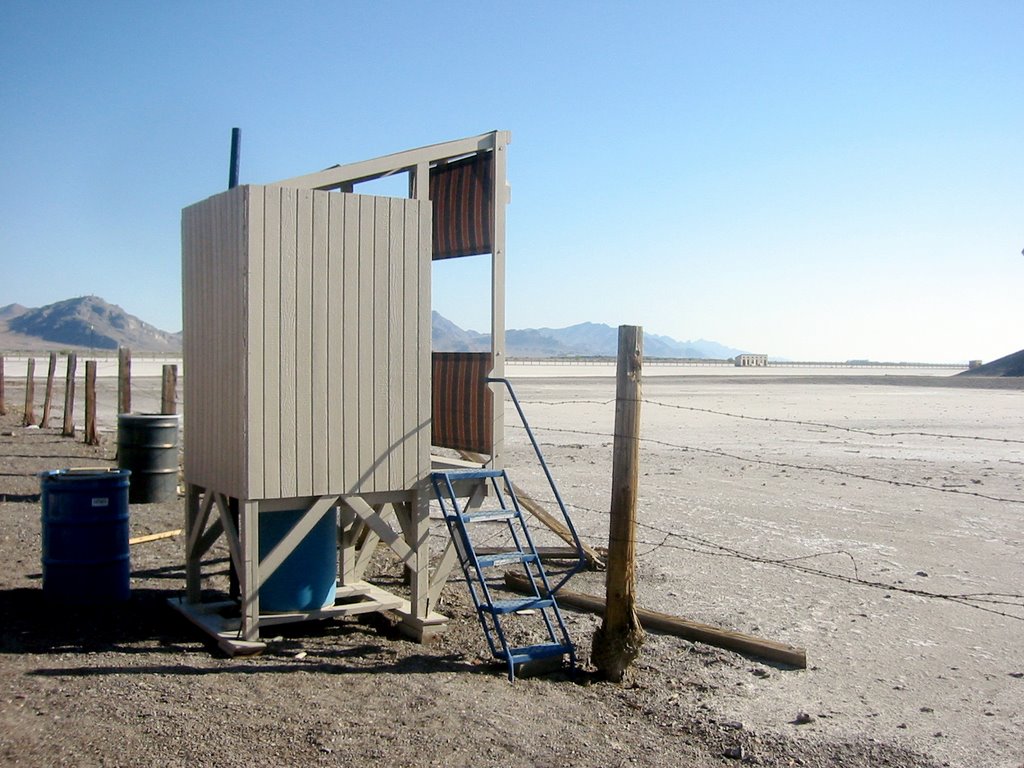
Clean Livin' features a set of solar panels, batteries, a solar shower, a refrigerator, and a composting toilet all housed in and around a repurposed WWII era Quonset hut. Water is biked in with specially adapted cargo bikes. Solar power pumps the water up to the tower where it is heated by the sun in a black drum. A solar panel array and batteries provide more than enough power, all day and all night, to run power tools and pump some tunes out on the powerful stereo system.

The composting toilet features, what must be the most stunning view to be seen from any toilet seat perch in the world - the decomissioned Wendover Airfield's munitions bunkers and the endless salt flats beyond.