Showing posts with label chickens. Show all posts

Thursday, October 25, 2012

Chicken Nipple Waterering Systems


A question came in this week from a reader who has tried our deep bedding suggestion but is having trouble keeping the chicken waterer clean as a result. Chickens are certainly expert at fouling (fowling?) their water source. Which is why many people use nipple waterers like the one above. Chickens learn to use them quickly (they like to peck at things, after all).
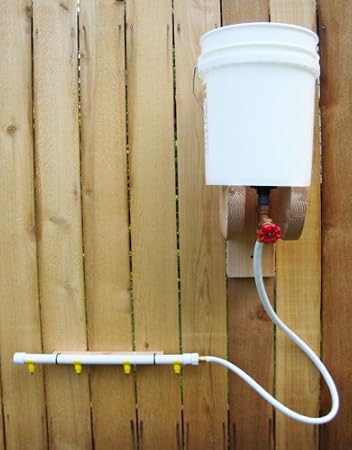

I've seen two DIY options: the simplest is a suspended five gallon bucket with nipples stuck in the bottom (as in the image at top), and the other is a five gallon bucket hooked up to a pipe with a line of nipples (as in the second image).

American Preppers Network blogger Stephanie Dayle has instuctions for making a bucket and pipe system here. You can purchase the nipples on Amazon. And the bucket and pipe system pictured above is being sold on Amazon here (I have not tested it).

Ideally all the parts should be food grade as I'm not a fan of PVC. Of course the zinc in the galvanized waterer is probably not so great either, so it's probably another case of not letting perfection be the enemy of the good.

Living in Los Angeles all my life I'm no expert on what to do with poultry nipple waterers when it freezes. I imagine it has to be drained and put away for the winter but please chime in if you have other ideas. And, in my own case, I think I'd keep my standard waterer as a backup. These poultry nipple contraptions have a tendency to leak and I'd hate to lose chickens on a 100º F day because my waterer failed while I was sipping lattes down on Sunset Boulevard (at some hip new human coffee nipple waterer bar, presumably).

Thursday, October 11, 2012

Poultry Houses of the Ultra Welathy Part 2


Are $100,000 chicken coops a sign of an empire on the verge of a decadent downward spiral? If so it's time to get that bug-out location ready because Neiman Marcus publicity flacks just announced a $100,000 "Heritage Hen Mini-Farm." From the description on their website:
Dawn breaks. The hens descend from their bespoke Versailles-inspired Le Petit Trianon house to their playground below for a morning wing stretch. Slipping on your wellies, you start for the coop and are greeted by the pleasant clucking of your specially chosen flock and the site of the poshest hen house ever imagined. Your custom-made multilevel dwelling features a nesting area, a "living room" for nighttime roosting, a broody room, a library filled with chicken and gardening books for visitors of the human kind, and, of course, an elegant chandelier. The environment suits them well as you notice the fresh eggs awaiting morning collection. Nearby, you pick fresh vegetables or herbs from your custom-built raised gardens. You've always fancied yourself a farmer—now thanks to Heritage Hen Farm, you're doing it in the fanciest way possible!
The Neiman Marcus folks apparently didn't get the memo on what happened to the original owner of Le Petit Trianon. Those angry mobs of real French peasants weren't all too happy with a royal family of pretend farmers. Will Neiman Marcus offer a diamond encrusted Gucci guillotine when the chicken coop class war breaks out?

And, in my humble opinion, British hedge fund manager Crispin Odey has a better coop.

Thanks to Root Simple reader Birdzilla Studios for the tip! 

Tuesday, October 09, 2012

Urban Chickens and Lead


From the One More Thing To Worry About department, the New York Times has an article on lead levels in eggs laid by urban chickens "Worries About Lead for New York City’s Garden-Fresh Eggs." According to the article, the lead levels found in New York City's home grown eggs ranged from none to over a 100 parts per billion. Since the FDA does not have an acceptable lead level in eggs it's difficult to interpret the results. And I have to wonder what unknown problems lurk in industrial eggs.

It's a reminder that those of us who live in older cities and grow food need to confront the lead problem. Personally, I'd also like to see the Real Estate industry come clean on this issue beyond boiler plate disclosures buried in sales documents. But I'm not holding my breath.

Thursday, September 27, 2012

Poultry Houses of the Ultra-Wealthy


Root Simple reader Christopher Calderhead tipped us off to a story in the Guardian on the plans by British hedge fund manager Crispin Odey to build a neo-classical chicken coop. Odey will, apparently, be spending at least £100,000 just for the stone. The Telegraph also covered the story and has more details on the construction,
The temple’s roof – adorned with an Anthemia statuette – will be fashioned in grey zinc; the pediments, cornice, architrave and frieze are in English oak; and the columns, pilasters and rusticated stone plinth are being hewn from finest grey Forest of Dean sandstone.

Sir Peter's duck house.

This isn't the first poultry house to cause a scandal in Britain. In 2010 Sir Peter Viggers claimed a £1,645 duck house as part of his expenses as an member of parliament.


Now if your taste runs more towards Dwell Magazine than the neo-classical, a British company sells a £1,950, "Nogg" chicken coop. Modern design, apparently, comes with an even higher price tag than Sir Peter's duck house!. And, like most modern design, the Nogg is more conceptual than practical. Looks like a tight squeeze for a couple of hens. The Nogg could get Prince Charles started on on one of his anti-modernist architecture rants.


Not to be outdone on this side of the pond, the current issue of Backyard Poultry Magazine ("dedicated to more and better small-flock poultry") has a cover story on Brent Engelhardt and Beth Roark's 100 bird chicken coop, which features a fake western town facade. A lot of the materials were scavenged to keep costs low (Engelhardt works in construction), but the couple admits the project was extravagant. Engelhardt and Roark remarked, "we wanted to build something we could enjoy as much as the chickens would."

Engelhardt and Roark make a good point--you have to stare at the thing for years so your coop might as well look decent. To be honest, I've regretted not paying more attention to aesthetics when I built our coop. I am much more happy with the chicken run our architect friend John Zapf designed for us.

The east elevation of Odey's coop.

Of course Odey's coop is a bit over the top, to put it mildly. The symbolic meaning of a hedge fund manager, who profited off the financial collapse, building an elaborate stone chicken house has ruffled a few feathers in Britain. But I have to admit that I share the same neo-classical pretensions. However, being on a more limited budget, my neo-classical chicken coop will have to be constructed with used futon frames and scavenged bags of stucco.

Odey coop, south elevation.

To that end, if you'd like to recreate Odey's neo-classical chicken house in futon frames and stucco, you can download a pdf of the plans here. And, I have to point out, the Romans did not build coops like Odey's. To see what they built, check out our post on the sacred chickens of ancient Rome.

Wednesday, September 26, 2012

Modesto Milling's Organic Layer Pellets


I could blog for weeks about all the lectures I attended at the National Heirloom Expo, but I thought I'd take a break to highlight a product I came across in the vendor hall: Modesto Milling chicken feed. I've been using it for a few months now on the recommendation of Craig and Gary from Winnetka Farms (where our chickens came from). 

In my opinion, if I'm going to go through the trouble of keeping my own chickens they should get good feed in addition to kitchen scraps and yard trimmings. Since I don't have a pasture to let my hens forage on, this feed is the next best thing. So that's why I've decided to use Modesto Milling's organic layer pellets, even though it's more expensive than the feed I used to use.

Modesto Milling feed is carried at stores in California, Arizona, Colorado, Utah, Hawaii and online (though I imagine the shipping charges might be prohibitive). I pick mine up at a local pet store. A list of retailers is on the Modesto Milling website. You can also arrange a bulk order and split it up. And if you're trying to avoid soy in your diet they have a soy free chicken feed.

Thursday, July 26, 2012

Teflon Coated Light Bulbs Deadly to Chickens


Something I never would have thought of: Teflon coated light bulbs are toxic to chickens. In the letters section of this month's issue of Backyard Poultry Magazine is the story of a woman who lost a flock of nineteen chickens after they succumbed to fumes put off by a GE Rough Service Worklight that was in the coop. When the bulbs heat up they release fumes that are deadly to chickens and other birds. According to the McMurray Hatchery website, birds are particularly vulnerable to airborne toxins. I can't help but wonder about the effect of these fumes on humans too. Several years ago, Dupont was unsuccessfully sued over the toxicity of Teflon in cookware.

Sylvania, apparently, has a warning label on their Teflon coated bulbs, "WARNING: This product contains PTFE (polytetrafluoroethylene--"Teflon" is a brand name). When heated, it creates fumes potentially fatal to confined birds." GE does not have a warning label.

I let the ladies take the winter off of laying and it never dips below 40ºF here so we do not have a light bulb in our coop. But for those of you who do, make sure you don't use one of these shatter resistant, Teflon coated bulbs.

See also the McMurray Hatchery warning on shatter resistant bulbs.

Friday, July 13, 2012

Lego-Robot Chickens


In response to our Monday post on clicker training chickens, Root Simple pal and fellow Master Food Preserver Diane Trunk posted a video on our Facebook page. Diane explains,
Here's a link to a silly video of our trained chickens. My son trained them to come running in response to a beep. The beep signaled that a lego-robot box (you'll see) was going to open, and the hens would get their favorite treat: string cheese. Alas, these hens are no longer with us. Our new ladies don't care about string cheese, or even Lego robots.

Monday, July 09, 2012

Clicker Training Chickens


Our new pullets aren't as used to being handled as were our last flock of hens. And because they don't come when called, they can't leave the chicken run to wander the yard.

So I'm working on training them. I know I could do more, but for now all I'm doing is taking special treats to them once a day and feeding them while making my chicken call (cheeck-cheeck-cheeck). They're beginning to associate me and the call with treats. This doesn't mean they trust me yet, but at least they have started making greeting noises when they see me. I hunker down in the run with the treats and hold very still. I put the treats close to me and make them come near to get them. The boldest one will sometimes take a treat from my hand.

This may work eventually. Or I could step up my game. Do you know that chickens can be clicker trained? My dog trainer friend tells me that in dog training seminars, trainers are often taught clicker training (a form of positive reinforcement) with chickens instead of dogs. This is because chickens are 100% food motivated and learn fast. Also, using hens takes away the potential mind games that occur between dog and trainer. Free of that distraction, the trainer learns the correct rhythm for training. It's pure stimulus-response--reward.

Here's a video of a chick learning the basics. You can find others of this sort on Youtube:


You might be able to find a chicken training seminar in your area, probably under the banner of dog training. With the rise of urban chicken-pets I think there is opportunity to be had in offering classes for would be chicken trainers. Googling around, I found this one in Lake Oswego, Oregon which is booked months in advance.

Have you trained your chickens to do anything?

Friday, June 15, 2012

The Very First Urban Homesteading Book


The urban homesteading shelf at your local bookstore, thanks to the great recession, sure has gotten crowded in recent years. There are many fine volumes now alongside our two books with a great diversity of authors opining on chicken coops, homemade soap and composting. This is a good thing--we need as many voices as possible.

But there's nothing new here. On a serendipitous trip to the library last week I stumbled across what must be the very first urban homesteading book, Cato and Varro's De Agri Cultura (On Agriculture) written around 160 BC. Well, it's really more of a rural homesteading manual, but much of the advice seems familiar.

Looks like Cato the Elder forgot to use sunscreen.
Cato holds the farmer in high esteem,
And when they would praise a worthy man their praise took this form: "good husbandman, good farmer"; one so praised was thought to have received the greatest commendation.
The tips on how to site your rural homestead is exactly as I would suggest:
It should have a good climate, not subject to storms; the soil should be good, and naturally strong. If possible, it should lie at the foot of a mountain and face south; the situation should be healthful, there should be a good supply of laborers, it should be well watered, and near it there should be a flourishing town, or the sea, or a navigable stream, or a good and much traveled road.
Varro's directions for building a chicken coop and run are pretty much what I followed, complete with netting to keep the hawks out. But I never thought of building a caretaker's residence into the coop:
In addition there should be a large room for the caretaker to live in, so built that the surrounding walls may be entirely filled with hens' nests, either built in the wall or firmly attached; for movement is harmful to a sitting hen.
Maybe this will be a new trend in big cities where chickens are hip. Half off the rent in return for living with the chickens!

Should you need to know the exact prayer to Janus, the right point to read the entrails and the precise number of employees you'll need to run a vineyard, you'll get that here too. But the best advice is probably this simple and timeless statement: "Be a good neighbor."

Tuesday, June 12, 2012

The Sacred Chickens of Ancient Rome


I stumbled on an odd historical anecdote last week: the use, by the ancient Romans, of sacred chickens as a form of divination. From the Encyclopedia of Diderot & d'Alembert:
Sacred chickens were chickens raised by priests in Roman times, and which were used for making auguries. Nothing significant was undertaken in the Senate or in the armies, without omens being drawn from the sacred chickens. The most common method of drawing these omens consisted in examining the manner in which the chickens dealt with grain that was presented to them. If they ate it avidly while stamping their feet and scattering it here and there, the augury was favorable; if they refused to eat and drink, the omen was bad and the undertaking for which it was consulted was abandoned. When there was a need to render this sort of divination favorable, the chickens were left in a cage for a certain amount of time without eating; after that the priests opened the cage and threw their feed to them.
I had hoped to be the first blogger to break the sacred chicken story, but a blogger named Elektra Tig beat me to it, telling the tale of a naval battle involving some sea-bound sacred chickens who delivered an unwanted prophesy. The naval commander, Publius Claudius Pulcher, refused to take no for an answer and had the sacred chickens tossed overboard saying, "Let them drink, since they won't eat."

Elektra Tig also found a drawing of a sacred chicken coop just in case some of you are looking for coopatecture inspiration:


Maybe some of us urban homesteader types can put together a flock of sacred chickens for the US senate. By Jove, it would probably work better than whatever means of projection they are currently using.

Update: Michael Pigneguy left a link on Facebook to a Smithsonian article with the following chicken divination anecdote:
A chicken bred for the demands of American supermarket shoppers presumably has lost whatever magical powers the breed once possessed. Western aid workers discovered this in Mali during a failed attempt to replace the scrawny native birds with imported Rhode Island Reds. According to tradition, the villagers divine the future by cutting the throat of a hen and then waiting to see in which direction the dying bird falls—left or right indicates a favorable response to the diviner’s question; straight forward means “no.” But the Rhode Island Red, weighted down by its disproportionately large breast, always fell straight forward, signifying nothing meaningful except the imminence of dinner.

Monday, June 11, 2012

Google Sketchup as an Urban Homesteading Tool


I just completed a new chicken run, greatly assisted by an amazing and free 3d design program: Trimble SketchUp (formerly Google SketchUp). While it takes some time to learn (I'm still learning!), this program helped me visualize the chicken run as well as estimate the amount of materials I'd need to buy. Here's how I used it to create the run:

Previous runs either did not work (chickens squeezed out and flew over) or were hideously ugly. I resolved to design a run that was both aesthetically pleasing and practical. Inspired by A-Frame cabins of the 60s Kelly and I came up with this idea:


I took my A-Frame plans to a friend, John Zapf, who runs Zapf Architectural Renderings. He took some time out, literally, from rendering multi-million dollar buildings to help with my lowly chicken run project. He could see a few problems with the A-Frame idea immediately--wasted space on the side towards the fence, and a lack of continuity between the shape of the chicken coop's roof and the new run. Taking out pen and paper (sometimes the quicker option!) he sketched out  a much better design:


I took John's sketch and entered it into Sketchup:


Being the low-tech bumpkin that I am, once I completed the run I was excited to see how much the real thing looked like the rendering.

SketchUp has some powerful features. There's a library of objects other people have already drawn for you that you can download for free. For instance, the fence and tree (the exact same species of tree in my backyard, by the way) were both in the SketchUp library. And, amazingly, you can drop your model into Google Maps and even figure out the shadow patterns it will cast in the course of a year.

I'd strongly recommend going through the tutorial videos before trying to use SketchUp (I didn't do this and wasted a lot of time initially).

And thanks to John Zapf and Anne Hars for your help!

Thursday, June 07, 2012

Our New Chickens


When I put out the call to you, our readers, to name the ideal urban chicken I got a call from my friend Craig Ruggless of Winnetka Farms. He said something like, "Duh, the Barnevelder, of course!" Craig and his partner Gary Jackemuk have an ambitions breeding program to take the Barnevelder from show chicken back to farm chicken. So far the results are impressive.

I took this as a message that I should fix my run and get ready for some new chickens. This weekend, I picked up four new pullets from Winnetka Farms, all crosses between a Barnevelder and an Americauna. I call them "Winnetkavelders."

The Barnevelder, according to Craig and Gary, are a great dual purpose breed that is both heat and cold tolerant. They also take well to confinement.

The "Winnetkavelders" that now live at the root simple compound have an unusual characteristic. At least one of the pullets is laying an olive green egg:

Hmm. This color may not display correctly. Basically, the green-ish egg they lay is exactly the color of a cocktail olive. Not one of those fancy (and suspiciously) bright green olives, but the true drab olive you'll find in your typical dive bar martini olive. (No offense to the hens! We're just talking color here.) Yesterday we were joking with a friend that we should paint red pimento spots on the end.

This is the result of crossing the blue/green egg color of the Americauna with the dark brown of the Barnevelder. Another of the Winnetkavelders is laying an amazing dark brown egg like a purebred Barnevelder and a third is laying a green/olive egg with brown spots. They've been very productive and are taking well to their new surroundings.

A big thanks to Craig and Gary!

Monday, March 12, 2012

Vital Farms: Pasture Raised, Organic Eggs at Whole Foods

Image from the Vital Farms blog.

Over the weekend I attended the Natural Products Expo West, a massive health food industry convention. Yes, indeed, Fabio was in attendance selling some sort of powdered supplement and I may have seen Ziggy Marley packing up his own bottles of "Coco'Mon" coconut oil. Such are the indignities one encounters on the downward arc of a career in reggae music or romance book cover modeling.

Out of the nearly 2,000 exhibitors of, frankly, health food store junk food, one stood out: Vital Farms, purveyors of eggs from pasture raised hens. The overwhelming majority of eggs in this country are laid by chickens crammed into small cages or, arguably worse, crammed into big sheds.  "Free range," "cage free" and "organic," mean absolutely nothing. What makes Vital Farms different is that the eggs they sell were laid by chickens who live outside, during the day, on pasture. Their spokesperson offered to let me tour the farms they contract with, something that, I doubt, any of the big egg producers would offer.

The Cornocopia Institute gives them a "five egg (exemplary)" rating, citing their rotational grazing methods, abstinence from the practice of beak trimming and year round outdoor access for the hens. Vital Farms contracts with several farms in Texas, Oklahoma and Georgia. Their eggs are available nationwide at Whole Foods and they have expanded into meat chickens.

Now, hopefully, I can recover from the spectral celebrity hallucinations induced by downing hundreds of free samples of things like pro-biotic frozen pizza (I'm not making this up) and caveman power bars. Perhaps a pasture raised egg omelet will wipe away my açaí berry hangover.

Thanks to Dale Benson for suggesting attending this event and for driving, spending a half hour finding a parking space and pointing out Ziggy Marley or someone who resembled Ziggy Marley packing up those bottles of coconut oil.

Friday, January 20, 2012

Is This Egg Good?

From left: Very Fresh • Pretty Fresh • Bad • Cat

When you're wondering about the age of an egg, put it in glass of water.

Really fresh eggs lie on the bottom the glass, flat. These are the eggs you want for poaching and other dishes where the egg is the star.

If one end bobs up a bit, as does the middle egg above, the egg is older, but still good. The upward tilt can be more extreme than it is in this picture. In fact, the egg can even stand up straight, just so long as it is still sitting on the bottom of the glass. The egg in picture above is just a tiny bit past absolutely fresh, but still very suitable for egg dishes. If it were standing up a little more, I'd use it for baking or hard boiling. Indeed, older eggs are best for hard boiling, because fresh eggs are impossible to peel.

What you don't want to see is a floating egg. A floating egg is a bad egg. (Like a witch!) Old eggs float because the mass inside the egg decreases--dries out--over time, making it lighter. I personally don't trust any floating egg, but I do know that other people draw a distinction between eggs that float low and eggs that float high, and only discard the high floaters. And I honor their courage.

Monday, September 26, 2011

Banty Break-In! Lingerie Layer Strikes Again!

photo by Anne Hars

Above is evidence from the shocking scene in a local closet. Recently one, possibly two, bantam hens broke into an unidentified house and adopted a brassiere as a nest.

Wednesday, September 07, 2011

Free Postmortem Exams for Backyard Flocks in California


It's too late for us now, but if I had another two chickens die in close succession, I'd consider rushing the bodies off to one of the California Animal Health and Food Safety's labs run by the University of California Davis' School of Veterinary Medicine.

A Root Simple reader who is a veterinarian tipped us off to this service. You don't need a veterinarian (though you might need one to help interpret the results) and the service is free to those with less than 1,000 birds. All you need to do is get the body, as soon as possible, to one of four labs in either Davis, Turlock, Tulare or San Bernardino.

The backyard flock submission form is available at: http://www.cahfs.ucdavis.edu/submission_forms/index.cfm. The addresses of the labs are on the form. I'm sure that many other states offer similar services. Call your local Extension Service for details and leave a comment if you know about your state's testing programs.

Friday, September 02, 2011

How to start a chicken retirement community


Mrs. Homegrown here:

So--here's the story of another mistake we made. When Erik and I first got chickens we didn't lay out a plan for dealing with the chickens as they aged. That was the mistake. Simple as that. Make your plans, people!

We learned how to slaughter chickens--we knew we could do it if we needed to--but we never really sat down and decided what would happen to our ladies when they stopped laying. We're very good at procrastinating that way.

What happened is sort of surprising, looking back.

Wednesday, August 31, 2011

Another Chicken Fatality

We lost another chicken last night meaning that we've got something infectious. I didn't have the stomach to do a post-mortem exam, nor would I know what to look for anyways (chicken CSI would make a nice class if only there were someone to teach it). I thumbed through Gail Damerow's Chicken Health Handbook, but I don't have much evidence to go on.

I didn't see any obvious symptoms other than a very small amount of listlessness just before both chickens died and a bit of what might be bloody diarrhea on the roost. Mrs. Homegrown disinfected the coop as best she could and I swept out the bedding. A heat wave last week may have weakened the flock and helped bring this on.

We are now down to two chickens, one of whom does not lay any eggs. Looks like we'll be either not be eating eggs or we'll have to buy them at the farmers market for the next few months.

Mrs. Homegrown here: 

I wanted to add that the remaining hens seem perfectly healthy.  If they drop over dead tomorrow, it's going to be quite a headscratcher. They're out happily roaming in our yard right now, all bright-eyed and perky. I've eyeballed them for signs of respiratory infection or diarrhea, and see nothing. All the poop under their roost looked fine.  It's a mild day, as was yesterday--so I don't know if heat was the culprit in either death. The possible bloody diarrhea that Erik mentions above consisted of a couple of  small dark stains on the roost. Hard to say what that was--if it was anything. All in all it's quite a mystery.

It could be coincidence. Both of the deceased hens are of the same breed, from the same hatching, same store--maybe they were even sisters. They were very close. Maybe when one went the other followed, like devoted old couples sometimes do.

I say this just to keep hope that this isn't some bacterial thing. It's impossible to truly disinfect a wooden coop with a dirt floor. We'll do our best, open it up to light and give it a good airing and hope for the best.

It looks like we might get a chance to start our flock fresh, and this time we're going to do things differently. It looks like there are two paths we could follow--those paths, and the choice we make, will have to follow in the next post.


Monday, August 29, 2011

How Long Do Chickens Live?


This morning we found one of our hens dead in the coop. She'd died near the feed bin, which shows she was a true chicken right to the end. This is our first chicken death. I've been gone most of the weekend, but Erik says she didn't seem ill, though in retrospect he thinks maybe she was little slower than usual for the past few days. The other hens seem healthy enough. There was no sign of predation or injury.

I suppose we'll find out soon if there is some kind of infection that will take the remaining three. But for now we're chalking it up to age and general frailty. This hen, Jane, was always the smallest and the weakest of the four, and lived a hard life at the  bottom of the pecking order. Poor Jane. She's the hen I'm holding in that picture of Erik and I over at the right hand bar. None of our ladies like to be held, but Jane was always the most patient with photographers.

Our neighbor, Sue, has twenty years experience with backyard hens, and once she told us that she figured their average lifespan ended up being about 5 years. I've read that chickens have a theoretical lifespan of 13 years, but of course, so many die young of mishap or disease. Sue's estimate always sounded sensible to me. Jane died at 4 years and a few months old.

How long have you had your chickens? Do you cull them when they slow down their laying, or do you have some Methuselian hens pecking around your yard? What's the oldest hen you've even had? What do you think the average lifespan of a backyard hens is?

Of course, this leads to lots of interesting questions about backyard flocks, how and when to rotate in new stock, to cull or not to cull, the danger of naming, etc. I think all that will have to wait for another post, because it's a big subject and needs its own space. Maybe we'll do that tomorrow. Right now, let's hear about lifespans.

Monday, May 30, 2011

It's not really bragging...


It's more of a public service announcement when we say, once again, that home raised eggs are the best things in the world. I mean, look--even the whites are perky.

Remember, it's easier to keep hens than it is to keep a dog...