Showing posts with label urban homsesteading resources. Show all posts
Tuesday, October 23, 2012
Steve Solomon's Soil and Health e-Library
I'm really enjoying the incredible variety of obscure old books being scanned and put up on the interwebs. Of interest to readers of this blog will be the archive of free e-books maintained by gardening author Steve Solomon. His Soil and Health e-library contains books on "holistic agriculture, holistic health and self-sufficient homestead living" You can download the books for free, but Solomon requests a modest $13 donation. You can find this amazing resource at: www.soilandhealth.org.
The "Radical Agriculture" part of the archive contains many early organic ag classics by authors such as Sir Albert Howard, J.I. Rodale and Ehrenfried Pfeiffer. The "Homesteading" part of the library contains tomes dating from the 1700s (William Ellis' The Country Housewife's Family Companion), all the way to the appropriate technology movement of the 1970s (Gene Logsdon's Getting Food From Water: A guide to Backyard Aquaculture).
So go load up those e-readers. Or maybe print them out in case we have a revolution.
Labels:
urban homsesteading resources
Wednesday, August 26, 2009
Urban Farm Magazine
We have a article on urban farmers across America in the premiere issue of a magazine bound to appeal to readers of this blog, Urban Farm. Our article, Where Urban Meets Farm, profiles the efforts of our friends the Green Roof Growers of Chicago, Em Jacoby of Detroit and Kelly Yrarrazaval of Orange County. All of these fine folks have repurposed urban and suburban spaces to grow impressive amounts of food, a common sense trend popular enough to have spawned this new magazine.Editor Karen Keb Acevedo says, "Urban Farm is here to shed a little light on the things we can all do to change our lifestyles, in ways we think are monumental as a whole, yet at the same time, barely noticeable on their own." The first issue has practical articles on goats, bees and chickens as well as how to get rid of your lawn. There's also a nice article by John Jeavons, who developed the Grow Biointensive method, and wrote the seminal book How to Grow More Vegetables and Fruits
Check your local newsstand for Urban Farm or pick up a copy of the premiere issue here.
Labels:
events,
urban farming,
urban homsesteading resources
Friday, July 24, 2009
Author and Urban Farmer Novella Carpenter Rocks Los Angeles
Yesterday, Homegrown Evolution had the great privilege of meeting urban farmer and author Novella Carpenter who was in Los Angeles to deliver a lecture and sign her new book Farm City. She's a phenomenal speaker, both hilarious and inspiring. What we like most about Carpenter is her honesty in describing the ups and downs of raising pigs, goats, chickens, turkeys, rabbits and more on squatted land next to her apartment in Oakland. As she put it, "I don't like to sugarcoat things." As owners of a garden that is often a little rough around the edges, we were inspired by this photo of her squated garden that she showed during her lecture. We could have listened for hours to her stories of dumpster diving for pig feed, gardening in a neighborhood where "crack zombies" and prostitutes come out at night and how the local Yemeni liquor store owner came over to show her how to slaughter her mean goat. If you have a chance to hear her speak, make sure to go!We've read excerpts from Farm City and Carpenter is a terrific writer. In addition to her books and articles she blogs at ghosttownfarm.wordpress.com and offers workshops on raising and slaughtering animals for meat in the city. And like Carpenter, we also fantasize about trading the bicycle for a mule. Time to print up the "one less bike" saddle stickers . . .
Sunday, July 19, 2009
California Agriculture Journal Online
The University of California has put 63 years worth of its journal California Agriculture online for convenient downloading at californiaagriculture.ucanr.org. There's plenty of detailed (peer reviewed!) nuggets for the home gardener between the pages of this scientific journal. Make sure to check out the article and video of UC Berkeley entomologist Gordon Frankie explaining what kinds of plants are best for attracting bees in your urban garden.Thanks to Los Angeles County Master Gardener Coordinator Yvonne Savio for the tip.
Labels:
bees,
urban homsesteading resources
Tuesday, August 19, 2008
Ramshackled!
Saturday, August 09, 2008
A Grand Tour
Say howdy to Wendy and Mikey, intrepid homesteaders from Truth or Consequences, New Mexico. Thanks to the wonders of internet video we can all see what they've been up to: a long list of activities that includes, papercrete, oyster mushroom cultivation, DIY drip irrigation, vegetable gardening, rainwater harvesting, dome building and more.
The Grand Tour from Mikey Sklar on Vimeo.
Wendy and Mickey blog about their activities at blog.holyscraphotsprings.com.
Here at Homegrown Evolution we'd like to start featuring more profiles of what you, our readers, have been up to. Please drop us a line, a link, a video or some photos--we're interested in any effort, from the simple to the grand.
The Grand Tour from Mikey Sklar on Vimeo.
Wendy and Mickey blog about their activities at blog.holyscraphotsprings.com.
Here at Homegrown Evolution we'd like to start featuring more profiles of what you, our readers, have been up to. Please drop us a line, a link, a video or some photos--we're interested in any effort, from the simple to the grand.
Monday, February 25, 2008
Gardening Classes at Silver Lake Farms
Local gardening guru Tara Kolla, who we met in the course of writing our book the Urban Homestead, will be hosting a series of very reasonably priced classes at her beautiful urban farm in Silver Lake beginning in March. Topics include vermicomposting, organic gardening and more. Full information on the Silver Lake Farms website. If you're in the Los Angeles area, we highly recommend taking a class or two, and sign up early as space is limited.
Monday, December 25, 2006
Backwoods Home Magazine
Imagine Martha Stewart as a gun-toting radical libertarian and you’ll have some idea what the always informative and entertaining Backwoods Home Magazine is like. Even though its primary emphasis is rural off-grid living, every issue has something to offer for the urban homesteader. The current January/February issue features a detailed article on how city dwellers can maximize their vegetable production in small spaces. Even the article on running a cattle ranch has the side benefit of letting us all know where our food comes from, and the challenges of running a family farm, “Jessica Troxel has donned a plastic sleeve, greased it with mineral oil, and reaches in through the cow’s anus to see if this one is pregnant.” reads the caption over a photo in that article.While the mainstream media fawns over the latest gadgets and ignores the nefarious doings of our proto-fascist government, the folks at Backwoods Home are calling hydrogen cars bullshit and informing us of Halliburton’s contract for building domestic detention camps.
If that ain’t enough the magazine features long, rambling reader letters, recipes, fetishistic firearms advice, and endearingly naïve cover art! But what SurviveLA especially appreciates is the magazine’s emphasis on techniques and knowledge over technological gimmickry.
Six issues (one year) is $23.95, but most of the articles are available for free online.
Labels:
urban homsesteading resources
Saturday, November 18, 2006
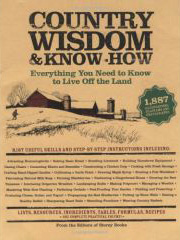
Country Wisdom
Thanks to a tip from the Soapboxers, SurviveLA augmented our homesteading library with a copy of the extremely useful book, Country Wisdom & Know-How by the editors of Storey Books. Country Wisdom is a compendium of tips culled from the Country Wisdom Bulletin published in the 1970s and oriented to the "back to the land" movement of that time.While geared to country living there is plenty in here for city dwellers such as ourselves. Divided into sections covering animals, cooking, crafts, gardening, health and wellbeing, and home repair/construction, Country Wisdom has straightforward advice with clear illustrations.
While we don't anticipate having to skin and eat bear anytime soon, "Bear meat is dark and well flavored. The layer of fat should be trimmed off or it will give the meat a strong gamey taste" we did appreciate things such as the three pages of quick bread recipes (we'll test some and let you know how they work) and the tips on using herbs. And lots of folks in our neighborhood could benefit from the dog training advice.
Who knows, someday we may find ourselves sitting down to a meal of backyard squirrel and possum . . .
Labels:
urban homsesteading resources
Saturday, September 16, 2006
La Alternativa
Today's Wall Street Journal (paid subscription required) has an article on the Cuban equivalent of Martha Stewart, Margarita Gálvez Martinez who writes a column for the Pinar del Rio dioscecan bulletin Vitral and if tough times are coming, SurviveLA would rather have Margarita on our side than Martha. While Martha is out fretting over terry pillows and Halloween cupcakes, Margarita is surviving.
Cuba has faced some very tough years since the fall of the Berlin Wall and the loss of trade (oil for sugar) from the former Soviet Union. Gálvez's advice falls under what Cubans call la alternativa, or alternatives for the luxuries we in the US take for granted. As the Wall Street Journal article notes, Gálvez's advice has included everything from salad dressing that doubles as hair conditioner, beauty treatments that consist of soaking in bread crumbs and warm milk, a flan made with fruit or vegetables rather than scarce corn starch and eggs, and laundry soap made from the jaboncillo tree. What we like most about Gálvez is that she is a strong proponent of urban gardening, maximizing every available space for food, a contrast to Martha Stewart's useless pesticide and fertilizer drenched flower gardens. See the the film Power of Community How Cuba Survived Peak Oil for more on Cuba's inventive urban gardening.
While we hope that the US does not face a Cuban style economic crisis, we at SurviveLA believe that it's time for la alternativa for other reasons, namely reducing our environmental impact and rampant consumption.
If you speak Spanish, please enjoy Gálvez's recipe for vinegar made from pineapple rinds or banana peels. There is an recipe in English (not quite the same) here.
Cuba has faced some very tough years since the fall of the Berlin Wall and the loss of trade (oil for sugar) from the former Soviet Union. Gálvez's advice falls under what Cubans call la alternativa, or alternatives for the luxuries we in the US take for granted. As the Wall Street Journal article notes, Gálvez's advice has included everything from salad dressing that doubles as hair conditioner, beauty treatments that consist of soaking in bread crumbs and warm milk, a flan made with fruit or vegetables rather than scarce corn starch and eggs, and laundry soap made from the jaboncillo tree. What we like most about Gálvez is that she is a strong proponent of urban gardening, maximizing every available space for food, a contrast to Martha Stewart's useless pesticide and fertilizer drenched flower gardens. See the the film Power of Community How Cuba Survived Peak Oil for more on Cuba's inventive urban gardening.
While we hope that the US does not face a Cuban style economic crisis, we at SurviveLA believe that it's time for la alternativa for other reasons, namely reducing our environmental impact and rampant consumption.
If you speak Spanish, please enjoy Gálvez's recipe for vinegar made from pineapple rinds or banana peels. There is an recipe in English (not quite the same) here.
Labels:
urban homsesteading resources
Tuesday, September 05, 2006
Dwelling Portably
Dwelling Portably is one of the finest publications we have ever come across. Produced on a manual typewriter in a yurt in an undisclosed location in a forest in Washington State, Dwelling Portably is a how-to guide to living without a permanent roof over your head. In short, this is a guide by homeless folks for homeless folks. Holly and Bert Davis have been putting this collection of tips and anecdotes out for decades. Formerly known as the Message Post, this zine has evolved from multiple pages with a staple to just a single sheet or two with incredibly small type, so as to save paper.Content ranges from cooking and bathing out of your car, to edible weeds, to improvised bicycle pannier bags, to musings on 12 volt microfiche readers and the practicalities of nudism. The advice, written in a consistent and factual manor, is interspersed with letters from readers who are also living the portable life. These stories offer a glimpse into a lifestyle most of us have not lead, and offer a perspective on and compassion for those who don't have a place to call home. Even if you do have a roof, the practical advice in this publication should be a part of the library of every Urban Homestead.
Holly and Bert Davis don't have much nice to say about computers or the internet and as a result the only way to receive this fine periodical is by mail at
POB 190
Philomath, OR 97370
DPc/o Lisa Ahne (just the initials of dp, ie, NOT spellled out)
POB 181
Alsea OR 97324
Via Kevin Kelly's Cool Tools blog here is an excerpt from Dwelling Portably:
Legality of salvaging from dumpsters. Amy Dacyzyn, who phoned several police officials, said (in The Tightwad Gazettte, July 1993), "Dumpster diving is generally considered to be legal with the following exceptions: -- If the container is on CLEARLY MARKED private land, behind a fence or locked up. However, most dumpsters in 'semi-public' areas such as parking lots are fair game. -- If the discarded items are outside the dumpster they should not be taken." A deputy district attorney in Santa Clara, CA, where many people rummage for high-tech discards, told Amy: "By putting items in a dumpster, the companies have abandoned ownership.... The idea that people are stealing is not a prosecutable case."
Labels:
urban homsesteading resources
Saturday, August 12, 2006
Instructables
The SurviveLA inbox contained a useful link from Komrade Box - a web site called "Instructables", which is a compendium of useful tips ranging from how to pimp out your bike to how to recycle stuff you have laying around the house.
Sites like this make the "internets" seem useful. Of course, you could also waste your time watching shit like this.
Labels:
urban homsesteading resources
Subscribe to:
Posts (Atom)