Showing posts with label book reviews. Show all posts

Wednesday, October 31, 2012

Book Review: The Blood of the Earth: An Essay on Magic and Peak Oil

Phoebe says that despite her midnight coat and lambent eyes, she has nothing whatsoever to do with magic. Or peak oil. And for the record, she also scorns Halloween.

What do magic and peak oil have to do with one another? Quite a lot, actually, if you believe the author, John Michael Greer. And if you read The Blood of the Earth: An Essay on Magic and Peak Oil you'll probably come to agree with him, because in this book, as in all of his writing, Greer is remarkably lucid, straightforward and persuasive.

Blood of the Earth is unlike any other book you'll read on peak oil. It's challenging, honest, sobering and inspiring.

It's not a end-times book. Greer doesn't do apocalypse. Nor is it an airy-fairy "we'll save the world by the magic of positive thinking" sort of book. Instead, it is an investigation of the spiritual/psychological impulses that play out in our responses to peak oil. Part of this is understanding behavior and propaganda in magical terms. To do this, Greer offers a quick, intriguing primer on Western magic.

Magic, according to Greer, has nothing to do with stage magic, or the fictional magic practiced by Harry Potter and his friends.  It is a discipline of the mind, with a strong relationship to psychology. One definition is "the art and science of causing change in consciousness in accordance to the will."  Greer sums it up better than I can, and explains clearly what magic can and cannot do. Most importantly he asserts magic cannot "fix" our situation. We can't change the hard material limits of our resource crisis through magical thinking or incantations. Magic cannot change matter.

Magic is for changing minds--preferably your own mind. All change begins within, right? So Greer argues that we cannot rescue ourselves from this downward spiral of denial and non-action by activism alone. We have to knuckle down and change ourselves.

Too often we ask for change, and then point to others and say they have to change. Stop those other people from using so much energy, please. Or we blame politicians. Or we hold on to hope we won't have to change, not really, because science will save us. We'll come up with a better energy source, soon right? Or we'll find more oil. There's always more oil. 

Greer asks us to free ourselves of these delusions and live clear-eyed in the reality of the situation. He lays out concrete suggestions on how we can change our own minds, and thus our behavior, to prepare realistically for the coming hard times. And beyond that, to find joy and deep meaning in the post-petroleum world, by celebrating the potential of the human rather than the potential of machines.

For such short book, the ideas big and far-ranging.

At the risk of this being a spoiler, I'm going to share with you an exercise of sorts from the end of the book, three suggestions for practical action that you can take now. I'm sharing these because I think they show how down-to-earth and practical his thinking is, and how it will appeal to Root Simple readers. Greer explores these ideas in more depth, but I think you'll get the picture:

Learn One Thing: Learn a practical skill, so that you have something trade in a barter economy.

Give Up One Thing: Choose one material possession that you believe you depend on, and that you also know is quite dependent itself on our complex, petroleum-fueled industrial system. Go without it now, so you know it's possible. And that really, it's not that bad to go without.

Save One Thing: Consider how wide reaching our knowledge base is now, yet how fragile, since so much of our knowledge is tied up in digital media. Choose one thing you want to be able to pass on to future generations. Maybe it's a book, or a song, a philosophy, or a craft technique. Find some way to preserve it and pass it on.

The one drawback to this book is that it is not cheap. The publisher, Scarlet Imprint, is offering it in three forms. Two--a gorgeous leather bound edition and a handsome cloth-bound edition--are tempting, but out of my price range. The paperback was even expensive, but I justified it as a birthday gift for Erik. (A gift we could both enjoy! I'm ever-thoughtful.) I ended up buying directly from the publisher. I saw no price break anywhere else and figured all of my money may as well go there, rather than to a middleman. The least expensive option is the digital book, but at 10.00 GBP it is no steal, either. All forms of the book are available on this here page.

The paperback version is (sorta)(sometimes) available at Amazon.

A good, free way to get to know Geer's thinking is to read the archive of his weekly blog, The Archdruid Report. Right now he's doing something a little different: a series of fictional pieces to illustrate some of the ideas he's been working on lately.  But you'll find many of the concepts from The Blood of the Earth in his older blog posts, especially those over, say, the last two years or so (2010-2012).

Friday, July 27, 2012

Have You Read Any Good Gardening Books?

A scene from Peter Jackson's new movie.

Someone asked me recently if I'd read any good gardening books lately. I had to admit that I haven't. Year after year I pick up the same two books when I have a question, John Jeavons How to Grow More Vegetables,and The Sunset Western Garden Book.

Have you read an interesting gardening book recently? If so, leave a comment.

Tuesday, July 24, 2012

Book Review: More Other Homes and Garbage Designs for Self-Sufficient Living


If I could have only one book on my zombie apocalypse bookshelf it would be this one. Though it has to be one of the worst book titles ever, More Other Homes and Garbage: Designs for Self-Sufficient Living, by Standford University professors, Jim Leckie, Gil Masters, Harry Whitehouse and Lily Young has everything you need to set up your off-grid compound. This book, first published in 1975 and revised in 1981, grew out of a heady period in appropriate technology research and DIY hippie experimentation that took place in the late 1960s and 1970s. In some ways it's the rural version of the original urban homesteading book, The Integral Urban House: Self Reliant Living in the City.Both books, not coincidentally, share the same publisher.

Feeding the digestor on the homestead. An illustration from More Other Homes and Garbage.

More Other Homes and Garbage covers alternative architectural materials, passive cooling and heating, home power generation, solar water heating, methane digesters, sewage reuse and disposal, water supply, small scale agriculture and aquaculture. All topics are covered in great detail with, as is expected for a group of engineer/authors, lots of formulas and tables. While some material is out of date (Art Ludwig has taken greywater well beyond what's in this book), most of the 374 pages of More Other Homes and Garbage are still very useful.

I especially like the can-do DIY tone of the introduction which describes a middle ground between "terminal pessimism" and "technophilic optimism." What's depressing, in fact, is that a lot of the topics in this book have not received much attention until very recently. The frivolous 80s and 90s were simply not the time for More Other Homes and Garbage. Thanks to the great recession, however, this book is relevant again. Get your copy before vengeful Mayan time travelers zap the interwebs in December.

Update July 31, 2012
A Root Simple reader, Lisa, pointed out that you can download this book for free here. Thanks Lisa! 

Wednesday, June 20, 2012

Eating In: The Biosphere Cookbook


This has to be one of the strangest cookbooks ever published, Eating in: From the Field to the Kitchen in Biosphere 2. Author Sally Silverstone was the food systems manager during the much hyped and ultimately disastrous Biosphere "mission" that began in 1991. Without falling down the rabbit hole of discussing what went wrong and why the Biosphere project became fodder for a Pauly Shore movie, I'd just point out the hubris of thinking that you can simulate mother nature in her infinite complexity.  Watch episode 2 of Adam Curtis' All Watched Over By Machines of Loving Grace for more on that problem.

Philosophical quibbles aside, what's interesting about this cookbook is that ambitious suburban homesteaders might be able to, like the Biospherians, source entire meals from the backyard and make use of the bare-bones recipes in this book. And don't worry about having to grow your own cooking oils--the Biospherians had trouble with that and have thoughtfully skipped any deep fried items.

The Biosphere's kitchen.

But let's get to those recipes! For relaxing next the the shore of the Biosphere's simulated ocean there's "Beach Blanket Bean Burgers," "Bean Balls in Cheese and Tomato Sauce" and "Banana Bean Stew." For meat eaters there's pork, chicken and tilapia but, as this is the Biosphere, you'll have to do the slaughtering yourself. And for desert there's "Biospherian Rice Pudding," "Biospherian Baked Doughnuts" (made with potatoes) and "Banana Wine."

Like Archdruid John Michael Greer, I find it hard to believe that the fantasy of orbiting space colonies that inspired the Biosphere seemed doable when I was a kid. It's obviously time to revise those plans. I have a strong suspicion that in the future we'll be "eating in" just like the Biospherians, except that our "in" will be good old terra firma.

Wednesday, June 06, 2012

Book Review: 1491


I'm way late to this party, because 1491: New Revelations of the Americas Before Columbus came out in 2006 and was a best seller, so it's probably not news to many of you that this is a fantastic book.

For those of you who haven't read it, though, this is the type of book that you look up from every few minutes and say, "Listen to this!" or "Did you know...?" 

1491 is a depiction of the Americas just before and just after contact with the Europeans. The gist of it is that the peoples of the Americas were much more populous and their civilizations more advanced than we are taught in our school books.

The first part of the book deals with horrific impact of imported European diseases on the native populations. I always knew it was very bad--but I never understood the extent of the devastation. In part this is because I never understood extent of the civilizations destroyed. This section is depressing, but it's well worth understanding.

The rest of the book covers so much ground that I don't even know what to focus on. Warring archeologists struggling to define the past. The complex and fascinating debate over when and how the first people came to the Americas. (Nope, the old land-bridge theory doesn't hold water anymore.) Grisly tales of the Conquistadors coupled with intriguing records made by Spanish scribes that offer us precious insights into the strange and magnificent technologies and theologies of the Inka, Maya and Aztecs. The mystery of the development of corn and it's impact on the world. The true history of the buffalo and the passenger pigeon--it's not what you were taught. The wonders just pile up. 

What I think back on most, though, is what is revealed through these stories about the relationship between nature and culture in pre-contact Americas. As with Tending the Wild: Native American Knowledge and the Management of California's Natural Resources, which we've reviewed here before, a picture rises of very active human management of natural resources. All across the Americas there is compelling evidence of intense landscape management practices which in most cases (but not all) managed to provide for the needs of burgeoning human population without destroying the land. This is permaculture. The real deal.

There are so many lessons to be learned from these ignored histories. And what's most interesting is that it seems we are only able to understand the skill and knowledge these lost people now, because we are only just becoming able to conceptualize more subtle relationships to nature. For instance, until we began to understand food forestry as a legitimate agricultural practice, we had no hope of recognizing an ancient Amazonian food forest when we saw one.

Lots to think about.


You can hear 1491 author Charles Mann deliver an interesting lecture, “Living in the Homogenocene: The First 500 Years” on the Long Now Foundation's podcast.


Thursday, May 31, 2012

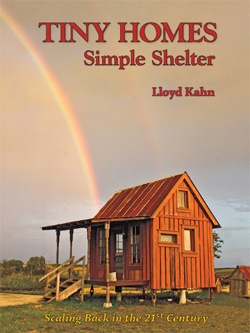
Tiny Homes Simple Shelter by Lloyd Kahn

Full admission, I'm a bit of a Lloyd Kahn fanboy. So when he announced a new book Tiny Homes: Simple Shelter I knew I had to have a copy.

Kahn has profiled the alternative building scene since the 1960s and edited the building section of the Whole Earth Catalog. I often thumb through a tattered copy of his seminal book Shelter that I picked up at a garage sale. Want to live in a driftwood shack? Shelter will show you how.

I heard Kahn speak at Maker Faire and show photos from the new book Tiny Homes. He began his talk by describing the first two best selling books that he wrote, both about geodesic domes. To Kahn's credit he pulled these books from print when he realized the folly of dome building: the waste of materials (plywood comes in 4 x 8 sheets), the fact that they are hard to add on to and their propensity to leak. As he put it, "I didn't want any more domes on my karma."Of Dwell Magazine, he says that he doesn't believe that anyone actually lives in the fastidiously clean and sterile rooms shown in the lavish photos spreads.

In contrast to Dwell, the buildings shown in Tiny Homes look well lived in. And very diverse: there's everything in this book from conventional frame structures, to intricate masonry, to cob, to yurts and sailboats. Plenty of inspiration and ideas here for the aspiring owner/builder. And Kahn has an eye for vernacular American architecture.

In a way my favorite building is Tiny Homes is the most modest--Tom's cabin. It's a a $4,000 Tuff Shed from Home Depot turned into a cozy caretaker's cabin. Tom took the shed, which already has a built-in loft, converted that loft to a bedroom, insulated the walls, put in a small kitchen and covered the interior studs with 3/8" particle board.  Ton's cabin isn't much to look at from the outside, but on the inside it's a real home. And that's the point. It may not actually be practical for many of us to live in really tiny houses (Kelly and I are happy with our current, and by the standards of this book, mansion-like 980 square feet). But size is not what matters. While limited to buildings of less than 500 square feet, Tiny Homes is really about the search for meaning and spirit in the places we call home. After years of bloated McMansions and the debt crisis that went with them, it's no coincidence that this book has appeared at this time.

Tuesday, February 28, 2012

Book Review: The New Sunset Western Garden Book


The Sunset Western Garden Book was one of the first gardening books we picked up when we bought our house back in 1998. A new version is out this month, now dubbed The New Sunset Western Garden Book, and it's a significant improvement over our old copy.

Lavish photos have replaced the drawings of my 1998 copy. The new edition has significantly more coverage of edibles, including a vegetable planting schedule as well as nice photographs of veggies worked into ornamental landscaping schemes.  One of the improvements I'm most pleased to see are lists of plants for attracting bees, butterflies, birds and beneficial insects. And Hawaii, Alaska southern British Columbia and Alberta residents will be happy to find their states and provinces included.  I also find Sunset's zone system more useful than USDA zones.

I have a few minor quibbles with some of the advice. Adding compost when planting trees is not a good idea. Neither is solarizing. And, speaking as a beekeeper, I would never recommend using imidacloprid under any circumstances. I am happy to see invasive pampas grass moved from "maybe don't grow" to "definitely don't grow."

But it's the plant list that forms the heart of this book. Even though much of this information on the internet now, I still prefer to get it in book form. I trust the curatorial expertise of Sunset's editors and the climate specific advice for those of us in the Western US. And the plant lists are still extremely valuable when planning a new garden or remodeling an old one.

ETA: Check out Sunset's handy online plant finder.

We'll be giving away six copies of the The New Sunset Western Garden Book tomorrow. Stay tuned!

Monday, September 19, 2011

The Practical Beekeeper by Michael Bush

“There are a few rules of thumb that are useful guides. One is that when you are confronted with some problem in the apiary and you do not know what to do, then do nothing. Matters are seldom made worse by doing nothing and are often made much worse by inept intervention.”-Richard Taylor
Michael Bush, in his new book on natural beekeeping, The Practical Beekeeper Beekeeping Naturally, begins with Taylor's quote, which could just as easily apply to gardening or many other areas of our lives. Yet doing nothing is one of the hardest things for us Homo sapiens to wrap our busy heads around. Nassim Taleb is fond of pointing out the huge number of medical mistakes that could easily have been avoided by the doctor having the courage to not intervene with some needless procedure or pharmaceutical. Up until some time in the 20th century, in fact, you were actually better off not going to see a doctor.

Michael Bush's The Practical Beekeeper is the new bible of natural no-treatment beekeeping. Bush's non-interventionist approach is based on the work of Dee and Ed Lusby and is at odds with conventional (beekeeping associations and academics) reliance on chemical treatments, re-queening, artificial insemination etc. Beekeeping, in my and Michael Bush's opinion, is one of those fields, like economics, where the experts have been thoroughly discredited by recent events--our current econopocolypse and, in beekeeping, colony collapse disorder. Of CCD, Michael Bush blames chemical treatments, directed at controlling mites and other issues, which throw off the microbial balance of the beehive. Bush's emphasis in symbiotic microbial relationships puts his work in line with soil scientist Elaine Ingham and the pro-biotic movement in human health.

The Practical Beekeeper would benefit from an index (something said of our first book) and some editing for repetition, but those minor points aside, this is a must-have book for beginning and advanced beekeepers. There's much good, practical information and I learned a lot reading this book on a long train trip. Bush has many interesting tips and tools that you can build yourself. And it's the few books I've seen that tells you how to do swarm captures and cut-outs.

Bush's website, The Practical Beekeeper also has an encyclopedia's worth of handy info.

Monday, June 27, 2011

Tassajara Cookbook


Mrs. Homegrown here:

A quick cookbook review for ya'll. I'm having lots of fun with the Tassajara Cookbook which I have out from the library. So much fun that I'm considering buying it. Tassajara Zen Mountain Center is a Buddhist monestery here in California. This book is based on their famous bagged lunch offerings for their guests. This means it's all picnic/finger food sort of stuff. This suits me fine because summer is here, and I like making meals that require chopping rather than cooking, and that keep well in the fridge.

I love the simplicity, the pure pleasure and endless variety, of chips n' dips, bruschetta, tapas, mezza... I could live entirely on appetizers and finger foods. This is why I like this book so much. Mr. Homegrown is not as happy--he's a more of a three-square meal a day sort of guy. But he's surviving, because for now, in the heat, he'd rather scoop up pesto with crudités than break down and cook.

This book is vegetarian, with plenty o' vegan recipes. It focuses very much on spreads, dips, pestos, tapenades, sandwich fillings--that sort of thing, as well as various composed salads. It also has a large cookie section, which I've not allowed myself to explore yet. The tone of the food is cheerfully high end California hippie: healthy, vibrant, and heavy on the nuts. (No, that's not a California joke!).

I was surprised by all the haters at Amazon when I checked the reviews of this book. The primary objections are that it's 1) all snacky stuff--to which I answer they should read the cover and 2) that it's poorly edited--to which I answer it hasn't bothered me yet. For instance, if the recipe says preheat the oven at the start, and then goes on to say something has to marinate for two hours before it bakes, I'm not going to blow a gasket. I'll just hunker down and ponder my way out of that deeply confusing situation.

Friday, June 24, 2011

Waiting for our tomatoes/Tomatoland

grow! grow faster!
Mrs. Homegrown here:

Via Boing Boing, I found this excerpt on Onearth Magazine's website, from a new book called Tomatoland by Barry Estabrook, which is apparently a document of all the indignities suffered by the industrial tomato--the tomato that sits, bright red, useless and flavorless, on store shelves year round, country-wide. Here at the Root Simple compound, we choose to eat tomatoes seasonally--when they're coming out of our yard--and make do with canned and dried tomatoes for the rest of the year. Basically, we believe that fresh tomatoes are a privilege, not a right. Right now our tomato plants are covered with blossoms and tiny green fruit, and I'm almost frantic for fresh tomatoes. (The basil is in! Where's the tomatoes?!?) Yet I know better than to buy a tomato at a store. I haven't for years.

In this excerpt, Estabrook explains why Erik and I avoid store-bought tomatoes like a plague. I haven't read his book, so can't comment on the whole, but I liked the excerpt. It focuses on the tomato industry in Florida. Here in California, we're not often offered Florida tomatoes. Ours seem to come mostly from Mexico at this time of year--and I have no idea how those tomatoes are grown. Are they better than Florida tomatoes, which are coaxed reluctantly from nitrogen-free sand beds, with massive inputs of chemical fertilizers and pesticides?
...they must be protected from competitive weeds, disease spores, and especially nematodes, which thrive in Florida. Growers have a ready solution to these problems. They kill everything in the soil. To do so, they fumigate the beds with methyl bromide*, one of the most toxic chemicals in conventional agriculture’s arsenal... The chemical is injected into the newly formed beds, which are immediately sealed beneath a tight wrapper of polyethylene plastic mulch. Then the growers wait while the chemical does its lethal work. Within two weeks, every living organism -- every insect, fungus, weed seed, and germ -- in the beds is dead. "It’s like chemotherapy," said Ozores-Hampton. Once the soil is suitably lifeless, it’s time to plant tomatoes.
And methyl bromide is just the start--it's just soil prep. The tomato growers use a large chemical arsenal to bring their crops to fruition:
U.S. Department of Agriculture studies found traces of thirty-five pesticides on conventionally grown fresh tomatoes: endosulfan, azoxystrobin, chlorothalonil, methamidophos, permethrin trans, permethrin cis, fenpropathrin, trifloxystrobin, o-phenylphenol, pieronyl butoxide, acetamprid, pyrimethanil, boscalid, bifenthrin, dicofol p., thiamethoxam, chlorpyrifos, dicloran, flonicamid, pyriproxyfen, omethoate, pyraclostrobin, famoxadone, clothianidin, cypermethrin, clothianidin, cypermethrin, fenhexamid, oxamyl, diazinon, buprofezin, cyazofamid, deltamethrin, acephate, and folpet. It is important to note that residues of these chemicals were below levels considered to be harmful to humans, but in high enough concentrations, three are known or probable carcinogens, six are neurotoxins, fourteen are endocrine disruptors, and three cause reproductive problems and birth defects.
Yes, it important to note that "residues of these chemicals were below levels considered to be harmful to humans" but I dunno...I'd rather skip them altogether, thankyouverymuch.

And is the result of this chemical onslaught a delicious tomato? A "well, it was worth all that methyl bromide" sort of tomato? No, indeed, it is not. All of the resulting tomatoes are picked while green and hard and reddened by application of ethylene gas, eliminating any possibility that they will ever develop flavor. Taste plays no part in the equation. As one of the growers says:
"People just want something red to put in their salad."
I grew up on flavorless, industrial tomatoes, and as a child, I assiduously picked them off everything I was fed. In retrospect, I don't blame my young self--they were horrible. Believe it or not,  I didn't know what a real tomato tasted like until I was 20 or so, not until an aggressive fruit vendor foisted a slice of heirloom tomato on me and I was too polite not to eat it in front of him. The flavor exploded in my mouth. It was--truly--a life changing revelation.

I wonder if more people grew up eating the real thing whether the bottom would fall out of the market for these ghastly Franken-tomatoes? Or are we really satisfied just to have "something red" in our salads?


*Reading the latest scientific literature, Erik has learned that methyl bromide is being phased out of the FL tomato biz, not because of toxicity, but because it generates too much greenhouse gas. (What a charming substance!) There's no saying it will be replaced by anything less toxic.

Sunday, March 13, 2011

Hugo, humanure and nettles

One of the original illustrations to Les Misérables (1862)
Mrs. Homegrown here:

Anne, our neighbor with the pea-ravaging Chihuahua, brings to our attention the fact that Victor Hugo was a humanure enthusiast, and in fact dedicates long passages of Les Misérables to it.

This is taken from Volume V, Book 2 (The Intestine of the Leviathan), Chapter One, provided by Project Gutenberg:
Paris casts twenty-five millions yearly into the water. And this without metaphor. How, and in what manner? Day and night. With what object? With no object. With what intention? With no intention. Why? For no reason. By means of what organ? By means of its intestine. What is its intestine? The sewer.

Twenty-five millions is the most moderate approximative figure which the valuations of special science have set upon it.

Science, after having long groped about, now knows that the most fecundating and the most efficacious of fertilizers is human manure. The Chinese, let us confess it to our shame, knew it before us. Not a Chinese peasant—it is Eckberg who says this,—goes to town without bringing back with him, at the two extremities of his bamboo pole, two full buckets of what we designate as filth. Thanks to human dung, the earth in China is still as young as in the days of Abraham. Chinese wheat yields a hundred fold of the seed. There is no guano comparable in fertility with the detritus of a capital. A great city is the most mighty of dung-makers. Certain success would attend the experiment of employing the city to manure the plain. If our gold is manure, our manure, on the other hand, is gold.

What is done with this golden manure? It is swept into the abyss. 

Thursday, March 03, 2011

Nurturing the Next Generation of Nature Lovers


Recently, a friend of mine took her daughters for a visit to their pediatrician. She was shocked when her doctor told her on average a child in the Los Angeles area only spends 15 minutes outside each day.

I have always been interested about how children forge a relationship with the world outside. What happens when the door from inside to outside is opened? Is the child given the time and space to build a relationship?


Since becoming a parent, my interest has become even more acute. I discovered Richard Louv's book Last Child in the Woods: Saving Our Children from Nature-Deficit Disorder where he takes a critical look at children's shrinking access to unstructured time outdoors. Louv asks who will protect the world outside if they have no connection to it? He argues that the next generation of nature lovers will only grow when they have the space and time to be outside and fall in love.

I think it merits more than 15 minutes a day, but that's a start.

Monday, February 28, 2011

Bees: Shown to the Children


Mrs. Homegrown here:

Homegrown Neighbor lent us this beautiful little book. The author is Ellison Hawks (what a name!) and dates to 1912. This book is part of a series of books for kids on various natural history topics, all titled the same way (i.e. X: Shown to the Children). I'd love to see the whole collection.

Every time I read an old children's book, I'm struck by the sophistication of the language and themes presented, and wonder why this has been lost, and then try not to despair for civilization. Take this passage about intruders to the hive, from the chapter called Workers in the City (in the book, the hive is conceptualized as a bee city). It's poetic and morbid and violent fascinating--all things I would have loved as a child:
Sometimes a mouse or a snail enters the hive, and then indeed there is great excitement. Imagine a great elephant-like creature, thirty or forty feet high, with a tail thirty feet long, to come walking into one of our cities, and you will have some idea what it seems like to the bees when a mouse is foolish enough to poke its head in the hive! But the bees are not frightened; the guards are promptly called out, and the poor mouse is soon put to death by hundreds of stings. Having made sure that the intruder is quite dead, the bees leave his body to the scavengers, who are confronted with the problem of disposing of it. If it were left it would cause disease and pestilence throughout the city, and it is too big and heavy for them to move. It is true that they might bite it into tiny pieces and thus carry it outside the hive, but this would take too much of the bees' valuable time. A better plan is thought of, and the body is soon covered over with a thin coating of wax. It is thus embalmed in a beautiful white tomb, which is made perfectly air tight. If the tomb is near to the door, and interferes with the passing in and out of the workers, tunnels are cut through it. Sometimes when we look inside a hive, we may see two or three of these little mounts of was, and we may be sure that each one is the grave of some intruder who had no right to be there.
Granted, I believe foreign bodies in the hive, such as mouse corpses, are actually covered with propolis, not wax, but I'm not going to hold it against the authors. First, I'm not sure if I'm right or not, and at any rate, the idea is the same, and very well described.

There's so much good to say about this book. It's illustrated with early photos, line drawings, and pretty full color illustrations. In somewhat more than 100 pages it covers bee anatomy, behavior, the process of collecting nectar, hive society, beekeeping basics and even includes a chapter on "The Ancients" which addresses the apparently long-lasting ancient supposition that bees are born from the rotting bodies of oxen (?!?). I'm wondering if that was more of a symbolic conceit, because surely the ancients were no dummies and could tell the difference between blowflies and bees. But it makes for colorful reading, and again, as a child, I would have been entranced. Even if I couldn't understand half the words.

Turns out this book is hard to find in the US because it's an UK title. There's only one Amazon listing, and it's $23, and a couple more expensive at Alibris, but lots of UK listings for less. We may have to begin direct negotiations with Homegrown Neighbor for this copy.

UPDATE: A reader wrote in to tell us the whole book is available online, for free, at the Hathi Trust Digital Library. So if you want you can jump over there and page through it. I'd checked Google books, and it's not there. I'm glad to learn of Hathi. They've got three other books in the series, too, btw.

Wednesday, December 29, 2010

New Year's Resolutions

It's a week for formulating New Years resolutions and I have two that stem from reading Ferran Adrià's A Day at elBulli. Adrià is one of the main proponents of "molecular gastronomy" (though he rejects the term) a style of cooking that involves not just unusual ingredients, but the creation of entirely new forms of cooking. Think dry ice, freeze drying and culinary thoughtstylings such as "Spherification." But back to my two resolutions which are:

1. Read, listen to and experience more divergent opinions. I checked out A Day at El Bulli from the library expecting to hate it. I'm all about quality ingredients (preferably homegrown) prepared in simple, traditional ways and will never attempt any of the ridiculous recipes included in this big picture book. That being said, I came away from thumbing through the book with an admiration for Adrià's creativity even if I agree with Mrs. Homegrown description of the entrees looking like "dog vomit."* It's all too easy in the age of Google to succumb to "confirmation bias," the errors that come with finding only what you're looking for. While I wouldn't buy a copy of A day at El Bulli, I'm glad a librarian chose it for the library and I'm happy I took the time to consider Adrià's point of view even if I disagree.

2. Speaking of Adrià's creativity--he spends half the year developing new methods in Barcelona and the other half the year working at the remote El Bulli. Making the time for creative thinking is essential, I believe. Even after co-writing two how-to books I find myself spending too much time answering emails and not enough time growing, tinkering and building things. Adrià has it right: if you don't make that time for creativity it will fill up with unproductive duties. Of course Adrià has someone else to sort through the 2 million (no exaggeration) annual reservation requests.

* A clarifying note frome Mrs. Homegrown: I used the term dog vomit specifically in relation to their signature dishes based on flavor-infused foam. Many of their dishes are strikingly beautiful, art without doubt. But speaking as a dog owner, if you present me with a plate of chunks of food swimming in yellow foam, my mind is going one place and one place only. And when the foam is white instead of yellow, I'm thinking about spittle bugs, or pond life, or stinky beach foam. But you know...whatever turns your crank.

And speaking of those 2 million reservations, Mrs. Homegrown and I are taking a few days off to catch up with things--we'll be back soon.

Wednesday, October 27, 2010

Learn How to Compost Via the Humanure Handbook

The Humanure Handbook: A Guide to Composting Human Manure, Third EditionComposting ain't rocket science but it does require some finesse. Following up on an earlier post which contained a comparison of different composters, I thought I'd mention my favorite written resource on how to compost. In my opinion, the best writing on the subject comes from a surprising source, the Humanure Handbook by Joeseph Jenkins. Best of all, an edition of this book is available online for free. Even if you have no intention of composting human waste, The Humanure Handbook contains excellent directions on how to easily maintain a hot n' healthy compost pile. You can access the free edition here. Jenkins also has a bunch of great how-to videos here.

On the subject of humanure, news coverage of the terrible cholera outbreak in Haiti only gets half of the story. I keep hearing the press refer to the problem as one of a "lack of access to clean water." True, but the other half of the problem is what Jenkin's Humanure book is about, keeping human waste out of waterways in the first place and turning it into a resource rather than a disposal problem.