Showing posts with label shelter. Show all posts

Tuesday, October 30, 2012

Chairs, are they killing us?

Even American cats sit in chairs.

The knee injuries I've accumulated running, hiking and fencing have a lot to do with basic flexibility problems. Mrs. Root Simple likens my inflexibility to that of a ginger bread man or a 2 by 4 pitched into a swimming pool. So should I plant my stiff derriere on the nearest yoga mat? Or should I throw out all our furniture? I'm thinking the latter. Let me explain.

Photo from Max in Kabul

I'm willing to bet that traditional societies that don't use chairs have fewer flexibility problems later in life. I'm reminded of a dinner I attended at an Afghan co-worker's house in San Diego many years ago. We spent a few minutes in a typical suburban living room. The rest of the evening, however, took place in a room of the house that had only an Afghan rug and some pillows--no chairs or tables--where we sat for several hours listening to a concert of classical Afghan music. It was a lot like the picture above. Everyone, young and old, sat on the floor, cross-legged for the entirety of the concert. Imagine a group of Americans sitting down to a Thanksgiving dinner like this. And we wonder why Americans injure themselves doing yoga?

I have to ask what exactly do chairs do for us? Are they just about status, a kind of throne envy? I'm willing to bet that elderly people in chair-less traditional societies fall down less and have fewer joint problems.

Arakawa + Gins, Bioscleave House (Lifespan Extending Villa),2004, photo: Léopold Lambert

Maverick architects Madeline Gins and her partner, the late Arakawa (he only used his last name) had the idea that our houses should not be comfortable in the western sense of having lots of couches, chairs and ease of access. Rather, they designed off-kilter floors, awkward doorways and dangerous staircases with the idea that being forced to be more active would give us longer, healthier lives.

Gins and Arakawa were being deliberately provocative to make a point. I don't think we have to be as extreme. But will I have the courage to turn the Root Simple headquarters into something more like a traditional Afghan abode? Will I ditch the chairs? Will I lower the desk I'm writing this blog post at? Let's hope so.

If you do the Pinterest thing, I've started an idea board of chair free living spaces. 

Wednesday, April 11, 2012

Kelly's Shibori Challenge

Hanging shibori fabric.  Image by Katie, courtesy ofWikipedia
Kelly here:

1) I know, I know. What's with Root Simple and all this Japanese stuff? I don't know!

2) This is less a post than a plan. I'm going to tell you all my plan so I can't get lazy, back out, and watch Netflix instead of working.  As I execute this plan, I'll post some more and so hopefully will share some useful information with you along the way,

The plan is in three parts:

Part the First: I'm going to make natural dyes using common plants like red cabbage and sour grass, following the instructions in The Handbook of Natural Plant Dyes: Personalize Your Craft with Organic Colors from Acorns, Blackberries, Coffee, and Other Everyday Ingredients by Sasha Duerr. It's a gorgeous little book and very inspirational--we'll see if the instructions work.

Part the Second: I will apply these dyes to fabric using shibori techniques. Shibori is the art of dying fabric using pattern making techniques like folding, binding and stitching the fabric prior to soaking it in the dye bath. It's super-classy Japanese tie dye. Except common tie dye is to shibori as this post is  to a Shakespeare sonnet.

I just got a book which is supposed to be the classic text on shibori from the library: Shibori: The Inventive Art of Japanese Shaped Resist Dyeing. It's an encyclopedia of all the (many, many) shibori techniques--with how-to's-- and lots of photos of mind-blowingly gorgeous old textiles. As a bonus, in the appendix they tell you how to mix up your own indigo dye.

The shibori cloth crafted by ancient Japanese artisans is maybe just a little beyond my skill set.  However, at Honestly... WTF you can see the nice results that crafty people get when they try their hand with some basic shibori techniques.

Part the Third: I will sew this fabric up into cocktail napkins, something along the lines of the napkins in this post on Design Sponge. We need cocktail napkins so I don't have to keep buying paper napkins when we have groups at our house, and more importantly, to reintroduce myself to the sewing machine. Technically I know how to sew, but I've never been very good at it, and now I'm so rusty I'll be lucky to remember how thread the machine. The napkins will remind me how to sew in a straight line.

Here's the challenge:  By May 15th (1 month plus a few extra days because I have to travel)  I have to be able to show you some finished shibori-dyed cocktail napkins. And there will be how-to posts along the way. Or posts relating disasters.

If anyone has tips on foraged dyes, shibori or cocktail napkin techniques, please do chime in.

Wednesday, April 04, 2012

A Japanese Themed Modular House


We continue our Japanese week at Root Simple with a nice modular house from an Oakland based company called Joinery Structures. From the Joinery Structures website:
RIKYU House is based on a grid layout system. While this system achieves a high level of efficiency and cost effectiveness for each project, it also offers the ability to customize each design to the client’s specific needs and desires.
The RIKYU House features recycled components and elegant details:


You provide the site and foundation and Joinery Structures fabricates and ships the building on a truck. If only more modular buildings looked like this!

Via Lloyd's Blog.

Wednesday, March 21, 2012

The Most Beautiful Shed in the World


Located in the Willamette Valley in Oregon, this writer's shed designed by Erin Moore has some mighty fine details. According to a blog post on Float Architectural Research and Design,
The writing studio is designed to reveal the ecological complexity of the site to visitors and in this way it is successful: Small tunnels under the studio bring rare reptiles and amphibians into view through the floor-level window. The water collection basin that doubles as the front step draws in birds and deer. At midday, the silhouettes of these animals project from the water onto the interior ceiling. Windows on the west and north sides frame different bird habitats—the tops of fence row trees and the patch of sky at a hilltop updraft. The roof diaphragm amplifies rain sounds and the collection basin is a measure of past rainfall.


I've got shed envy.

Via Lloyd's blog.

Thursday, March 08, 2012

Earth Based Finishes for Walls

Kurt demos proper hawk and trowel technique.

I just spent a blissful weekend in the California desert learning earth based finish techniques from adobe master Kurt Gardella. Some observations:
  • Earth plastering is not something you can learn from a book. It takes practice and hands-on experience. In this excellent workshop we got three full days of learning the techniques both for indoor and outdoor surfaces.

Clay, sand, wheat paste and prickly pear juice as an exterior plaster.

  • There's no simple recipe for earth based finishes since clay and sand have different properties depending on where they come from. You figure out the right proportions of clay/sand/straw by doing test patches. Too much clay and the surface will crack. Too much sand and it wont stick to the wall when you try to trowel it on. Straw can be used to strike a balance. We did a second scratch coat on the first day that ended up cracking badly. We tried to add more sand but that made the plaster too hard to trowel on. The solution was to add more straw, which allowed us to keep a higher clay content in the mix, while preventing the coat from cracking when it dried.

Kurt shows how to work over the final mud plaster coat.

  • Earth based walls have an indescribable, almost metaphysical presence. I had been in the small desert cabin we plastered when it had wood paneling. Once the walls were filled with cob and the plaster coats applied it had a weightiness that's difficult to describe in words. Some other advantages: it absorbs sound, regulates humidity and is a good insulator. Drywall seems flimsy in comparison. There's something about traditional plastering techniques (even the lath and plaster of our 1920s house) that give a room a comforting feeling. Of course, plastering with a hawk, trowel and darby take a lot of skill and time which is why they are seldom done anymore. It's a pity.

Image from japanesetrowels.com

  • The Japanese make the best trowels. And, yes, there is a japanesetrowels.com. The flexible ones are especially nice for finish coats. But they ain't cheap.

Fermenting prickly pear.

  • Rotted prickly pear cactus juice, combined with some wheat paste, makes an amazing stabilizer when mixed with adobe. The mucilaginous texture of prickly pear gives adobe a stability that helps it resist water penetration. To extract the cactus juice you chop up prickly pear, put it in a bucket with some water, and let it ferment for a few weeks. We used a prickly pear stabilizer in a mix that covered the top of a cob oven.

If you're interested in learning adobe techniques Kurt Gardella will be coming to LA to teach a class on oven building. More info here. Some plastering will be done in the course of the oven class.  There's also a nice book on the subject: Using Natural Finishes: A Step-by-Step Guide.

One last thought: Working earth plaster by day and sleeping in a cozy desert cabin with a copy of the Odyssey is just about as perfect a life as I could hope for. Thank you Meredith and Doug for your hospitality!

Monday, February 06, 2012

Easy To Make Furniture: Sunset DIY Manual From the 1970s


PVC pipe and an avocado colored cushion? Instant outdoor furniture, or so this campy 1970s furniture manual, Easy-to-Make Furniture,from the editors of Sunset Magazine, would have you believe.

While I think DIY furniture books from this period are somewhat horrifying, I have a respect for their can-do attitude in the face of the era's declining wood shop skills. Then, WHAM, the global economy and Ikea came along and wiped out the last remaining economic reasons to try to make your own furniture.

That being said, I think some clever folks with time on their hands and an eye for discarded materials could make use of some of the concepts in this book.

So start dumpster diving! Let's take those scavenged materials and revisit the bean bag. Easy-to-Make furniture has its own unique twist on the concept. Say hello to the "Multiposition Tube Seat":

And yes you can have a particle board chair:


With a built-in magazine rack:


Scope out this book in its entirety here.

Monday, December 12, 2011

Gingerbread Geodesic Dome


Scout Regalia Reel 02: Gingerbread Geodesic Dome from Scout Regalia on Vimeo.

Now you can bake your own version of Drop City without getting "baked" yourself! Some local designers, Scout Regalia, have cooked up a gingerbread geodesic dome and offer a kit for making one.

Now when it comes to geodesic domes as shelter I'm with former dome builder Lloyd Kahn who concluded that "Domes weren’t practical, economical or aesthetically tolerable."

But when it comes to gingerbread domes, I'm all for it!

Via the Eastsider.

Thursday, December 08, 2011

Michael Reynold's Beer Can Houses

Construction of One of Three Experimental Houses Built from Empty Beer and Soft Drink Cans.

The National Archive just put thousands of 1970s era images from the Environmental Protection Agency online. One of the photographers working for the EPA, David Hiser, captured New Mexico architect Michael Reynolds building houses out of adobe and aluminum cans. See a selection of these photos after the jump . . .

Tuesday, December 06, 2011

Armchairs Made From Scrap


Artist and designer Wholman has some really nice plans for a chair made out of scrap over at Instructables. Check out his many other very cool Instructables here. And his blog: ObjectGuerilla.

Monday, November 28, 2011

How to Build an Igloo


TRANSA | Iglu Bauanleitung from Sooli Entertainment on Vimeo.

Paul Overton over at Dude Craft (a great website, by the way) described this slick video as "Swiss hipsters build an igloo." Sure looks like fun. Instructions are in German, but I think the process is pretty self explanatory. Makes me want to head up into the mountains and give this a try.

Thursday, November 10, 2011

Video Thursday: A Houseboat, Tomatoes and Tiny House Living


One way to live cheap in expensive Northern California. Via Lloyd's blog.


Growing tomatoes in Brooklyn. Via BoingBoing.


Wish I had seen this before I went to college.

Tuesday, November 08, 2011

Mud for the People! Building an Adobe Garden Wall


This weekend Kelly and I had our first adobe encounter. We were lucky to have been invited to attend a workshop led by Kurt Gardella and Ben Loescher. Kurt also teaches both live and online classes that you can find out about on his website, www.kurtgardella.com. We'll post announcements for future classes, because I haven't had so much fun in a long time! This past weekend's workshop focused on making bricks and building an adobe garden wall. If you want to learn about adobe, Kurt and Ben are the folks to go to. And, lest we forget, adobe is the traditional building material of the Southwest United States and many other parts of the world. Adobe needs just people power and locally available materials.


What follows, after the jump, is a pictorial essay of our adobe experience.

Thursday, September 29, 2011

Iron Sulfate as a Concrete Stain

My concrete Platonic solids stained with iron sulfate.

I'm not a big fan of concrete in the garden. It raises soil alkalinity (a problem for us, here in the Southwestern US) and it prevents rain from infiltrating into the ground. That being said, concrete is occasionally useful and/or unavoidable.

But I also don't like the color of bare concrete, nor can I afford the high price of concrete stains. Thankfully there's a cheap way to stain concrete with iron sulfate, a mineral supplement you can get at nurseries in the Western US (it can be harder to find elsewhere, but Amazon caries it).


Iron Sulfate gives concrete a pleasing, rust colored stain. I recently ended up with a bunch of patio pavers that I stained with iron sulfate in a concrete mixing tray using about a quarter cup per gallon of water. You can also mop it on. Varying the strength of the iron sulfate/water solution you use will increase or decrease the intensity of the stain. Remember that there's no going back, though. Once stained you can't get it out.

For more info about iron sulfate as a concrete stain see How I Stained my Concrete Floor.

Monday, September 12, 2011

Home Sweet Dumpster


Via Lloyd's Blog, artist Gregory Kloehn's dumpster living unit.

Sunday, August 14, 2011

The Construction of Secret Hiding Places


I love alternate views of our normal notions of domesticity and home economics. On a recent trip to the book section of a large surplus store I noticed our first book The Urban Homestead right alongside books on burying weapons caches, wiring solar panels, acting as your own dentist and assembling SKS rifles. We certainly have exciting company on this journey.

One book in particular caught my eye, The Construction of Secret Hiding Places by Charles Robinson. You can download a pdf of this book for free here. Of course the fact that this info exists in book and interweb form means that the secrets aren't, well, secrets anymore. Nevertheless, I'll never view a stairwell, baseboard or that useless space under the dishwasher in quite the same way again.

Do you have a favorite secret hiding place? Anonymous comments are welcome . . .

Saturday, May 28, 2011

Mosaics


Above is a table the Kelly and I made many years ago with glass mosaic tile. We copied a portion of an ancient Roman mosaic depicting sea life. It took about 40 hours of painstaking work.

We still have a box of glass tile sitting in the garage and I'm thinking about breaking up the ugly concrete patio in the back yard and doing some mosaics. Kelly is less than enthused about this for a number of reasons, not least of which is that it will take me away from more pressing matters such as a back door that doesn't open and a non-functioning computer network.

Nevertheless I was inspired to return to mosaic work after seeing the stunning garden designs of Portland, Oregon based pebble mosaic master Jeffrey Bale.

A pebble mosaic from Jeffrey Bale's blog

You can view Bale's work on his blog and read a great how-to article Bale wrote for Fine Gardening Magazine.

Our squid table was made by gluing the tiles directly to the wood and grouting once all the tiles were in place. This would not work for exterior mosaics. Instead, for my patio I would glue the tiles to a piece of paper and then set them into a mortar mix in place (the indirect method).

Using pebbles as opposed to glass mosaic tile, by the way, cuts costs way down. Should I get permission to do the back patio I'm thinking of combining pebbles with small areas of glass tile. In fact, I may just stop answering emails so that I'll have the time to do this!

Friday, May 06, 2011

Photo Tour of the Root Simple Compound

New, as yet unnamed, kitten enjoying homebrew. Photo by Emily Ho for re-nest.
In case you've tired of the continuous coverage of Osama Bin Laden's compound, how about a look at ours? Writer and photographer Emily Ho sure did a nice job putting together a photo tour of our crib over at re-nest in a post entitled "Kelly and Erik's Urban Farm."

Funny, when I look at our house I see all the work I have left to do, the chipped paint and broken concrete. Emily managed to capture the pretty stuff. Thanks should also go to Tara Kolla of Silver Lake Farms who helped us redesign the garden last fall.

Friday, January 07, 2011

The Kingdom of Bolinas


In Ernest Callenbach's 1975 novel Ecotopia, Northern California, Oregon and Washington break away from the union to form their own highly groovy utopia. What Callenbach predicted may never have happened on such a big scale, but the small town of Bolinas, CA sure feels like it broke off from the rest of the country. Callenbach, in fact, featured Bolinas in the prequel to Ecotopia, Ecotopia Emerging.

Bolinas residents, famously, remove the turnoff signs on the highway on a regular basis, giving the town an independent vibe. One of the first things you see on approaching Bolinas is a series of picturesque organic farms, including Gospel Flat Farm which runs an honor stand along the road. When we visited they had some nice looking beets:


And a quirky mobile facility:


Bolinas also has a free store:


With its own unique signage:


And a multi-denominational alter thingy on the main drag:


With yet more creative signage:


The list of former residents reads like a who's who of American art and poetry. It's easy to see why. Bolinas has natural beauty, a good set of small businesses and all that fresh produce. It's also the home of my favorite bloggers, publisher and author Lloyd Kahn. 

Kind of hard to find myself back in Los Angeles, the most un-Bolinas of cities!

Monday, January 03, 2011

Garden Bench Ideas


I've been contemplating building a garden bench for our backyard so whenever I see a nice one I take a picture. The first example (above) resides in a nursery in Bolinas, California. Looks like one end is the ubiquitous cinder block and the other a pre-cast concrete pier. Add some driftwood (there's a lot of it in Bolinas) and you've got a bench.


This arts n' craftsy bench is in the San Francisco Botanical Garden in Golden Gate Park. If I want to recreate this I'd have to pull out the router to do the fancy lettering. Would be kind of funny to offer naming rights to objects in our backyard, though.


Also in the Arboretum, this massive stone bench. Kinda hard to get those heavy stones up the steps to our house. It's beautiful, but if I recreated it poorly I'd have an object that recalls the tiny Stonehenge gag in This is Spinal Tap. The amusing back story to many of the stones in the San Francisco Arboretum is that they came from a Medieval Spanish monastery that William Randolph Hearst bought and had disassembled, crated and shipped to California at great expense. A couple of fires destroyed the crates and markings and years of acrimonious debate on where to put Hearst's monastery ended with many of the stones getting distributed around the park as benches and walls. Most went to the construction of a new abbey near Sacramento.


Really nice stonework here--a bench midway up a staircase on the Lands End trail overlooking the entrance to the bay. It's the most beautiful place on the planet with a nice bench to enjoy the view. 


A bench at the Preston Winery, home of that olive oil I blogged about yesterday.

I don't 'think a short bench like any of these would work in our backyard. At home I'm either running around or completely horizontal. Perhaps some kind of lounge chair might work better or a really long bench with some cushions.Will have to consult with the boss . . .

Saturday, November 27, 2010

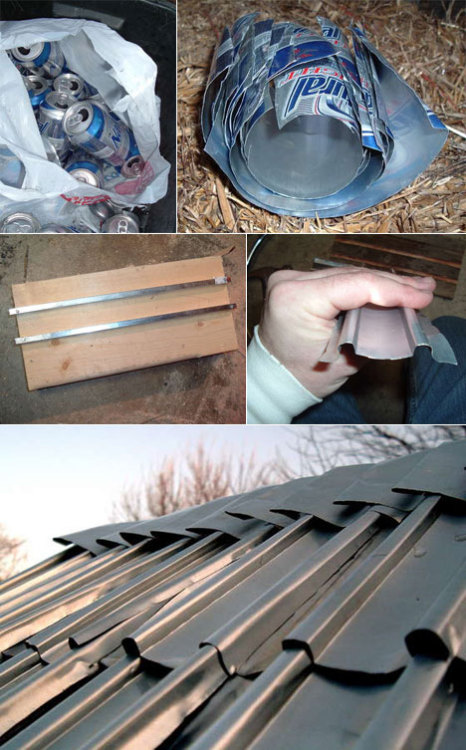
Beer Can Shingles


A neat idea via the Uncomsumption blog. Bricoleur Billy Robb took a bunch of beer cans, flattened them and ran them through a custom made die. The result: tiles for the roof of a chicken coop. It's reminiscent of Houston's renowned beer can house:

The Beer Can House
You can read Robb's beer can shingle directions on an Instructables.