Showing posts with label solar energy. Show all posts

Monday, August 20, 2012

How To Dry Food With the Sun

Drying Apricots in Southern California--early 20th century style.

Dehydration is one of my favorite food preservation techniques. Drying food concentrates flavor and is a traditional technique in our Mediterranean climate. Best of all, drying food is one of the best applications for low-tech solar power. In many places, you can simply set food out under cheesecloth to dry in the sun.

But there's a catch to sun drying: humidity. Food dries best when temperatures are above 85º F and below 60% humidity. If you live in a desert, humidity isn't a problem. But in most other places in North America it's simply too moist to set food out under the sun. It will rot before it dries. In Los Angeles, due to the influence of the ocean, it's slightly too humid most of the year for sun drying to work well.

But there's an easy way to overcome humidity: convection, i.e. hot air rises. Most solar dehydrators take advantage of the passive movement of hot air to lower humidity enough to dry food. Here's a couple of solar dehydrators that harness this simple principle to dry food without electricity:

Appalachian Solar Dehydrator


This is the dehydrator I built with plans from Home Power Magazine. The plans and an improvement on the original plans are split between two articles in Issue #57 and Issue #69. You need to download and read through both articles before building this dehydrator. This dehydrator has performed well for us. The same design can also be modified to work as a rudimentary solar house heater. I had originally used a sheet of plastic over the collector, but have sinced replaced that plastic (which ended up spltting) with a door I was getting rid of.

Cardboard Box Dehydrator


Mother Earth News has plans for a Appalachian style dehydrator made from cardboard boxes. As long as you keep it out of the rain, this dehydrator should work just fine, and is a lot easier to make than the plywood version. I've never built one of these, but am interested in hearing from anyone who has. 

Eben Fodor Solar Food Dryer

Photo from Simply Resourceful

This design is by Eben Fordor, and is described in a book by Fodor called  The Solar Food Dryer: How to Make and Use Your Own Low-Cost, High Performance, Sun-Powered Food Dehydrator. I have not seen one of these in person, but the folks at Simply Resourceful built and blogged about their Fodor style dryer. If you've got a Fodor dryer, please leave a comment to let us know how it worked.


Solar Tunnel Food Dryer
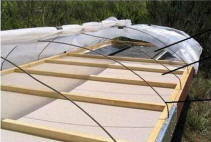

Builditsolar.com has a link to a solar dryer that's, essentially, a mini hoop house with ventilation. It's a scaled down version of the large hoop houses that small farmers use to dry fruit. Again, if you've used something like this, please comment.

Beware of Bugs

One drawback to outdoor drying is that you can often get infestations of flies and pantry moths. We've lost a lot of dehydrated tomatoes this way even though our Appalachian dryer has screens. I've even lost batches I've done in an electric dehydrator inside. Thankfully it's easy to kill larvae by sticking your dried food in the freezer at 0ºF for 48 hours. I'd recommend this step.

Further Reading

Build It Solar is one of my favorite resources. You can check out a couple of other solar dehydrator designs that are variations on the ones above on their Solar Cooking, Food Drying, Solar Stills and Root Cellars project page.

Thursday, June 14, 2012

Sun Boxes: A Solar Powered Public Art Project


It's not often that my unused music degree intersects with the topic of this blog, but I got an email from Craig Colorusso describing a neat, solar powered public art project that he's touring the US with called Sun Boxes. From the description on his website:
Sun Boxes are an environment to enter and exit at will. It’s comprised of twenty speakers operating independently, each powered by the sun via solar panels. There is a different loop set to play a guitar note in each box continuously. These guitar notes collectively make a Bb chord. Because the loops are different in length, once the piece begins they continually overlap and the piece slowly evolves over time.
You can find out more about the project at www.sun-boxes.com. Make sure to listen to the recording of the boxes--I could listen for hours--the sound is at once hypnotic and deeply relaxing.

Wednesday, January 11, 2012

Low Tech Solar Heating with a Thermosyphon Collector


Yet another great post from the folks at Build It Solar: a simple and low tech solar heating system called a thermosyphon collector mounted in the wall of a garage. It uses the same principle as the solar dehydrator we have on our garage roof--basically it's just some clear plastic and a heat collector made out of black window screen. If your climate is cold and sunny (think Colorado) this would work nicely.

Read the post to see a review of its performance over the past nine years here.

Tuesday, October 18, 2011

SunCalc: A Sun Trajectory Calculator


In attempting to figure out how to align a garden path with the sunrise of the summer soltice (that's the way we roll at the the Root Simple compound), I came across a neat Google Maps hack: SunCalc, the creation of Vladimir Agafonkin.

According to the description on the site,
SunCalc is a little app that shows sun movement and sunlight phases during the given day at the given location.
You can see sun positions at sunrise (yellow), specified time (orange) and sunset (red). The thin orange curve is the current sun trajectory, and the yellow area around is the variation of sun trajectories during the year. The closer a point is to the center, the higher is the sun above the horizon. The colors on the time slider above show sunlight coverage during the day.
I can see SunCalc being useful for laying out a garden, window and solar panel placement, evaluating potential real estate, or for planning your own personal Stonehenge.

Wednesday, August 10, 2011

CooKit Solar Cooker Made Out of Wood


The nice folks at Solar Cookers International gave us permission to reprint plans for their CooKit solar cooker in our book Making It. You can access those plans, as well as many other solar cooker projects, for free, on their website here.

I've made CooKits out of cardboard and aluminum foil a couple of times. One problem is that I eventually bang up the cardboard and I've got to make a new one. This summer I had a lot of  1/4 inch plywood leftover from fixing up Mrs. Homegrown's writin' shed. Rather than send that plywood to the dump I decided to make a more permanent CooKit.


I blew up the CooKit pdf from the SCI website using Adobe Illustrator.  I did a tiled printout and taped the pieces together to create a life sized pattern. I used this pattern to cut out the plywood pieces.


I spray glued the aluminum foil to the plywood. Next, I drilled holes in all the pieces and inserted twist ties to, essentially, create little hinges so that I could fold up the CooKit when not in use.


The plywood CooKit folds much better than my cardboard versions did.


This type of "panel" solar cooker works best for things like polenta and rice. Now I've got a convenient folding panel cooker for backyard use and camping trips.

Monday, February 28, 2011

Genetically-Engineered Organism Secretes Diesel

Image © Joule Unlimited, Inc.

It sounds like science fiction but according to an article by Jay Lindsay of the Associated Press, A Massachusetts company has a patent on a genetically modified organism that secretes diesel fuel from water, sun and CO2 inputs. Here's an excerpt:
Joule claims, for instance, that its cyanobacterium can produce 15,000 gallons of diesel fuel per acre annually, over four times more than the most efficient algal process for making fuel. And they say they can do it at $30 a barrel.
Normally I am opposed to genetically modified plants but this would appear to be a contained situation. Would it be a good thing for the planet if we had unlimited diesel fuel? I would guess that the CO2 would be net neutral whatever escapes the exhaust pipe would have had to have gone into the fuel initially - right?

Mass. company making diesel with sun, water, CO2

I'm curious what other people think about this.

Thursday, June 10, 2010

Sundiner


Beekeeper Dennis made one of those once in a lifetime garage sale finds earlier this year: a solar oven from the 1960s called the "Sundiner." I couldn't find much on the interwebs about it except for a brief mention in the  April 1963 issue of Desert Magazine,
"Here's a new product that suits desert living as few others can—it collects and concentrates the heat of the sun and allows outdoor cooking without fuel or fire. They call it the Sundiner. The technical description is "Solar Energy Grill." Sundiner is a compact unit, 17-inches square and 6inches tall. Fold-out mirrors are metalized Mylar plastic, supported by polypropylene holders. The mirrors focus the sun's heat on the lower section of the cabinet, where heat slowly builds up to a maximum of about 450 degrees—plenty to cook with. Directly below the apex of the mirrors is an oven enclosure. Plastic foam insulation and a pair of glass plates prevent excessive heat loss. The solar energy grill works in this simple way: point the mirrors toward the sun for a few minutes until the right temperature is reached (built-in heat indicator dial) and pop a tray of food into the oven. There is no fire or fuel to handle. Sole source of cooking stems from the collected, concentrated rays of the sun. Here is a sample of how long various meats take to cook: Hamburgers, franks, and fish, 15 to 20 minutes. Steaks and fillets, 20 to 25 minutes. Quartered chicken, 25 to 30 minutes. Temperature variations are possible by turning the Sundiner toward or away from the sun. The advantage of the Sundiner is that it can be used as a safe substitute for a fuel-fired stove on beaches, parks, decks of boats, and other restricted areas. Carrying handles are standard. The price is $29.95. From Sundiner. Carmer Industries. Inc., 1319 West Pico Blvd.. Los Angeles 15. Calif."
That price would be about $207.62 today, just under what the very similar Global Sun Oven Solar Cooker costs.


When collapsed the Sundiner resembles, unsurprisingly, a 1960s era portable record player.


Dig that groovin' temperature dial.


 The instructions are printed on the inside cover.


I can almost taste the heavy nitrites in those 1960s hot dogs.

For more vintage solar thoughtstylings see Life Magazine's "Solar Power Back in the Day."

Friday, May 29, 2009

Lights Made from Soda Bottles

Via Make Blog, a clever homebrew solar light made from soda bottles.


I'm a bit skeptical about how you could make these watertight, but for an outbuilding or patio roof they might make for a nice low cost alternative to solar tubes or skylights.

Wednesday, October 01, 2008

Build a Solar Dehydrator


Like many of you, I suspect, we've got a few too many tomatoes at this time of the year. One of our favorite ways to preserve our modest harvest is with our solar dehydrator. There's nothing like the taste of sun dried tomatoes, but unless you live in a very dry desert climate like Phoenix, Arizona you can't just set fruit out in the sun and expect it to do anything but go moldy. In most places in the world, including here in Los Angeles, the relative humidity is too high to dry things out in the sun. Solar dehydrators work by increasing air flow to dry out the food. The one we built uses a clever strategy to get air moving without the use of electric fans such as you'd find in your typical store bought electric dehydrator.

Our solar dehydrator is constructed out of plywood and consists of a heat collector containing a black metal screen housed in a box with a clear plastic top. This screen heats up on a sunny day and feeds hot air into a wooden box above it. Vents at the bottom and the top of the contraption create an upward airflow through natural convection (hot air rises). You put the food on screen covered trays in the upper box. With sliced tomatoes it takes about two full days of drying and you have to take the food indoors at night to prevent mold from growing (a minor inconvenience). We built our dehydrator several years ago and have used it each season for tomatoes, figs and for making dried zucchini chips.

You can find plans for this "Appalachian Dehydrator", designed by Appalachian State University's Appropriate Technology Program, in the February/March 1997 issue of Home Power Magazine. The February/March 1999 issue of Home Power features a refinement of this plan, but we just built the original design and it works fine. The original plans and improvements to those plans are split between two articles: Issue #57 and Issue #69. You need to download and read through both before building this dehydrator. . Alternatively, the always excellent Build it Solar website has a whole bunch of solar dehydrator designs, including a nice cardboard version. And while you're in the library there's also a book by Eben Fodor, The Solar Food Dryer.

As an added bonus to the tinkerers out there, take almost any of these designs, remove the top box, stick it in a window and you've got a passive solar room heater.

Monday, March 24, 2008

A Parvati Solar Cooker

Damn, is solar cooking easy! Put some rice in a pot, place the pot in this simple panel cooker, made with cardboard and aluminum foil, stick it out in the sun and two hours later you have lunch.

We built our "Parvati" solar cooker with plans designed by Shobha Ravindra Pardeshi that can be found here. Pardeshi, who runs an "appropriate technology" company with her husband in India has another design for a similar dish-shaped cooker here. We found both of these cookers (and many more) via the amazing Solar Cooking Archive.

For the Parvati cooker, we cut the cardboard according to the plans, and affixed the aluminum foil with spray glue. For our first pot of rice we used a black enamel pot to better absorb the heat of the sun's rays, and wrapped it in a roasting bag to increase the efficiency of the cooker. A five gallon bucket made a convenient stand and did not have to be rotated in the two hours it took to cook the rice. Longer cooking times would require re-aiming the cooker as the sun moves across the sky. Temperature in the pot quickly went over 180º F, the point at which food begins to cook. The two hour cooking time is much longer than it would take on a conventional stove, but with a solar cooker there is no danger of burning, making the process, in our opinion, easier than stove-top cooking. Consider a solar cooker a kind of low-powered crock pot for lazy and cheap people--good for things like rice, beans, soups and stews, but not good for sauteing. Just remember the oven mitts--this thing gets hot!

When the sun gets higher in the sky, as we move into summer, this cooker will reach even higher temperatures. We don't remember where we read this but some folks say that panel cookers like this one cook best when your shadow is shorter than you are which, here in Los Angeles, is right about now. We tried this cooker back in January and it performed well, but did not get above 140º F, which is not hot enough to cook.

Perhaps here around the Root Simple compound we'll get around to turning our Parvati Solar Cooker into a low rent attraction. Just add some ostriches and we'll repeat this early 20th century tourist trap in nearby Pasadena (click to biggify):

Thursday, October 19, 2006

Suntracker

Brief linkage today. While Homegrown Revolution doesn't like to overdo the technology thing, we think this natural light collecting skylight device called the Suntracker One has promise. Similar in principle to the Solatube, the Suntracker, as the name implies, has an additional feature that the Solatube lacks -- it tracks the sun with a built-in electronic brain and mirrors. Both the Solatube and the Suntracker direct the light down a tube, thus replacing the heinous blocks of fluorescent fixtures that typically light most commercial buildings with a more aesthetically pleasing natural light. Solatubes are available for residential use, but the Suntracker is oriented towards larger commercial applications.

Friday, September 29, 2006

Build a Ghetto Solar Cooker

Using crap we had laying around the homestead, SurviveLA fashioned a solar cooker based on plans from Backwoods Home Magazine, the Dwell of the Ted Kaczynski set. We just substituted an old cooler for the cardboard boxes, and we finished it off by using one of Los Angeles' ubiquitous abandoned car tires as a cradle to keep the cooker oriented towards the sun. It ain't pretty but it works. In our first test we reached 160º inside the oven, but we think we can do better with some refinements such as finding a black pot with a lid.

Yesterday we cooked up a somewhat disappointing batch of "chocolate pudding" which ended up with the consistency and taste of warm cake batter. We'll test out some other recipes in the next few days, sun permitting, and keep you, our loyal readers, informed.

For more information on solar cookers check out the superb Solar Cooking Archive. You can also purchase a commercially made solar oven called the Global Sun Oven, but why do that when you can make one with cardboard, aluminum foil, and a black pot?