Sunday, September 30, 2012

Picture Sunday: Egg-Laying Wool-Milk-Sow


For picture Sunday, a German expression: eierlegende Wollmilchsau. It's one of those wonderful compound German words translated, according to Wiktionary, as "egg-laying wool-milk-sow." Wiktionary goes on to explain that the expression implies, "a single tool that attempts to handle the work of many."

Thanks to John Zapf for the German lesson.

Saturday, September 29, 2012

Saturday Linkages: Meditation Pods and Zombie Lawn Gnomes

Doesn't everyone need a vintage 1970s meditation pod?

DIY
How To Build Your Own Trippy Meditation Pod
 
Robin Wood Makes Wooden Bowls With Hand Tools in UK

Skate Villa: Skateboard-Friendly Hunting Lodge Conversion | Designs & Ideas on Dornob  

Open source brick machine: the evolution:

Nature
A classic work of entomology, available online in French and English:  

Health
Mark Bittman: Is Alzheimer's Type 3 Diabetes?

Bikes
Cyclists are safe and courteous, and your disdain for them is grounded in cognitive bias:  
 
Is It Time for Interbike to Dump Las Vegas?  

???
Zombie lawn-gnomes feast on a pink flamingo:  

For these links and more, follow Root Simple on Twitter:
 

Friday, September 28, 2012

Radical Beekeeper Michael Thiele Ventures Into New Territory

Thiele with an unorthodox hive--picture from his website Gaia Bees.

One of the lectures I went to at the National Heirloom Exposition in Santa Rosa earlier this month has really stuck with me. It was a talk by radical biodynamic beekeeper Michael Thiele that, frankly, I walked into biased against. But by the conclusion I could tell that the whole audience, including myself, left deeply moved by what Thiele had to say.

The reason for my bias was that I was not too impressed with the two other biodynamic lectures I attended. One was just too pseudo-scientific even for my intuitively biased brain. The other lecturer, when asked why biodynamicists follow certain unusual practices such as burying dandelion flowers stuffed into the mesentery of a cow responded, "because Rudolf Steiner said so."

Thiele was different. He is influenced by, what I believe to be, the true spirit of Steiner's ideas rather than the dogma of his followers. Steiner, I think, would want us all to continue to use our sense of intuition rather than rely on what he said to do. Thiele balances what we know from science about bees with an intuitive relationship with bees as a whole, and complex, organism.

Thiele uses an old German word Steiner also used to describe a beehive: "bien". On his website, Gaia Bees, Thiele defines bien as
an attempt to describe the oneness of the bee colony, [that] also recognizes its individual “personality”. The honey bee colony is one being in countless bodies. The biological term for this is super-organism. The bien is configured through the harmonious and functional relationships of all its parts. Every part depends on the other and all parts provide the necessary environment for their own existence. The colony is both a society of thousands of individuals as well as one super-organism, one bien.
Steiner's ideal farm, human being and society are also biens, approached as whole systems rather than as reductionist sums of parts.

Some other provocative points Thiele made about bees during his lecture:
  • The vorroa mite epidemic was a blessing because it exposed the failure of our industrial, reductionist approach to beekeeping.
  • "Let the bien tell us what it needs." In other words we should look to the needs of the bees rather than our own needs. Thus Thiele prefers highly unorthodox (from a modern beekeeping perspective) housing arrangements based on natural forms. One hive (home?) that he brought was a hollowed out log with a door on either side. Thiele believes that we should look at what feral colonies prefer rather than keep them in Langstroth hive boxes.
  • Intuitive communication is just as important when approaching bees as it is when working with other animals. But bees are different. Thiele said that bees don't "have a face like a cat or dog," thus our communication with the bien comes from, as Thiele put it, "a different place."
  • The hive is in, as Thiele poetically described it, "the aerial ocean," positioned between heaven and earth To this end he thinks hives should be kept higher off the ground as feral bees tend to do on their own. Indeed, most of the feral colonies I've seen in Los Angeles are between 9 and 12 feet off the ground.
  • Thiele does no treatments at all including the essential oils that some biodynamic beekeepers use. He believes we should focus on the health of the bees and not try to prop them up.
  • Thiele had advice for avoiding stings--"relax and focus on the bien" is how he put it. Oddly, I had a chance to try this technique just after the lecture. I walked over to a display by the local county beekeeping association (that Thiele would probably be horrified by) that included a hive in Langstroth boxes being fed sugar water and kept within a mosquito netted tent. Somehow there must have been a gap in the tent and a very pissed off bee landed in my hair. I did exactly as Thiele said--I relaxed and imagined the bien. The bee crawled out of my hair and took off. This has never happened to me before--every time a bee has made it into my hair in the past I've gotten stung. 
  • Thiele believes that honey is a precious substance, a "medicine" and that we should "receive" honey rather than "harvest" it. He's horrified by the use of honey as a sugar alternative and would, no doubt also be horrified by all the cheap Chinese honey to be found in ketchup style packs in fast food restaurants.
  • The bien can function as a intiatic gateway, as an inspiration for a vision of a healthier world. To experience this gateway we must look within and deal with our ego that is so neatly symbolized by the exploitative mentality of industrial beekeeping. Thiele described our ego as "a boy in the passenger seat of a car with a toy plastic steering wheel thinking that he's doing the driving." 
I have to say that several years ago, after I first began working with bees under the tutelage of radical beekeeper Kirk Anderson, I had odd, visionary dreams very much in line with Thiele's outre thoughtstylings. And I was never prone to those sorts of dreams until bees entered my life. It was as if the bien really did open some sort of new viewpoint or gateway. It's my hope that the same gate opens for many others. As Theile puts it on his website:
The Bien invites us to “see” with our heart rather than with our eyes. The extent to which the Bien’s “heart awareness” flows is seemingly limitless, is striking to us humans. It has the potential of fundamentally dismantling some of our core limitations and beliefs. The Bien comes as an in-spiration in times of great turmoil and change. Its wisdom and love presents an opportunity to step into the creative field of finding new ways of living. Living with bees is not about hardware, hives and such any more – it is about our survival as humans on Gaia, mother earth. Life on earth is at stake, and it is time to venture into new territory.

Thursday, September 27, 2012

Poultry Houses of the Ultra-Wealthy


Root Simple reader Christopher Calderhead tipped us off to a story in the Guardian on the plans by British hedge fund manager Crispin Odey to build a neo-classical chicken coop. Odey will, apparently, be spending at least £100,000 just for the stone. The Telegraph also covered the story and has more details on the construction,
The temple’s roof – adorned with an Anthemia statuette – will be fashioned in grey zinc; the pediments, cornice, architrave and frieze are in English oak; and the columns, pilasters and rusticated stone plinth are being hewn from finest grey Forest of Dean sandstone.

Sir Peter's duck house.

This isn't the first poultry house to cause a scandal in Britain. In 2010 Sir Peter Viggers claimed a £1,645 duck house as part of his expenses as an member of parliament.


Now if your taste runs more towards Dwell Magazine than the neo-classical, a British company sells a £1,950, "Nogg" chicken coop. Modern design, apparently, comes with an even higher price tag than Sir Peter's duck house!. And, like most modern design, the Nogg is more conceptual than practical. Looks like a tight squeeze for a couple of hens. The Nogg could get Prince Charles started on on one of his anti-modernist architecture rants.


Not to be outdone on this side of the pond, the current issue of Backyard Poultry Magazine ("dedicated to more and better small-flock poultry") has a cover story on Brent Engelhardt and Beth Roark's 100 bird chicken coop, which features a fake western town facade. A lot of the materials were scavenged to keep costs low (Engelhardt works in construction), but the couple admits the project was extravagant. Engelhardt and Roark remarked, "we wanted to build something we could enjoy as much as the chickens would."

Engelhardt and Roark make a good point--you have to stare at the thing for years so your coop might as well look decent. To be honest, I've regretted not paying more attention to aesthetics when I built our coop. I am much more happy with the chicken run our architect friend John Zapf designed for us.

The east elevation of Odey's coop.

Of course Odey's coop is a bit over the top, to put it mildly. The symbolic meaning of a hedge fund manager, who profited off the financial collapse, building an elaborate stone chicken house has ruffled a few feathers in Britain. But I have to admit that I share the same neo-classical pretensions. However, being on a more limited budget, my neo-classical chicken coop will have to be constructed with used futon frames and scavenged bags of stucco.

Odey coop, south elevation.

To that end, if you'd like to recreate Odey's neo-classical chicken house in futon frames and stucco, you can download a pdf of the plans here. And, I have to point out, the Romans did not build coops like Odey's. To see what they built, check out our post on the sacred chickens of ancient Rome.

Wednesday, September 26, 2012

Modesto Milling's Organic Layer Pellets


I could blog for weeks about all the lectures I attended at the National Heirloom Expo, but I thought I'd take a break to highlight a product I came across in the vendor hall: Modesto Milling chicken feed. I've been using it for a few months now on the recommendation of Craig and Gary from Winnetka Farms (where our chickens came from). 

In my opinion, if I'm going to go through the trouble of keeping my own chickens they should get good feed in addition to kitchen scraps and yard trimmings. Since I don't have a pasture to let my hens forage on, this feed is the next best thing. So that's why I've decided to use Modesto Milling's organic layer pellets, even though it's more expensive than the feed I used to use.

Modesto Milling feed is carried at stores in California, Arizona, Colorado, Utah, Hawaii and online (though I imagine the shipping charges might be prohibitive). I pick mine up at a local pet store. A list of retailers is on the Modesto Milling website. You can also arrange a bulk order and split it up. And if you're trying to avoid soy in your diet they have a soy free chicken feed.

Tuesday, September 25, 2012

Revolution: A New TV Series About Extreme Suburban Homesteading


This review is by Erik, but Kelly has a few comments of her own to make, in the form of end notes.

A few weeks ago I spotted an ad on the side of a bus that appeared to show a number of good looking people armed with crossbows and wandering a post-apocalyptic landscape. For you, our readers, I broke my ten-year TV show fast1 to find out what this was about. The show is called Revolution and you can view the pilot episode here.

Plot summary

The first scene begins in a flashback as a man frantically downloads the contents of his computer to a flash drive just before Mahmoud Imadinnerjacket causes a big electro-magnetic pulse.2 Said EMP knocks out all the power, iPhones, cars and jumbo jets in the entire world. Fifteen years pass, civilization reverts to an approximation of our first book The Urban Homestead, and we pick up the story with the now grown-up daughter of the dude with the flash drive.

One groovy HOA

The daughter lives in a suburban development. All the home owner's association rules have been relaxed allowing for growing front yard corn fields, potatoes in tires, chicken coops and even keeping a couple of horses all in a suburban cul-de-sac.  In reality, HOAs would never cave in so quickly even in the face of starvation. But I digress.3


Did the screenwriters visit Farmlab?

Imadinnerjacket's EMP killed all the normal-looking people, leaving behind only fashion models (with perhaps the exception of one Falstafian ex-Google employee). They have smashing wardrobes, too.4 And America's long lost archery skills have apparently been miraculously revived.

Come to think of it, Hollywood seems to be having a love affair with archery of late. Is the javelin next? Put down those Xboxes kids and start practicing! In Revolution it's also revealed that people suddenly know the names of plants and what to do with them even without access to Google.

But the tranquil suburban homesteading is not to last forever. An insurance adjuster turned warlord's assistant comes to town to kidnap the heroine's dad and get his hands on all the cool mp3s on that flash drive. A shootout ensues. Dad is killed and heroine's brother is kidnapped by the militia. 

Our heroine must then make a pilgrimage to Chicago to find her uncle and rescue her brother. Her uncle turns out to be running an artisanal cocktail operation in a derelict hotel that has, as most post-apocalyptic films have, an endless supply of either beeswax or tallow with which to keep hundreds of torches lit 24 hours a day. 5 We find out that the uncle possesses secret ninja skills--having, apparently, spent the past fifteen years working on both artisanal cocktail recipes and kendo.

Meanwhile the brother is temporarily rescued by a lone woman living in a tidy plantation house who is able to calm the kid's asthma attack with a 15 year old, fully functioning asthma inhaler. But then the evil insurance guy comes a knocking and hauls off the kid. The lone woman then heads up into her heavily locked attic, logs into a Unix terminal, and taps out a message warning about the militia's visit. So now we know that some people still have access to power--and to the Internets!

The pilot ends with a visit to the handsomely appointed campaign tent of Madison, the head cheese warlord who, at the beginning of the show, it is revealed has something to do with the flash drive with all those cool mp3s on it.


What does it all mean? 

The "ring", the talismanic object in this Lord of the Rings cycle is a flash drive, the contents of which, presumably, we'll find out about in a later episode. I certainly hope it contains 100 of the funniest viral cat videos. Curiously, it's also a flash drive that seems to generate its own power.

That the redemptive object in Revolution is a technological one is not surprising giving our culture's biases. John Michael Greer. in what I think is the most important book on our current crisis, The Blood of the Earth, writes about how our culture is blind to the fact that our problems are political, social and spiritual and not solvable by technological/scientific means. No amount of corn ethanol or switchgrass will stave off the fact that the earth has a limited amount of resources. But, in the stories we tell ourselves, magical flash drives can still save the day and maybe even power the whole world.

It's also telling that the voice over in the opening credits of Revolution reflects a fundamental confusion between an energy source and the means by which it's delivered, "We used electricity for everything--even to grow food," says the narrator. "Electricity" is not how we grow our food. Electricity is generated from finite sources, primarily coal and natural gas. And we use a lot of oil, of course, to grow our food.

Our technology, especially the internet and smart phones has radically externalized what used to be  collective and individual cultural memory. It's notable that this story places so much value on a flash drive as a repository of knowledge that used to be inside our own skulls.

The delusional aspects of the pilot episode gives me great pause for the future of this country. But without seeing the rest of the series it's too early to deliver a final judgement. It will be interesting to see if the flash drive has the same corrupting influence as the ring in both Tolkien and Wagner's stories.

_________

Kelly's interjections on the show's summary. She's not touching Erik's editorializing:

1Lest you think Erik is some virtuous, Thoreau-type character, I'll just say that he may not watch series TV, he does watch movies and documentaries and youtube cat videos in plenty.

2They did not actually say why the power went out, or who was responsible.

3The opening scenes showing the subdivision "village" was the best thing about the whole pilot. There were lots of nice details, like stacks of rain barrels and tire planting and a hose running through a window into a sink.  I found myself wondering what sources of information the writers were using (other than our book, of course.). Certainly Kunstler, both his rants and his fiction (which is a form of rant, imho) but also it reminds me very much of a book called Dies the Fire by SM Stirling, where all the tech goes out in one day and the world is remade by SCA and pagan types.  I don't think the SCA and pagans will get any play in this show, but the overnight tech-loss is completely Dies the Fire.

4These people look really good. The girl's leathers are artfully patched and oh-so-Katniss. Others have unpatched, fresh looking clothes. I can almost buy this because if there was a fast, massive die-off, maybe there were lots of clothes left in the stores. Maybe even 15 years worth. (Maybe? I'm suspending my disbelief.) What I have a harder time believing is the hair. Both the men and women look like they're all getting daily blowouts. No one is scarred or pocked or beset by unsightly skin growths. And I'll say in his defense that the Google guy may not be fashion-model thin, but he's not bad looking. 

5The overuse of candles by lighting designers in any post-apocalyptic setting is a major pet peeve of mine.  Erik is mentioning this here because he had to listen to me go on and on about it while we were watching the show. Those torches! What in the heck are they burning?

Monday, September 24, 2012

Resilient Gardens


The other day I was reading a message board where people from all over were talking about how their gardens had done this year. Most of them had trouble, and most of them blamed the strange weather. Now, of course, we can't know the weather was truly to blame in each and every failure--but temperature shifts, unseasonable heat and cool do play havoc in the garden.  It got me to thinking about climate change and how gardeners might be able to hedge their bets to make sure they get a harvest every season.

Climate change creates unpredictable weather, and unpredictability is a terrible thing for a gardener. Ensuring success, I think, will have to do more and more with identifying and perhaps even breeding tough-ass, locally adapted plants.  Plants that are known survivors can form the backbone of your garden. Each year you can try to plant tender favorites, exotics, delicate plants of all sorts, whatever you want--and if the roll of the weather dice falls in your favor, you may harvest those plants. But that backbone of tough plants will be there, so you'll have something fresh for your table no matter what.

Now, just what those plants are is going to vary by location. I'm going to list off some survivors for Southern California.  Please chime in with your location and your favorite, bomb-proof plant!

SoCal Survivors:
  • Prickly pear cactus. When the Armageddon comes, I'm sure we'll be living off of this while serving our mutant cockroach overlords.
  • New Zealand spinach. We just posted on this.
  • Arugula. As a winter crop--it doesn't like summer heat.
  • Artichoke. Everyone in SoCal should have one in their yard.
  • Cherry tomatoes. Cherries don't seem to be nearly as susceptible to the various tomato maladies. Climate change or no, they are an important backup to big tomatoes.
  • Swiss chard. The most amiable of all greens.
  • Fruit trees. They aren't bothered by much here in this mild climate--but this wouldn't be true somewhere where, say, a late frost could wipe out a crop. However, I think our chill hours are dropping in SoCal so I'd recommend very low chill hour trees, like figs and pomegranates, over more borderline trees like apricots.
  • And, we're very lucky to live in the ideal climate for avocados.  
Credit where credit is due: this is a post by Mrs. Homegrown--due to a computer glitch it got posted by Señor Homegrown. 

Sunday, September 23, 2012

Picture Sundays: Good News and Dog Carts


First off, Governor Brown signed the California Homemade Food Act, AB 1616, into law this past week. So Californians will soon be able to make and sell "non-hazardous" foods in a home kitchen and sell them.

But how will those goods get delivered? Above, a bakery in Holland using that long lost mode of transport, the dog cart. Picture via Terrierman's Daily Dose.

Saturday, September 22, 2012

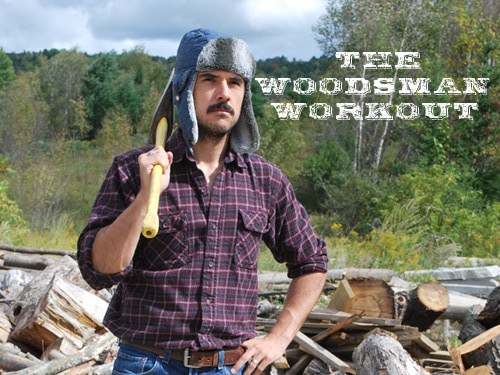
Saturday Linkages: From The Woodsman Workout to Crafting With Your Cat

Yes, it's the woodsman workout. Via the Art of Manliness.

Gardening
My new favorite botanic garden – in Mexico! | Garden Rant

Deconstructing the cornmeal myth:

DIY
Build-It-Solar Blog: DIY Solar Water Heating System in Southeastern Pen...

Indie Furniture: DIY Construction Made Accessible & Hip | Designs & Ideas on Dornob  

2 boards, 1 seat:

Food Preservation
FreshTech Jam and Jelly Maker Review

Cats 'n Crafts
Catification: Creative Table Leg Cat Scratcher

Book on Crafting With Your Cat: Kitty Jones Kitty Crafts link

Fitness
The Woodsman Workout | The Art of Manliness  

Things to worry about
Warmer Temperatures-New USDA Zone Map Already Obsolete

Why I don't Worry Too Much About Organic Fruits and Veggies:  

GMO-birthed "Superweeds" Oh joy. You  

The cat food crisis:

Bermuda Dunes woman's garden for eating has some neighbors hissing  

Waiter, There's Arsenic in My Rice via  

Preppin'
Rugged All-Terrain Trailer Home for Off-Road Adventures | Designs & Ideas on Dornob  

Earthquake proof desk:  

Just Plain Cool
And Now, the Skatepark House  

Wild Huts in the UK  

For these links and more, follow Root Simple on Twitter:
 

Friday, September 21, 2012

Fermenting culture wih Sandor Katz

Katz chats up Master Food Preserver and author Kevin West

Last night Erik and I went to see a talk by fermentation guru Sandor Katz, hosted by the Environmental Changemakers. Being a huge Sandor Katz fangirl, I was thrilled to get a chance to see him in person. These days he's sporting a charming 19th century mustache!

His first book, Wild Fermentation, was one of those really important, life-changing books for me. It might sound strange to say this about a book on pickling, but it opened my eyes in many ways. And it taught me how to do vegetable and salt ferments, which are the backbone of my pickling practice. The daikon pickles we wrote about in The Urban Homestead are due to Wild Fermentation.

Now he's got a new book out, The Art of Fermentation, which I've got to get my hands on:

Here are some excerpts from my notes:

•  For those of you who need convincing, The Four Benefits of Fermentation:

1) Pre-digestion: Fermentation makes foods more edible by breaking them down a little for us. Soybeans are hard to digest, tofu--easy. Milk is hard for some people to digest, but yogurt much easier, etc.

2) Nutrient Enhancement: These foods are rich in B vitamins as well as less known micronutrients, which are being studied right now. They also make minerals more available to us.

3) Detoxification: Some plant materials are downright toxic unless fermented, e.g. cassava root.

4) Live Bacterial Cultures: We need live bacteria in our gut-- most especially lactobacillus. By eating these foods we renew and diversify our microbial armies.

And of course, fermentation is a preservation process. Today that aspect isn't as important as it once was, but really, into the last century it was a survival skill.

And finally, it creates delicious, strong-flavored foods. Where would we be without stinky cheese, miso, sourdough, kimichi and kraut?

• He mentioned the Human Microbiome Project, which I'd never heard of but which I think we'll have to blog on soon. Thank god someone is studying this stuff!  He said they're really bringing to the fore our deep and intimate relationship with bacteria.

• Because we drink chlorinated water and antibiotics are so grievously overused, we need to consciously replenish and diversify the bacteria in our guts by eating living foods like fermented vegetables and yogurt.

• Lacto-fermenting vegetables is a very safe practice. The FDA has no reports of anyone contracting a food borne illness from eating live kraut, kimchi, sour pickles, etc.

• Sandor encourages people who are interested in fermented/cultured foods to start with vegetable ferments -- and I agree--it's where we started!  Vegetable ferments are safe, easy, require no special equipment or starter cultures. Here's our daikon pickle recipe from way back in 2007.  How did our blog get so old?

• Two kraut tips:

1) Don't use juice from the last batch of kraut to inoculate a new batch. It works, but it tastes much better if you just start from scratch with salt and the bacteria present on the cabbage. He explained that any ferment goes through stages where different strains of bacteria rise to dominance and effect flavor--which is why ferments taste different at different stages. The juice from ripe kraut contains late-stage bacteria. By inoculating with that bacteria, you skip all the delicious, intermediate stages.

2) He encouraged us not to be afraid of old vegetable ferments. Say you've made a big batch of kraut or kimchi. To retard the fermentation process (i.e. stop it where you think it tastes good) you'll want to pack it in jars and put it in the fridge. (You don't want to heat-process your jars, because that will kill all the living bacteria).  How long do you think a full jar of kraut or kimchi will last in the fridge? Sandor says two years is not unreasonable--as long as it is full. Airspace creates mold opportunities.

• "But I don't like the flavor."

One of the audience confessed she really doesn't like the strong flavors of sauerkraut. Sandor explained that when making kraut, or any veg ferment, you can stop the process anywhere from say, 3 days to 3 months, depending on both your preferences and the ambient temperature. 3 day old kraut is very different than 3 month old kraut, but both are delicious living foods.  I'd add that I agree. One of my favorite forms of kraut is a blend of red cabbage and green apples and caraway seeds which is fermented only for a few days. It's still crisp and bright when you eat it, sort of like a fermented salad.

• One thing he said surprised me: he doesn't think it matters at all what kind of salt you use. I've always used non-iodized salt for my ferments. But I'd bow to his greater experience. He did say that if you have it, and can afford it, high-mineral natural salts are fantastic to use.

• How much salt? That's sort of a perennial question. For him, it's a matter of taste. Other resources will give exact recommendations of salt per pound of vegetables. The more salt you use, the slower the fermentation will be, and the longer the end product will last. It will also, of course, be very salty. Less salty ferments go more quickly.  He salts his kraut to taste. Simple as that.

• I was glad to hear him admit that cucumbers are the hardest thing to pickle!

• If you're in the market for a ceramic crock, he pointed out that you can order one via Ace Hardware's website and then pick it up at your local Ace.

Thursday, September 20, 2012

Feijoa Fever

Image from Wikipedia

If you're lucky enough to live where you can grow it, pineapple guava (Acca sellowiana) is a beautiful tree. Evergreen, the leaves are dark green on top and silvery gray on the bottom. In the spring you get hundreds of pink and red, edible flowers (they actually taste like cotton candy). In the fall you get copious amounts of green fruit, high in pectin and sugar.  When I've seen pineapple guavas in our local supermarket they are priced at nearly $2 a piece. I planted one a few years ago in our front yard.

Image from Wikipedia

Last Thursday morning at the at the National Heirloom Exposition Mark Albert, a pineapple guava expert, gave a lecture on "Developments in Pineapple Guava." Those developments are, interestingly, entirely in the hands of amateur growers like Albert. Pineapple guavas are not part of any government breeding program. And the tree has really only been domesticated in the last 100 years or so. There's a confusing jumble of named varieties and considerable disagreement on how you even propagate them. During his lecture, Albert dropped a bunch of factoids of interest to pineapple guava obsessed fruit geeks such as me:
  • First, how to pronounce the Portuguese name for the fruit: feijoa - fay--ee--joe--ah
  • Don't pick from the tree--wait for it to fall to the ground.
  • Pineapple guava is very drought tolerant but needs summer water if you want fruit.
  • Albert's prefers to propagate from seed.
  • Pineapple guava's origins are in Uruguay. The region it comes from sometimes does not receive any rain in three years. It's also the climax species in this arid region.
  • The Spanish name for pineapple guava is Guayabo del país or wild guava. 
  • Albert, who lives in Mendocino County in Northern California (about as far north as you can grow this tree) propagates the seeds by soaking pulp in water for a few months and planting the seeds when it warms up in the springtime.   
If you live where it never gets below 15ºF, consider giving this gorgeous tree a place in your garden.

More info from the California Rare Fruit Growers on pineapple guava here. 

Wednesday, September 19, 2012

Toby Hemenway On How Horticulture Can Save Us

What I like about author and permaculturalist Toby Hemenway is that he does a lot better job, frankly, of explaining permacuture than do the founders of the movement, Bill Mollison and David Holmgren. Hemenway is a better writer and demonstrates how permaculture's abstract designs principles can apply at the household and neighborhood level. His book, Gaia's Garden, A Guide To Home-Scale Permaculture ought to be on everyone's bookshelf.

Last Thursday at the National Heirloom Exposition Hemenway gave a talk entitled "Redesigning Civilization: How Horticulture Can Save Us." What he meant by "horticulture" is not, say, propagating begonias. Rather, he defined horticulture as gardening, the kind of gardening some indigenous people did when they influenced the landscape to produce useful and edible plants. In other words, what we in the West would call permaculture. This is in contrast to agriculture which Hemenway considers to have a destructive influence on ecosystems, human health and culture.

Hemenway also, justifiably, critiqued some corners of the urban homesteading movement for promoting an egocentric self-sufficiency--"MY food on MY land" as he put it--a kind of industrial farming on a household level. While "self-sufficiency" appears in the subtitle of our first book (our publisher's idea), it's not a term we use. Kelly and I always emphasize, like Hemenway, the importance of community. We are much more comfortable with the title "gardener" rather than "farmer". We need farmers, of course, but I'd like to think of urban homesteading as being more about small scale, permacutural type projects that involve both individual and group efforts.

The takeaway from Hemenway's talk for me was the importance, especially in urban areas, of integrating community in any permacultural design project. After showing what everyone reading this blog knows, that our modern world is in big trouble, Hemenway ended on a positive note. With small scale, thoughtful design we can go a long way to solving some pretty big problems.

Tuesday, September 18, 2012

Tips on Composting from Will Bakx of Sonoma Compost

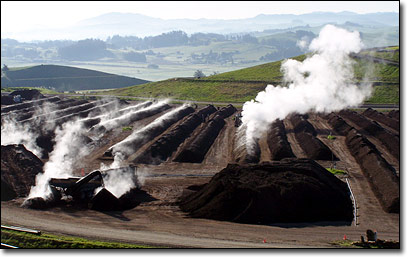
Sonoma Compost's composting operation.

On Thursday at the National Heirloom Exposition, Will Bakx, soil scientist and operations manager of Sonoma Compost, gave a rapid fire lecture on the nitty gritty details of composting. Here's some of his useful tips:

Temperature and Turning
Compost should stay above 131ºF for 15 days to kill pathogens. Bakx recommended getting a thermometer to check the temperature every day during the initial period and using Sonoma Compost's handy Temperature/Turning Sheet (pdf) to keep track of the temperature of the pile. If the pile dips below 135ºF, turn it. If it doesn't get up to temperature, add more nitrogen containing materials. If it gets above 163ºF, add more carbon containing materials. After the initial turnings just let it sit unless you have to turn to add moisture.

Bakx believes that you should turn as little as possible, just enough to achieve that first period of 15 days above 135º F. I really like the simplicity of this method and will definitely use the turning sheet the next time I build a pile. I really makes it clear when you should turn and how often.

Moisture
Lack of moisture, according to Bakx, is the number one mistake made by beginning composters. He suggested an ideal moisture range between 40-­‐60%. You can check the moisture level using the following technique:
Take handful of material. Squeeze firmly
Water escapes: >60%
Shiny ball: 55%--60%
Ball remains when tapped: 50--55%
Ball falls apart when tapped: 45--50%
No ball forms: 40--45%
Unless hand feels powdery dry: <40 p="p">
Bakx has drip irrigation set up on his large windrows, something I might try with my pile the next time.

Pile Size
The mimimum size for a compost pile is 3 x 3 x 3 feet or larger.

Things not to add
  • Ash--our soils tend to be alkaline in California and ash will raise pH. A small amount is ok.
  • Cardboard--Bakx is afraid of the glues and said that he is very conservative about what he ads to his compost.
  • Toilet paper--because of metals (I've been unable to verify this--if any of you know about this issue, please leave a comment.
Alleopathic plant material such as eucalyptus leaves and walnut leaves, on the other hand, are ok to add. Bakx cited studies where plants were successfully grown in leaf litter made entirely out of eucalyptus leaves. He suggested keeping such alleopathic material to less than 15% of the pile.

Web links
Sonoma Compost's website: www.sonomacompost.com
Sonoma Compost's Simple Guidelines to Composting (pdf)
Sonoma Compost's Temperature/Turning Sheet (pdf)
An online carbon/nitrogen ratio calculator

Monday, September 17, 2012

Carlo Petrini and Slow Food: A Joyful Revolution

Slow Food founder Carlo Petrini gave the keynote address at the National Heirloom Exposition last Tuesday. For those of you who don't know, the Slow Food movement began out of protests against a McDonald's that was slated to open near the Spanish Steps in Rome in the 1980s. Slow Food has since grown into an international organization that promotes food biodiversity and traditional farming practices.

Petrini spoke eloquently and without notes through a translator. He called our food system "entropic," adding that our agricultural system is, in fact, in a crisis of entropy.  When it takes 300 calories to produce 100 calories of food, according to Petrini, we clearly have a system headed towards collapse. When it comes to the health consequences our out of control food system, he noted the ironic fact that more money is spent on weight loss and obesity than buying food.

He brought attention to the incredible waste in our food system, calling our refrigerators "home graveyards." The greatest of all gastronomic acts, according to Patrini, is working with leftovers. He spoke of his Italian grandmother, and how she used to make ravioli stuffed with leftovers. He railed against what he called "food pornography," -- the endless TV cooking shows and glossy magazines that have nothing to do with the preparation of a simple, home cooked meal.

Petrini is optimistic and Epicurean in his outlook. He believes in the power of pleasure, saying that we are on the verge of a "joyful revolution." "Use pleasure as the basis for change" as he put it. He noted that when he first visited the US, in terms of beer, there was only Budweiser. The micro brew revolution brought diversity, and good taste, back to beer. He believes that we as consumers need to think of ourselves as co-producers with farmers. Our choices make a difference. More and more, people want to know where their food comes from and they want it to actually taste like something.

"Pleasure and change go hand in hand," said Petrini.

More On the National Heirloom Exposition

Squash tower at the National Heirloom Exposition

Quite honestly, between the lead and zinc in our soil and an endless heat wave that seems to portend climactic disaster, I've been a bit dispirited with our little urban homestead project this summer.

The Heirloom Exposition up in Santa Rosa lifted me out of my petty depression. The amazing speakers, exhibits and vendors, left me inspired and ready to get back to work.

This week I thought I would report on some of the many talks I attended as well as share links to interesting projects and products that I saw at the expo.

Sunday, September 16, 2012

Picture Sundays: Uncle Sam Calls For Fruit Plantings On Every Farm & Suburban Homestead


At a lecture at last week's National Heirloom Exposition, Gary Nabhan passed around this in-house newspaper directed at the sales force working for Stark Brothers Nursery in 1946.
To assist the Government's new Home FRUIT PLANTING campaign, Stark Bro's have been conducting a huge Direct-Mail drive to create interest in this important subject. Inquiries from the huge Direct-Mail Campaign are referred to YOU as soon as you start selling Stark Nursery Stock. As a result, aggressive salesmen and women are finding doors open to them everywhere.
Imagine that world of Government fruit tree planting programs and aggressive door to door nursery stock salespeople. Somehow I doubt the decline of apple tree plantings will come up as a topic in this year's presidential campaign. If it did we'd be talking about something important for a change.

Saturday, September 15, 2012

Fewer Linkages Today But More To Come


Not the usual link dump today since I was away all week at the National Heirloom Exposition in Santa Rosa. I camped, so the only tweeting I heard came from actual birds.  I'll blog about the many talks I went to this week, but until that time, here's some info from two of the speakers I heard at the conference.

A very different take on bees: www.gaiabees.com

From Sonoma Compost, information on:

How to compost: http://www.sonomacompost.com/Documents/Simple-Guidelines-to-Composting.pdf

A temperature/turning chart: http://www.sonomacompost.com/Documents/Temp-Turn%20Sheet1.pdf

Friday, September 14, 2012

Infinite Green Onions


Here's a handy little tip. I'm pretty sure I heard it first from Mr. Jack Spirko:

Save the root ends of your green onions (aka scallions) -- the parts you cut off when you're cooking. Plant those, roots down, under about an inch of soil and they will generate new green onions. Keep this cycle going throughout your growing season and you should have an endless supply of green onions for your table. It's much easier than starting from seed!

Green onions are shallow rooted, so work very well in pots. Also, they're so unobtrusive and easy to grow that you can just tuck them here and there in your garden--anywhere that gets water--and forget about them until you need them.

Happy growing!


Poopin' 2.0


Yes, it's time for poopin' 2.0. If you can get past the potty humor at the beginning, he actually makes an interesting point. Opinions?

Via fivegallonideas.com.

Wednesday, September 12, 2012

The Return of the Paper Collar?


During the summertime in the warm climate we live in I often find myself wishing for the return of the paper collar. What better way to deal with ring around the collar than to just throw out the old collar and put on a new one? I have a theory (unproven, admittedly) that using paper collars would have less environmental impact than all the water and detergents we use to scrub out ring around the collar. Of course, the best solution would be to adopt collarless shirts. The folkloric apparel in hot climates tends towards white and collarless or, at least, short collars. Until dashikis make a comeback I predict we'll see the same paper collar trend that hit the Victorians:
It is hardly twenty-five years since the advent of the paper collar. Prior to that time the average man wore neck-gear made from linen fabric, or was content to go without collars, except on Sundays and legal holidays. Then the collar was frequently built in with the shirt and worn with a loose, limp and decidedly comfortable manner. The mechanic going to his daily work despised collars altogether, and in order to see an aggregation of white linen, stiffly starched and held about the neck with satin stocks, it was necessary to attend church or go abroad at a Fourth of July celebration, Then it was that some genius discovered that there was nothing like paper, and produced that useful, convenient and always done up article the paper collar. It struck the popular fancy the paper collar did-as a cyclone strikes a Western hamlet, carrying everything before it, and so complete a revolution of gentlemen's toilet was never before effected in so short a time. Everybody, or pretty much everybody, appeared out in clean paper collars. Their advantage over any other collar was apparent. They never needed the careful attention of the washer-woman, and after one had been worn until it was in a state of dilapidation, another, bright, clean, folded without a wrinkle, was ready in the box to take its place. The banker if he was not too old-fogyish, wore paper collars; the business man, the society man, the workingman, even the dudes of those days wore paper collars.
-Taken from Manufacturer and Builder December 1886


A note from the Mrs.: This post is a good indication of the lengths Erik will go to avoid laundry.

Tuesday, September 11, 2012

When It Gets Hot in Chicago: Make Tempeh!

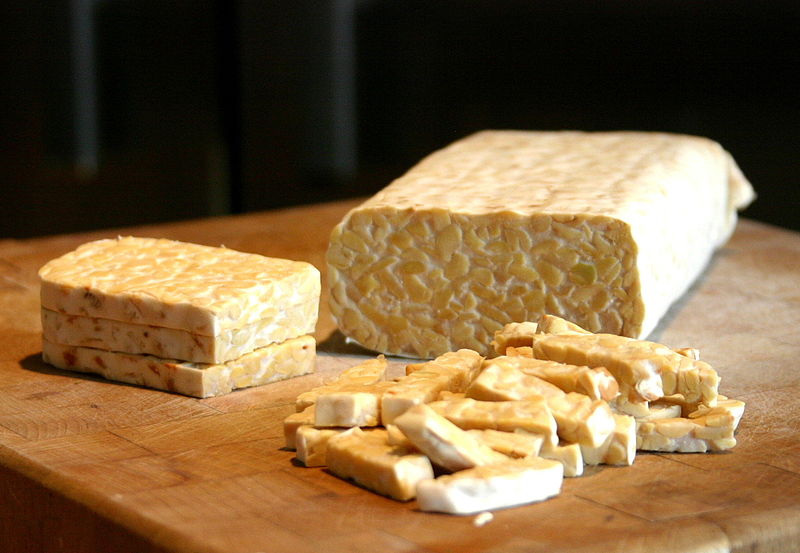
Tempeh image from Wikipedia.

Today, a guest post from Nancy Klehm, writing to us from Chicago, in the midst of an epic drought and heat wave. Here's Nancy:

A Drought of Inspiration

Until last week, we were at 12% of our normal precipitation for our eight month growing season. This, plus extreme temperatures, made us delirious when some humidity blew south from Canada and was sticky enough to grab ahold of some clouds and build them until they spilled rain. And yet, the GM soy is limp and the GM corn is dwarfed and tasseling weakly. The effects of which will impact all of us who shop and drive cars.

And frankly, we’ve been spoiled by the drought and heat – it’s always sunny and dry (just like L.A. and Phoenix!) no rain to spoil your bike ride, BBQ, or outdoor gardening. And the biggest benefit: No Mosquitos.

Put this in your bookmarks: US Drought Monitor droughtmonitor.unl.edu/

The rough side of our weather is obvious. Due to July temperatures in March immediately followed by appropriate, but ultimately harming coolness, we lost most of our tree fruit production. Local orchardists turned to growing supplemental vegetable crops. There are none or not many apples, Asian pears, peaches, cherries or plums this year. No pawpaws. What we are left with is heat-island city fruit, and shrub fruits of currants, gooseberries, black raspberries, blackberries, strawberries, elderberries, wild plums. But it is a okay pear year and I will be getting some American wild persimmons. Hubba Hubba.

And so I concentrate on the fact that this climate is prime to dry just about anything – and to fermenting my year’s supply of tempeh and the koji needed for my fall miso and tamari production.

I like to ferment passively, using the wide range of microclimates of my non air conditioned house. I have no uniform temperature control in my house, in spite of having a thermostat and I like it that way. It makes for a broad spectrum of air humidity and temperature that allows me to situate the different fermenting processes appropriately.

Tempeh: a passive ferment


Tempeh is a relatively quick ferment of 8-12 hours when temps are between 85-95 degrees. Tempeh is dang tasty. It is basically beans partially digested by and knit together with mold or as some would prefer to say, a ‘mushroom’ called Rhizopus oligosporus. Because it is fermented, it is a more highly nutritious and easily digestible soy form then is tofu or soy milk or the beans themselves. It is easy enough to make and relatively easy to jump the spore onto other substrates, i.e. experimental combinations of grains and legumes. The tempeh dance is easy enough and even easier to riff off of:

Soak selected beans and grains 24 or more hours for a primary fermentation, then under cook them (soft enough to bite, but not soft enough to enjoyably eat), drain and dry the beans/grains of residual moisture with a towel and allow to cool. Toss with the tempeh starter and a touch of vinegar and pack ½”-3/4” thick into ziplock bags that you have pierced holes through with a fork. Place in a dark place and allow the summer heat to do its job. Depending on atmospheric temps, this will take anywhere between 12 and 24 hours.

The tempeh is done when it is white and caked together with mold, maybe with some grayish or dark areas near the fork holes where the mold has started sporulation. Use or freeze immediately or the spore will keep running. Delish!

Next time: Koji.

My favorite, family-owned, tempeh spore source: GEM cultures.com

Barefoot Running With Ken Bob Saxton


Kelly discovered a barefoot running website, barefootrunning.com. many years ago. When she showed it to me I thought the idea was crazy. Then I had a series of running related injuries: plantar fasciitis, and arthritis in the knee. In desperation (I'm addicted to running) I gave going barefoot a try. The plantar fasciitis went away. Knee pain was greatly, but not entirely, reduced.

Old habits are hard to give up. When you spend your whole life in shoes it's difficult to adjust your running form. Thankfully, the proprietor of barefootrunning.com, Ken Bob Saxton, lives in Southern California and just so happens to give what he calls "play-fun-shops" at least once a month. Ken Bob doesn't believe in charging people to teach them how to run, so the play-fun-shops are free (and fun).

His message is simple--listen to what the soles of your feet are telling you, relax and keep your knees bent as you run. It's the knees bent part that was new to me. Ken Bob videotaped me running and then played it back in slow-motion. The video showed me running with straight knees, leading to heel striking. Heel striking leads to injuries.

The video above shows Ken Bob running with his distinctive bent-knee style (the music reflects his sense of humor). I gave the Keb Bob running style a try this Sunday and it was pretty amazing. I had less knee pain and I found myself booking along. It will take me some time to get used to, so I'm going to take it slow for a few weeks.

Bending the knee also, according to Ken Bob, applies to walking. I gave walking with a gently bent knee a try this morning too, and it seemed to help with the knee pain, particularly when going uphill.

I bought a copy of Ken Bob's book Barefoot Running Step by Step which describes his ideas in detail and has a chapter of drills to get the hang of the method.

Ken Bob travels occasionally and offers funshops elsewhere in the country--watch his calendar to see if he's coming your way. 

Even if you're not a runner, the barefoot running debate is a profound one in terms of the way in which technological or economic innovations (the production and marketing of complex running and walking shoes for instance) can have unintended consequences. Two quotes in Ken Bob's books neatly sum up this debate:
"I do think [barefoot running is] a fad. In fact, I don't think it exists; no one in my universe in eastern Pennsylvania runs barefoot. In terms of minimalist shoes and Vibrams--yes, possibly a tectonic shift there. But in terms of running without shoes, I don't see it." - Amby Burfoot, editor of Runner's World Magazine.

"If barefoot running is a fad, then it's a 2 million-year-old fad. From the perspective of evolutionary biology, I can assure you that running in cushioned, high-heeled, motion control shoes is the real fad." - Daniel Lieberman, Ph.D., Professor of human evolutionary biology, Harvard University.

Monday, September 10, 2012

California Homemade Food Act in Trouble


The California Homemade Food Act, AB 1616 would make it legal to produce non-hazardous foods such as bread and jams in a home kitchen and sell them. The bill is sitting on Governor Brown's desk awaiting his signature. Unfortunately, the bill is under attack by lobbyists who want to stop entrepreneurial opportunities for small businesses. The League of Cities is itself in league with these anti-small business lobbyists and sent out the following letter:
August 31, 2012

The Honorable Jerry Brown
Governor, State of California

RE: AB 1616 (Gatto) Food Safety: cottage food operations.
Request for Veto

Dear Governor Brown:

The League of California Cities respectfully requests your veto on AB 1616 (Gatto), which would require cities to issue permits to cottage food operations and require those operations to be deemed a permitted use of residential property for zoning purposes, local building, and fire codes.

While the League applauds the author’s attempt to encourage the growth of small businesses, this measure would single out these specific types of businesses for special treatment that other businesses do not receive. The League has a longstanding policy of protecting local zoning as a primary function of cities and an essential component of home rule. State policy should leave local siting and use decisions to the cities and not interfere with local prerogative. Unfortunately, AB 1616 would do just that by requiring local jurisdictions to either classify cottage food operations as a permitted use of residential property for zoning purposes or granting a nondiscretionary permit to use a residence as a cottage food operation. Given that this bill would allow businesses to be conducted out of the home, overall safety and particularly fire safety should be considered, but AB 1616 would deem these businesses residential for the purposes of the State Uniform Building Standards Code and local building and fire codes. This bill threatens to disturb neighbors that did not intend to locate their families next door to a business, deal with the traffic associated with a business, nor the smells that would permeate from a house. Local governments should be able to protect neighborhoods by regulating: hours of operation, the hours of on-site sales, inspections and advertising.

While many jurisdictions would welcome the opportunity to have cottage food businesses in their communities under the right circumstances, this bill wouldn’t give cities the ability to deny those operations permits and would limit the authority of cities to impose restrictions based upon health and safety considerations, such as the fire code. If the author could address the issue of local zoning by reintroducing this issue next year, then this legislation might have some beneficial policy effects.

We urge you to closely review the arguments we advance in opposition to this measure, and respectfully request that you Veto AB 1616.

Sincerely,

Kirstin Kolpitcke
Legislative Representative

Lark Park, Deputy Legislative Secretary, Office of Governor Brown
Gareth Elliot, Legislative Affairs Secretary, Office of Governor Jerry Brown
The League apparently wants to stand in the way of individuals, in a period of high unemployment, who want to start small businesses. We need to stop them. I urge you to take a moment and write a letter to Governor Brown saying that you would like California to join many other states around the nation that have made it possible to run a cottage food operation out of a home kitchen. Incidentally, many of those other states, such as Ohio, have far more liberal cottage food bills than the one proposed in California. You can write Governor Brown at:

Governor Jerry Brown
c/o State Capitol, Suite 1173
Sacramento, CA 95814

Actual letters are better than emails in this case. 

UPDATE: Good news! Governor Brown signed the bill into law yesterday, September 21, 2012.

See You At the National Heirloom Exposition in Santa Rosa


This week I'll be in Santa Rosa for the National Heirloom Exposition. I went last year and it was pretty amazing. This year looks to be even better. For the low price of $25 you get three whole days of some of the best agriculture and horticultural speakers in the world. Plus great vendors and cooking demos. Where Baker Creek gets the money to put this on is a big mystery to me, but I'm happy to enjoy the benefits.

I'll be camping and without interweb access, so I'll report back next week on what I learned. Hope to meet some Root Simple readers at the exhibition!

Sunday, September 09, 2012

Pictures Sundays: Bees Like Bikes


Kent sent this to me--a picture from someone named Scotty showing a bee swarm that landed on the seat of a bike at Venice Beach. Here's a closeup:


It's not the first time bees have taken to a bike seat in LA.

They also like minivans and motorcycles.

How do you capture a swarm? Watch this.

Saturday, September 08, 2012

Saturday Linkages: How to Wrap a Sari, Scotts Behaves Badly and America's Finest Bathrooms


DIY

Tea House in Santa Cruz Built of Recycled Wood

Bad Behavior

Scotts Miracle-Gro Fined $12.5M For Bird-Killing Pesticides | Inhabitat - Sustainable Design Innov..

And this article from MNN explains why Scotts poisoned the seed: http://www.mnn.com/earth-matters/animals/stories/judge-accepts-scotts-miracle-gro-guilty-plea-in-bird-seed-case

Dear Scotts: Just Try, One Time, Not to be So S***y. | Garden Rant

Your cellphone is a tracking device that lets you make calls:

The Unusual

Argentine Man Builds Giant Guitar-shaped Forest to Commemorate his Lost Wife | Inhabitat - Sustain..

America's best public bathrooms:

The history and science of meringue, from a new book by Linda K. Jackson and Jennifer Evans Gardner:

For these links and more, follow Root Simple on Twitter: