Happy New Year and many thanks to all of you for supporting this blog and contributing comments, suggestions and opinions. Thanks to all of you who have bought our book and thanks to our brave and innovative publisher Process Media.
We have one resolution for the new year: to tinker/experiment/garden/problem solve/explore and have fun doing all these things, laughing and learning from our failures as we go.

Wednesday, December 31, 2008


Sunday, December 28, 2008
Compost Outlaws
 Yard Trimmings being used as "ADC" at the Bradley Landfill in Sun Valley
Our neighborhood comrade Tara Kolla, who grows sweet peas for farmer's markets in her urban backyard, has been busted for . . . composting! Specifically for composting fruit and vegetable scraps from a local restaurant. From last Friday's Los Angeles Times:
Tara Kolla said she was doing a good thing for her Silver Lake Farms business while doing the right thing for the planet by filling a garbage can each week with produce scraps from a nearby restaurant and dumping them into her compost.It turns out it's against the law to compost material not generated at your own residence. So when you take back that bag of coffee grounds from Starbucks to put in your compost pile you're an outlaw. It's a law that benefits the status quo, where the the city and private contractors haul away all that perfectly good organic matter that could be nourishing our neighborhood gardens, parks, and street trees and stuff it in . . . the dump.
A neighbor did not see it that way and complained about the compost, which Kolla has in two wood boxes covered with black plastic.
"I didn't put it here to offend anyone. I put it here because it's a work area," Kolla said one morning as she showed a visitor her half-acre urban farm, where she grows flowers as well as some other crops to sell at farmers markets in Echo Park, Hollywood and Silver Lake.
In August, Kolla received a letter from the Los Angeles Local Enforcement Agency telling her to "cease and desist" composting food waste that was not generated at her home. The letter was signed by David Thompson, the agency's program supervisor, who declined to talk on the record. But a city spokeswoman said there would be no additional action taken if there are no more complaints.
There's a dirty little secret with what happens to the organic matter
The green bin is a sham, but it gets worse. According to Mayor Sam's Sister City, classifying waste as ADC "allows dump operators to escape paying State per ton fees which in turn are used for State recycling and enforcement programs."
There's a opportunity in this composting kerfuffle for an elegant solution. Anyone who gardens in the city knows how important, and sometimes difficult, it is to get enough organic matter. How about regional composting facilities? Instead of trucking organic matter from restaurants and yards to far-off dumps (and generating tons of diesel particulate matter on those long hauls), how about we compost it closer to home? We'll need skilled workers for this, perfect in a time of rising unemployment. This is precisely what our friend Nance Klehm does in Chicago, taking the waste from 6,000 daily meals at the Pacific Garden Mission and, with a large worm composting operation, turning that waste into prized worm compost which is sold at a farmer's market. The operation is staffed with homeless clients from the Mission. Waste is reduced, gardeners get compost, homeless people get work and everyone benefits.
Now let's change these silly composting laws and get to work . . .
[Editors note--Tara had a correction to the LA Times story--she does not "dump" stuff in her compost pile, but skillfully and responsibly layers green and brown materials. You can take a compost class from her at the Norman Harrington / Franklin Hills Community Garden. More information at Silver Lake Farms.]
Friday, December 26, 2008
A Tensegrity Table
 Tensegrities are an attractive structure that can be built with rods and string or wire. The term is Buckminster Fuller's combination of "tension" and "integrity", though Fuller probably did not invent the concept. Having seen a coffee table that used a tensegrity as a base, I decided to see if I could make a similar table, only out of scavenged materials (scavenging seems appropriate in these crummy economic times!).
 To make your own tensegrity table, molecular biomechanics professor Dr. William H. Guilford has some very nice step-by-step instructions here. My version is slightly different, but frankly Guilford's design is probably more stable. I used some electrical conduit tubing left over from remodeling the house, some rope and a stop sign that I found laying in a driveway (note the "anarchy" graffiti - is that "stop anarchy" or a pro-anarchy statement?). Putting the tensegrity together was a bit more time consuming and frustrating than I expected, but once I got my head around the geometry of the concept and learned how to tug the rope, my slightly wonky scrap tensegrity miraculously seemed to assemble itself.
 Tensegrities make a nice project for using up short scrap materials and can be stacked to form a tower. An example of a very tall tensegrity structure is sculptor Kenneth Snelson's "Needle Tower", installed at the Hirshhorn in Washington D.C. While more of a traditionalist when it comes to architectural forms, tensegrities make a nice addition to the Hoemgrown Evolution design vocabulary and I'm contemplating a tensegrity bean trellis for the backyard . . .
Thursday, December 25, 2008
3D Greetings
 Homegrown Evolution's holiday gift to our readers is a headache. Well, to be precise, we offer you three dimensional images of two of our favorite garden plants. Above, the prickly pear cactus (Opuntia ficus-indica) and, below, spearmint (Mentha Spicata). To view these two images in three dimensions follow these instructions, specifically the bit about "parallel viewing". Be persistent, like all good things it might take some practice.
 We taught ourselves how to free view three dimensional images a long time ago and, in additional to it being good for your eye muscles, it opens up a whole world of fun with old stereoscopic images such as these.
To make your own stereographs all you need to do is take two pictures slightly spaced apart. As long as your subject doesn't move you can do it with just one camera. Full instructions here.
For those of you who, after an hour of reviewing those parallel viewing instructions, now have a headache can't uncross your eyes, we suggest downing a few cups of eggnog to make things just fine in the new year.
Wednesday, December 24, 2008
Home Baked Bread in Five Minutes
 If you've bought our book, followed this blog, or gone to one our workshops you'll know that we tout a wild yeast bread recipe adapted from Nancy Silverton's La Brea Bakery method. We contend that our delicious recipe can be worked into all but the most crazed work schedule. But our recipe does rely on equipment and tools, specifically a heavy duty mixer and a wooden bread form. This month's issue of Mother Earth News has a bread making solution for those of you unwilling to make the investment in the mixer or unable to fit the long rise times of wild yeast bread into your work schedule.
The article, "Five Minutes a Day for Fresh-Baked Bread" by Zöe François and Jeff Hertzberg, explains their simple recipe. Combining just flour, water, salt and yeast, with no kneading, you make up a very wet dough, let it rise for two hours and then either bake it or stick it in the refrigerator. The dough keeps in the fridge for up to two weeks, taking on a sourdough flavor as it ages. When you want a loaf of bread you tear off a softball sized chunk, let it rise for 45 minutes and stick it in the oven. A pan of water in the stove creates steam and gives the bread a nice, hard crust.
We tried the basic white bread recipe in the Mother Earth article and can report that it works quite well. Hertzberg and François have penned a bread cookbook, Artisan Bread in Five Minutes a Day, that takes this basic recipe and uses it as the base for variations such as pizza dough, sticky rolls, and whole-wheat bread. While not having as rich a flavor as our wild yeast recipe, Hertzberg and François' method is an excellent solution for busy households. We look forward to seeing the book.
For more on the five minute a day bread method see:
Hertzberg and François' website, which has additional recipes and variations.
A youtube demonstration by the authors:
Friday, December 19, 2008
A Used Tire Hose Caddy
 Here's a cheap and easy way, using one of our favorite junk building materials--used tires, to keep that hose from trippin' you up in the back yard.
 Cut out the sidewall of one side of a tire using a sabre saw. You could use a sharp knife, but electricity makes this task a lot easier.
 You'll end up with the half cut out tire you see above. But your work is not yet complete.
 Drill a bunch of drainage holes in the bottom of the tire, at least one hole every three inches. This is to keep water from pooling when it rains. Incidentally, used tires combined with water make the perfect breeding ground for mosquitoes (more on the tragic global consequences caused by mosquitoes incubating in tires here). With a bunch of drainage holes you won't have a problem.
Got more used tires? See our used tire composter here.
Thursday, December 18, 2008
Bikin' in LA
When riding a bike in a city like Los Angeles I've come to the realization that it's best to cultivate a stoic, ninjaesque calm while squeezing betwixt the masses of cell phone wielding Neanderthals piloting their four ton land yachts. Unfortunately, I sometimes lose my temper. But over the past few years since I climbed back on a bike, I've discovered that it's best to brush off the inevitable indignities and pretend all those Neanderthals are rushing off somewhere important like, say, to save a drowning puppy or sing Christmas Carols at a nursing home.
The ethos I try to live by is: on the bike stay calm and enjoy the craziness of it all (it's like skiing with SUVs, after all), off the bike raise hell. And, as the bike path photo above from über bike activist Stephen Box's SoapBoxLA blog demonstrates, there's plenty to raise hell about with Los Angeles' terminal car-centric design. For me the issue ain't about bikes--I actually enjoy hauling ass through congested rush hour traffic on two wheels. Instead my off bike ire is more about two questions that, I hope, everyone will care about whether you ride a bike or not:
1. Can children safely walk or ride their bikes to school and thus avoiding becoming fat, Xbox addicted idiots. Or, do they have to go everywhere tethered to mommy and daddy in steel and glass bubbles never learning anything about independence.
2. Can elderly folks safely walk to a market, church, bingo hall without having to get behind the wheel of a car.
In Los Angeles and most of the rest of the country the answer to both of these questions is a big fat, obese NO! However, we're at a turning point here in L.A. The testifying and lobbying that we in the bike community have been working on has begun to pay off and, I hope, make life for everyone here better.
When folks talk to me about national politics I say, sure you should vote but it's the local that really matters. It's by speaking at city council meetings or just writing letters to local officials that we can make the changes to our world that need to be made. In the case of transportation, it doesn't matter whether you are right, left, libertarian or whatever. We all have the right to safe, inexpensive mobility no matter our age, race or income level. Tell your local officials!
To find out more about what's been going on in Los Angeles read:
Los Angeles Magazine's account of the local bike community
The recently revived SoapBoxLA
StreetsblogLA

The ethos I try to live by is: on the bike stay calm and enjoy the craziness of it all (it's like skiing with SUVs, after all), off the bike raise hell. And, as the bike path photo above from über bike activist Stephen Box's SoapBoxLA blog demonstrates, there's plenty to raise hell about with Los Angeles' terminal car-centric design. For me the issue ain't about bikes--I actually enjoy hauling ass through congested rush hour traffic on two wheels. Instead my off bike ire is more about two questions that, I hope, everyone will care about whether you ride a bike or not:
1. Can children safely walk or ride their bikes to school and thus avoiding becoming fat, Xbox addicted idiots. Or, do they have to go everywhere tethered to mommy and daddy in steel and glass bubbles never learning anything about independence.
2. Can elderly folks safely walk to a market, church, bingo hall without having to get behind the wheel of a car.
In Los Angeles and most of the rest of the country the answer to both of these questions is a big fat, obese NO! However, we're at a turning point here in L.A. The testifying and lobbying that we in the bike community have been working on has begun to pay off and, I hope, make life for everyone here better.
When folks talk to me about national politics I say, sure you should vote but it's the local that really matters. It's by speaking at city council meetings or just writing letters to local officials that we can make the changes to our world that need to be made. In the case of transportation, it doesn't matter whether you are right, left, libertarian or whatever. We all have the right to safe, inexpensive mobility no matter our age, race or income level. Tell your local officials!
To find out more about what's been going on in Los Angeles read:
Los Angeles Magazine's account of the local bike community
The recently revived SoapBoxLA
StreetsblogLA
Saturday, December 13, 2008
Making Beer in Plain Language
 "The move from a structuralist account in which capital is understood to structure social relations in relatively homologous ways to a view of hegemony in which power relations are subject to repetition, convergence, and rearticulation brought the question of temporality into the thinking of structure, and marked a shift from a form of Althusserian theory that takes structural totalities as theoretical objects to one in which the insights into the contingent possibility of structure inaugurate a renewed conception of hegemony as bound up with the contingent sites and strategies of the rearticulation of power."
-Guggenheim Fellowship-winning professor of rhetoric and comparative literature Judith Butler via the Bad Writing Contest
Huh? At least the terminology surrounding beer making ain't that obtuse, but it certainly could use some simplification. For novice home brewers, such as us here at Homegrown Evolution, the terminology creates an unnecessary barrier as impenetrable as a graduate school seminar in the humanities. Let's see, there's a mash, a mash tun, a wort, some sparging, malting, all the while specific gravities are measured and hopsing schedules followed. We've made beer using kits from a home brew shop and found the process relatively simple, but the thought of making an all grain batch (extracting our own fermentable sugars from the grain rather than using the extracted syrup in a kit) seemed intimidating. Thankfully comrades Ben, Scott and Eddie showed us how to do an all grain batch a few weeks ago. Here, in plain language and crappy pictures is how it works. To the possible horror of beer aficionados, we'll substitute plain English in the interest of encouraging more folks to try this:
 1. Slightly sprouted and roasted grains from a home brew shop (they've been sprouted and roasted for you) are soaked in hot water.
 2. Music, courtesy of Triple Chicken Foot, kills some time while the grain steeps.
 3. After soaking, the liquid is drained off and more hot water is added. The liquid pouring into the pot on the ground contains sugar from the grains.
 4. The extracted sugars are boiled with some hops for an hour.
 5. After boiling for an hour you cool down the liquid as rapidly as possible. Here comrade Ben uses ice and a coil of copper tubing with water from a garden hose flowing through it, to bring that temperature down.
 6. The cooled liquid is poured into a glass carboy and yeast is added. After a week or so this will be transferred with a tube into a second carboy. After about two to three weeks of fermentation some additional sugar is added (for carbonation) and the beer is bottled. After bottling I've discovered that it's best to wait for at least three weeks, to let the carbonation happen and the flavors mellow, before sitting down with a post-structuralist theory tome and popping open a cool one.
From the pictures you can see that brewing from scratch like this takes some special equipment. You can build these items yourself, or you can skip the equipment and brew with an extract kit from your local home brew shop with little more than a large pot and a carboy. Remember that if prisoners can make wine behind bars (recipe for prison "Pruno" here), we all can certainly make an acceptable beer in our kitchens.
For detailed info on how to brew beer and make your own brewing equipment see John Palmer's free ebook How to Brew.
Monday, December 08, 2008
December Homegrown Evolution Events
 Bread Making
If you're in the Southern California area, come on down to Good Magazine's splashy digs for a bread making demo we'll be doing on Monday December 15th at 12:30 p.m. We'll be showing how to bake our favorite wild yeast bread (in our book and on our website here). Come at 11:30 a.m. and catch our organic gardening pals at Silver Lake Farms do a talk on winter vegetable crops. Stick around for puppets! Good Magazine is located at:
6824 Melrose Ave.
Los Angeles, 90038
More info on Good Magazine's December events page.
 General Partying
On Thursday December 11th at 7 p.m. our publishers Process Media and Feral House are putting on a Winter Solstice Celebration at La Luz de Jesus Gallery, 4633 Hollywood Blvd in Los Angeles. We hear rumours of bonfires (not our book we hope!), Druids, "mystics and madmen, mulberry and mead." We'll just be hanging out, enjoying the festivities. Come on down and see us and get discounts on Process and Feral House books. Details here.
Friday, December 05, 2008
Talkin' Chicken
 One of the Homegrown Evolution Hens taking care of our termite problem last week
We're in the Los Angeles Times today "clucking" about chickens. We share mention with fellow Los Angeles urban homesteading bloggists Dakota Witzenburg and Audrey Diehl, who write Green Frieda. Witzenburg designed an amazing coop, complete with a green roof planted with succulents that you can see on Green Frieda here.
In other chicken related news, the December/January issue of Backyard Poultry Magazine is hot off the presses with a provocative article by permaculturist Harvey Ussery, "The Homestead Flock: Pets or Partners?" The article is not online yet, but you can read Ussery's excellent guide to keeping poultry here.
Lastly, poultry expert and author Christine Heinrichs, who we met at a recent poultry show, has an interesting post on her blog about the lack of genetic diversity in chickens.
Thursday, December 04, 2008
FEMA Plans for a Bar That Folds Into a Fallout Shelter
 Sometime back in the early 1990s I signed up for the Federal Emergency Management Agency's free home study course in radiological emergency management. Along with the text book and quizzes came a couple of plans for home built fallout shelters. Most of these shelters were what you would expect, underground cinder block cubes accessed through a trap door on your back patio. But one plan really stood out for its cocktail era inventiveness, a basement "snack bar" that converts into the perfect place to ride out Armageddon.
 Incoming missles? Just fold down the snack bar's false roof, toss in those cinder blocks and hunker down for a few weeks of endless martinis and canned cocktail wieners with five of your best friends. To help you prepare for the possibility of Kim Jong Il interrupting your holiday party (assuming you've got "5 man-days"), I've posted a pdf of the plans for this bit of FEMA genius here."The principal feature of this shelter is a sturdy wood overhead canopy which serves as a part of a pre-built snack bar in a basement recreation room. Consisting of three units hinged to the back wall, the canopy can be lowered to rest on the snack bar in an emergency.
In basements where the level of the outside ground is above the top of the canopy, adequate shelter from fallout radiation is provided for 6 people when the canopy is filled with 8" solid concrete block or brick.
The snack bar should not take more than 5 man-days to construct."

Incidentally, despite the 1960s vibe of this publication, it's dated 1980 and some of the other designs were kept up to date until at least 1990, proving that cold warriors kept up the fight late in the game. I wonder if FEMA had any nifty hurricane plans . . .
Sunday, November 30, 2008
Seaching for Seeds
 Old school seed searching: order assembler standing next to racks containing packages at the W. Atlee Burpee Company, 1943
It's never too early to start planning that garden. And towards that goal, Mother Earth News has created a nice custom Google search engine that scours over 600 seed suppliers. It's the perfect way to find those obscure plants and varieties not at the local nursery. The search engine even includes our favorite seed company, Seeds from Italy. You can test out this new tool here on the Mother Earth website, or on the right toolbar of Homegrown Evolution.
Now it's time to go plant some oca!
Now it's time to go plant some oca!
Friday, November 28, 2008
Do Something Day
 In honor of Buy Nothing Day, we present a memorable Craigslist ad found by our comrade, neighbor and art blogger Doug Harvey while looking for a refrigerator to replace the one that got fried in a freak electric storm the other night,
 "Never used, brand new 2008 GE Energystar fridge in original box. Blessed by his Holiness the Dalai Lama upon his last visit to Los Angeles, this fridge is sure to maintain the temperature and spiritual balance of all food. Due to health and dietary restrictions and my strict belief in the tenets of Mahayana Buddhist teachings, I asked his holiness Tenzing Norbu to bless the fridge upon his last visit. He guaranteed blessings and long life would be bestowed upon the fridge and the contents it protects. We have not used the fridge yet and unfortunately we need to move and can not bring the fridge with us. It is sad, but we are happy to give this spiritual appliance to another."At $1,500 Harvey passed over the Dalai Lama blessed "spiritual appliance" due to budget constraints and, no doubt, queasiness attributing supernatural qualities to an refrigerator. An ad for BMW takes this animist notion of consumer objects to the next level, simultaneously making fun of our obsession with consumerism and, in a kind of post-modern mental judo, using that perceived obsession to sell cars (a healthy dose of sex doesn't hurt).
 It's this type of hyper-consumerism that provokes a backlash from organizations such as Adbusters, the folks behind Buy Nothing Day. Yet, I wish that Buy Nothing Day was, instead, Do Something Day or, perhaps, Build Something Day. In our book and presentations we've distanced ourselves from the dourness of the environmental movement, preferring ideas to be presented in the positive rather than the negative, in the form of actions rather than protests. So rather than head to the mall today we propose learning an odd and useless task, say the feat of balancing on chairs.
 From Practical Projects for the Handy Man published in 1913,
Among the numerous physical exercises is the feat of balancing on the two rear legs of a chair while one foot rests on the front part of the seat and the other on the back of the chair. This may appear to be a hard thing to do, yet with a little practice it may be accomplished. This exercise is one of many practiced by the boys of a boys' home for an annual display given by them. A dozen of the boys will mount chairs at the same time and keep them in balance at the word of a commanding officer.So on this first Do Something Day, the crashing sound heard around the Homegrown Evolution compound this weekend will be the sound of a middle-aged eco-blogger falling over backwards . . . Now go out and Do Something!
Thursday, November 27, 2008
Busting open a Durian
Via Mark Frauenfelder over on BoingBoing, a trailer for Adam Leith Gollner's entertaining book, The Fruit Hunters:
Is their something about being an older white man of a certain age and exotic fruit? Mrs. Homegrown has become concerned about Mr. Homegrown dropping talk of durian into conversations at inappropriate moments of late. And look out Mrs. HG, because Mr. HG just heard about the Mimosa Nursery (thanks beer making Scott!), purveyors of exotic fruit trees here in Southern California. From my web research it looks like Mimosa has at least two locations, one in Anaheim and the other at 6270 Allston in Los Angeles. We're planning an expedition soon . . .
Is their something about being an older white man of a certain age and exotic fruit? Mrs. Homegrown has become concerned about Mr. Homegrown dropping talk of durian into conversations at inappropriate moments of late. And look out Mrs. HG, because Mr. HG just heard about the Mimosa Nursery (thanks beer making Scott!), purveyors of exotic fruit trees here in Southern California. From my web research it looks like Mimosa has at least two locations, one in Anaheim and the other at 6270 Allston in Los Angeles. We're planning an expedition soon . . .
Wednesday, November 26, 2008
End of Season Tomato Review
 Homegrown Evolution had ambitious plans to review each and every tomato variety out of the garden this year, but alas, we fell behind in our bloggulating duties and planted way too many tomatoes. So here, as "winter" appears in Southern California (it's raining, that's how you tell), we'll review what worked and what didn't work.
The tastiest tomato award goes to the Pineapple variety pictured above. Not only did this heirloom tomato have the best flavor, it was also the prettiest tomato we've ever grown, a brilliant yellow with streaks of red in the middle of the fruit when you slice it. And they're just about as big as a Cadillac Escalade. We saved some seeds and will definitely be growing these again next year.

The most productive, trouble free and productive tomatoes this year were plain old Romas and San Marzanos, both of which provided a summer of tomato sauce and enough extra fruit to do some canning. Two hybrid cherry tomatoes we grew in self watering containers, Sun Gold and Sweet 100 also did well. The Romas have the additional benefit of being fusarium wilt and verticillium resistant. It may be organic gardening heresy to say this, but hybrid tomatoes such as Roma are the best varieties for beginning gardeners to grow due to their trouble free and disease resistant qualities. The down side is that you can't save the seeds.
We also grew Syrian Giants, but unfortunately our Doberman Pincher ate most of them on late night raids. Perhaps because the Syrians grew in less than ideal partial shade conditions, they weren't that tasty. See also our earlier reviews of Banana Leg and Red Currant varieties.
 Most of the tomatoes were grown in cages made from concrete reinforcing wire (instructions on making tomato cages here) in raised beds with a drip irrigation system as pictured above. As an experiment for folks in apartments or with limited space, we grew a bunch of tomatoes in self watering containers on a strip of concrete next to the back wall of our garage (note crappy picture below). You'll see that we were too lazy to put the container tomatoes in cages--don't do this as you'll have a sprawling ugly mess! Nevertheless, the containers worked.
 So readers, leave some comments! Tell us your favorite tomatoes this season. Weigh in on the heirloom vs. hybrid issue. We're sure that forward thinking folks planning seed purchases for the spring would appreciate the advice.
Sunday, November 23, 2008
The New Home Economics

 So what is this simple, elegantly designed object? It's a bottle opener from Africa as seen on one of our favorite blogs, AfriGadget. Tough times call for elemental solutions, not to mention popping the cap off a beer.
And speaking of tough times and ingenuity, with our economy continuing to meltdown and unemployment on the rise (check out this youtube interview with author Nasim Nicholas Taleb and mathematician Benoit Mandelbrot for a real scare), we've begun to see sudden interest in the long forgotten topic of home economics. A good example of this new home economics is 30 bucks a week, the recipes and strategies of a couple in Brooklyn attempting to limit their grocery bills to, yes, just $30 a week.
But back to that African beer bottle opener pictured above. Yes, it exists in the context of poverty, but it's also a symbol of hope, of facing adversity with resourcefulness, a sense of style and play.
Thursday, November 20, 2008
A Used Tire Compost Bin
 There's so many damn used tires littering the sidewalks of this grungy town, Los Angeles should incorporate them into the city seal. Thankfully tires make a fine raw material for building projects and Homegrown Evolution has been experimenting with their many uses over the past year. This week we built a compost bin.


 Step one is to cut out the sidewalls. You might be able to do this with a sharp knife, but it's much easier with an electric saber saw. We used a knife to cut a slit to get the saber saw started. Once both sidewalls are cut out you just stack your modified tires up, fill it with compost, put a cover on it (we used a piece of scrap aluminum), and fetch a beer.
We'll post another tire project soon.
Tuesday, November 18, 2008
Homegrown Evolution at Environmental Change-Makers
 We'll be doing a talk this Thursday in Westchester (Los Angeles) at the monthly meeting of Environmental Change-Makers. But don't just come to see us! This event is at the Church of the Holy Nativity, which took out a lawn to grow food for the needy, an idea we'd like to see spread around the world.
The Church of the Holy Nativity is located at Dunbarton at 83rd St., (6700 West 83rd Street) Westchester 90045. The meeting and talk begins at 7 p.m.
More on Church of the Holy Nativity's amazing garden here.
Wednesday, November 12, 2008
Time Banking
 So what is money but an abstract representation of misery, time spent doing things we'd all rather not be doing? How about an alternative? How about taking all of our hard earned capital away from the Wall Street types? Get ready for time banking.
With time banking, you get together with your local community members, friends and family and exchange hours rather than currency. Time Bank USA describes the concept succinctly:
"For every hour you spend doing something for someone in your community, you earn one Time Dollar. Then you have a Time Dollar to spend on having someone do something for you."Time banking isn't defined as barter, so you don't have to pay taxes on services or goods exchanged. And time banking is egalitarian--everyone's hours are valued equally--an hour of digging a ditch is the same as an hour of legal services, or acupunture or whatever.
Homegrown Evolution met our local Echo Park Time Bank organizers Lisa Gerstein and Autumn Rooney last night at a joint appearance we did at Materials & Applications. Gerstein and Rooney, related to the audience a number of success stories from the time bank, such as how one busy woman was able to keep her cat after the time bank found someone to administer daily shots while she is at work.
With our economy in a tailspin, Time Banking has great potential. If there isn't a time bank in your area Time Bank USA has software and assistance to help you set up one.
Friday, November 07, 2008
Chickens in Chicago
Another gem from City Farmer News. Somehow it's a lot more fun to listen to someone else talking to city bureaucrats:
For more info on the law in your area, City Farmer News suggests checking City Chicken's list of chicken laws.
"Video by Chad Kimball. Raising Chickens In The City - Chicago Police Say NO. “Is it legal to keep chickens in the city of Chicago? Listen to conflicting information I receive from the police, the city clerk, and the legal department.”
For more info on the law in your area, City Farmer News suggests checking City Chicken's list of chicken laws.
Wednesday, November 05, 2008
Kitchen Alchemy
 "Those who believe civilization can be run according to different principles - humane, equitable, and collaborative ones - need to step forward now with concrete proposals and put ideals into practice."
-Daniel Pinchbeck
A Homegrown Evolution reader quite rightly scolded us recently for not writing enough about what people in apartments who can't keep gardens or chickens can do. It's our contention that all of the activities profiled on this blog are a kind of alchemy, symbolic gestures that ultimately lead to the kind of societal transformations that Pinchbeck writes about. These symbolic gestures need not be over sized, nor do all of them require land. Cooking homemade meals from scratch, as often as possible, is just the kind of alchemy one can practice anywhere you've got food and a source of heat. And what is cooking anyways, but a form of alchemical transformation? As luck would have it, we've had a number of visitors to our humble casa in the past week, Pinchbeck included (read his thoughtful Prophet Motive columns here). Two other visitors are cookbook authors. All share a common vision of positive change through personal and household actions.
 Ysanne Spevack moved to our neighborhood recently and has a really nice cooking website and blog at www.organicfoodee.com. That pumpkin bread she blogged about recently looks mighty tasty and we can't wait to try her buckwheat recipes recently featured in the Los Angeles Times. She has written a number of books, specializing in cooking with organic ingredients.
 We also got a visit from farmer and agriculturalist Shannon Hayes of New York's Sap Bush Hollow Farm. She's the author of two books on how to cook grass fed meat. Hayes is currently working on a book on what she calls "enlightened homemakers", touching on the kind of societal transformation that can occur when we change the way we run our abodes.
Lastly, there's a new online cooking school that has some mighty nice how-to videos and a free trial offer for 30 days. At Rouxbe.com we've learned a couple of nice tricks, our favorite being how the pros slice an onion. Very handy.
Now I've gotta stop blogging and make a pizza . . .
Tuesday, November 04, 2008
Action!
To those frustrated with national or even local politics, I say just get out there and do something. In the words of London's guerrilla gardener and author Richard Reynolds, "The point at which I became a guerrilla gardener is when I realized that I would get a lot more accomplished by just getting out there and doing it than phoning up the council and complaining about the landscape all around me." So skip those endless returns and watch a mini-doc of one of Reynold's actions:
Via City Farmer News.
Via City Farmer News.
Monday, November 03, 2008
Vote Yes on 2 (if you're in Cali)
 Homegrown Evolution ain't making any political endorsements regarding that little election thingy happening tomorrow, with the exception of California's Proposition 2, a measure that would, "prohibit the cruel confinement of farm animals in a manner that does not allow them to tum around freely, lie down, stand up, and fully extend their limbs." Whether you are left, right, center, libertarian, carnivore, vegetarian or none of the above we think this measure is an important first step in reforming appalling and unsafe agricultural practices that have become all to prevalent since the disappearance of family farms in the 1970s.
Does Proposition 2 address the underlying problems, i.e. bloated farm bills and agricultural policies that subsidize and incentivize large scale industrial farms? Is keeping chickens in big sheds with no sunlight ("cage free" and "free range") a good idea and will prop 2 take care of this? Sadly, no on both counts. But we've gotta start somewhere.
We were especially ticked off to see that University of California veterinarians, supported by our tax dollars (not to mention our past tuition dollars), have lent their support to the anti-prop 2 campaign alleging that removing animals from confinement will lead to disease outbreaks. Since these researchers get their funding from industrial agriculture, one can't expect anything but biased, junk science. Given the funding situation, it's also wise to view all extension service advice, even tips directed at home gardeners, with skepticism.
We'll be voting yes on 2 and, sorry UC, you'll never see any alumni contributions from us!
Thursday, October 30, 2008
Food Fight
 Homegrown Evolution readers in the Los Angeles area can catch a free screening of a new documentary by Chris Taylor called Food Fight on Saturday November 8th at 3:15 p.m. at the Mann Chinese 6 (6801 Hollywood Blvd.). Food Fight centers on the influence of Alice Waters founder of Chez Panisse, a Berkeley restaurant that pioneered the use of fresh, organically grown foods and what later came to be called "California Cuisine". In addition to Waters, Food Fight features interviews with food pundits Michael Pollan, Marion Nestle, Dan Barber and celebrity chef Wolfgang Puck. Homegrown Evolution viewed a preview copy and particularly enjoyed a segment on Chez Panisse's mercurial chef Jeremiah Tower and the quixotic attempt by congressman Ron Kind to reform the last farm bill. While the California-centric local food movement portrayed in Food Fight can easily be dismissed as an elitist lifestyle for the wealthy, (it ain't cheap to dine at Chez Panisse, any of Puck's eateries or shop at farmers markets) Food Fight makes the case that we all pay a hidden cost for cheap processed supermarket food, namely obesity, diabetes and a host of other nutrition related maladies.
For more information and to view a preview go to www.foodfightthedoc.com
Wednesday, October 29, 2008
Bisphenol-A

Above, the bisphenol-A or BPA molecule, a type of plastic found in all kinds of products including baby bottles, plastic food containers, Nalgene bottles, some wines (from the plastic stoppers and the lining of fermentation tanks) and the lining in metal cans. The U.S. Food and Drug Administration says it's safe, a viewpoint contradicted by at least 100 studies. The problem: BPA is a endocrine disruptor linked to a host of problems, according to some researchers, including cancer, obesity, childhood hyperactivity and the early onset of puberty in girls.
We've done our best around our little urban homestead to eliminate plastics from our lives, but where we still encounter BPA is in canned foods which we like to have on hand. Next time you pop open a can take a look at the inside--odds are there is a nearly invisible clear plastic lining which is where you'll find the BPA. So with BPA we have yet another one of those throw up your hands in disgust, anger and desperation moments at the supermarket. What to do?
Canning your own food is one good option. We started doing this last year and it's surprisingly easy. The Ball company's website can get you started on that project. Drying and pickling foods are other alternatives. Also, not all processed food manufactures use BPA. Eden Foods, available at health food stores, skips the BPA.
Separating industry sponsored junk science from government policy is another important, though much more difficult step. Within the means of each of us is developing our own scientific literacy as individual citizens. Read the studies, write your government representatives and fire up that hot water canning bath.
Monday, October 27, 2008
The Poultry Review June 1908
 For your reading pleasure we present the June 1908 issue of the Poultry Review, in its entirety, as a downloadable pdf here (via archive.org). Download a hi-res version of the Art Nouveau styled cover suitable for framing here. We picked up this obscure periodical at the American Poultry Association meet we went to over the weekend. Highlights of this issue of the Poultry Review include an article entitled "What Does it Cost a Year to Keep a Hen?"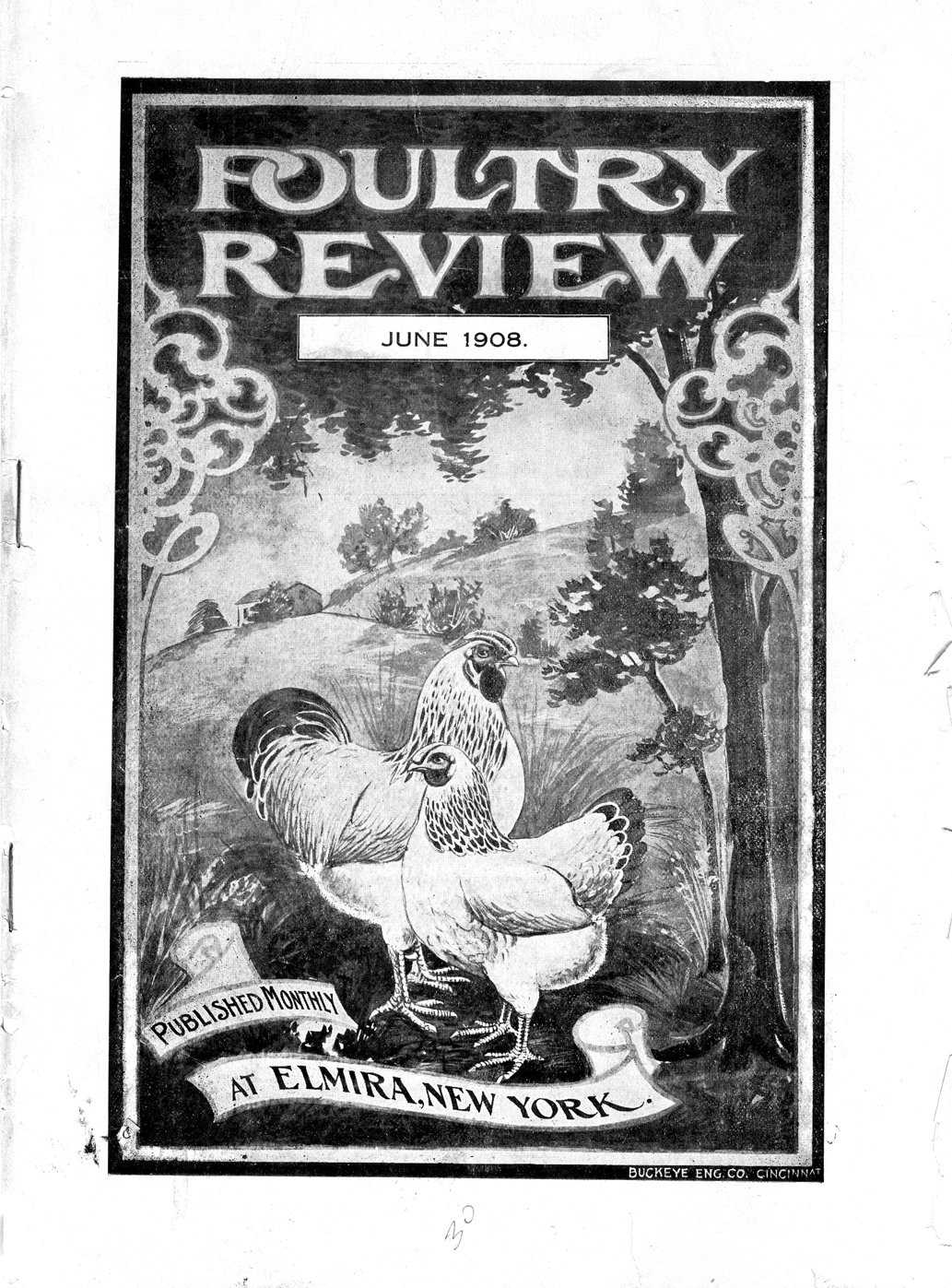
"What does it cost a year to keep a hen? This was the conundrum propounded to the chairman of the Committee on Agriculture at Washington a few days ago. The congressman who asked the question was in a facetious mood, and the question was greeted with ripples of laughter. But it is no laughing matter to several millions of people in the United States. It is a more important question to the poultry keeper than the cost of our army and navy, the amount of the river and harbor bill, or even the fate of our foreign dependencies."The article goes on to tell how the Boston Herald took up the question and offered a prize for the three best answers, a testimony to how many people kept chickens at the time.
For those tired of poultry, an ad in the back of the Poultry Review asks, "Are you Discouraged with Chickens? If so, try the Ginseng Business. It will pay you LARGER, SURER, PROFITS, requires very little land and the least amount of work of any crop grown. Sells for $6.50 to $9.00 a pound." Sounds like the $20 a pound Goji berries I saw at Whole Foods last week.
 Like many magazines and newspapers today, the line between the editorial department and the business end is a little vague. Poultry Review, in fact, seems to be a thinly disguised ad for the "Philo System of Progressive Poultry Keeping" developed by its editor as an intensive method of raising chickens.
Now, who can identify the chicken breed on the cover? Leave us some comments . . .
Saturday, October 25, 2008
So Much Poultry, So Little Time


Homegrown Evolution just got back from the American Poultry Association Annual Meet at the Ventura Fairgrounds. We know nothing about show chickens and we're too exhausted to blog coherently, so we'll let the pictures speak for themselves with just a few observations:
-If you don't want to bother raising chicks, a poultry show is a good place to start a flock and talk to some knowledgeable folks. There were quite a few chickens for sale at reasonable prices.
-Someone needs to put together an urban version of the 4-H club to bring urban agriculture programs to the inner city. Maybe it's already been done, but from what I've been told urban 4-H clubs are all about nutrition, science fairs, and maybe training guide dogs. Kids desperately need contact with nature and animals. Let's grow some food! But we may need to hippify the uniforms a bit . . .
-When the economy hits the skids people start thinking about keeping chickens. I spoke to the editor of the always informative Backyard Poultry Magazine about this phenomena. She said that she tries to tell people that you should keep chickens in good times and bad (amen!), but that when the economy tanks Backyard Poultry's circulation soars. We predict Ben Bernanke will put together a coop behind the Federal Reserve.
-And speaking of big things, Jersey Giants are bigger than the national debt.
Stay tuned for some scans of the June 1908 issue of the Poultry Review that we picked up at the meet.
Subscribe to:
Posts (Atom)