
Showing posts with label self watering containers. Show all posts
Showing posts with label self watering containers. Show all posts
Friday, October 19, 2012
A New and Improved Self Irrigating Pot System
A very cool improvement on the self irrigating pot (SIP) idea from Larry Hall of Minnesota. Rather than the two bucket system we've blogged about in the past (see a roundup of our SIP resources here), Hall uses one long rain gutter to supply water. He's even got a clever double rain gutter system for growing strawberries that I'm tempted to try on our back patio.
I spotted this video on Inside Urban Green always a good source for SIP related news.


Friday, June 01, 2012
A 3d Printed Self Irrigating Pot Yogurt Cup Insert

A really nice low-tech/high-tech hybridization here: a 3d printed insert that turns yogurt containers into small self irrigating pot. Creator, Carlynoram, describes the project:
This project is a 3D printed insert for a yogurt cup or any container that needs a new purpose. It turns trash into a self irrigating planter for kitchen herbs or flowers. Done in OpenSCAD, I tried to make it as parameterized as possible. Also, it should be able to print without support material in most cases.You can download the plans at: http://www.thingiverse.com/thing:22978.
Apparently this project was inspired by a demo we gave at the innovative Crash Space in LA. We're proud to have prompted this project and wish Carlynoram the best of luck in refining the design.
Wednesday, May 23, 2012
World's Largest Chard Grows in SIP

The story of SuperChard:
Its origin is unknown. It might come from Bountiful Garden seed, or perhaps Franchi.
It volunteered in a corner of one of our backyard beds, in a bed we were resting. We didn't water it. It grew all summer long anyway, despite having no rain at all. In fact, it grew huge and lush. We never harvested it, though, because it was growing in our lead contaminated soil. So we continued to ignore it and it continued to thrive.
It sucked up the winter rains and grew even bigger. Then, early this spring, as part of our whole "dealing with the lead" problem we tore out the two raised beds in Lead Central in order to dig out the clay beneath them to make adobe bricks. By this time SuperChard was so magnificent I couldn't kill him (around this time I began to anthropomorphize the chard), so I trimmed off his outer leaves (some of which were as long as my arm) and transplanted him into a self-watering container (SIP).
I knew that transplanting such a big, established plant would be difficult, but by this time I really wanted to harvest this plant's seed. So I told him that I wanted to preserve his genetic legacy--what plant doesn't want that?--and praised his beauty, and babied him through the transition.
SuperChard adapted beautifully to life in a container and quickly grew back to full size. We took him with us to our various gigs, both to show people what a SIP was and to blow their minds with the beauty of chard. I wish I had a pic of SuperChard in full leaf. In the photo above all his energy has gone into the flower, so the leaves are a sad shadow of their former glory. Basically, SuperChard used to look like an exotic, pampered tropical plant. One that did not mind rattling around in our hatchback and getting dragged all over tarnation.
Chard reproduces in its second year, and SuperChard's time has come. He began to bolt with our first heat wave and has sent up a huge flower spike. He drinks like crazy to support the SuperSpike--so we fill the SIP reservoir daily.
I'll be sad to say goodbye to SuperChard, but I will be collecting his seed. And I do believe we will have to keep our promise to him and spread his genetic diversity far and wide by sending his seed across the country to be stewarded by our readers.
Watch out for a seed giveaway later this summer.
Tuesday, September 06, 2011
SIP Improvement
 |
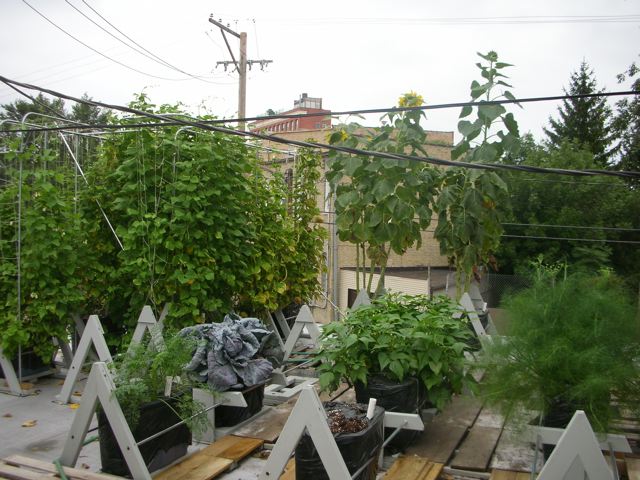
| Tomato SIPs on the Chicago rooftop of the Green Roof Growers |
With tomatoes, you need to lay down a layer of high-quality landscape cloth (don't use the cheap stuff) to keep the tomato's roots from getting into the water chamber. You run it from the bottom of the bucket all the way up to the top of the soil line. If those roots get to the water chamber, your tomatoes will end up tasteless and watery. As long as you lay down the cloth and keep the SWC full, use good potting soil, fertilizer, etc. - you will have some damn good tomatoes, and plenty of them!I'd also recommend growing smaller tomato varieties in SIPs.
If you're using SIPs this season, leave a comment and let us know how it went.
Friday, June 17, 2011
Rooftop SIP Garden in LA

Got to visit John Zapf's vertiginous LA compound yesterday. He's got an amazing rooftop vegetable garden using self irrigating pots. John has little sun in the yard so the roof is only option for veggies.

He uses drip line to refill the reservoirs. Reminds me of the Green Roof Growers of Chicago (minus the extreme weather).
His two cents on what to grow: chard good, zucchini good, corn in pots not so good.
For more info on self irrigating pots on Root Simple click on the label for this post below.
Friday, November 12, 2010
Skid Row Community Garden Gets SIPs

Two master gardeners, Anne Hars and Maggie Lobl asked me to show them how to put together some SIPs (read more about what a SIP is here) for the Los Angeles Community Action Network, which works with homeless and low-income residents on skid row. Hars, Lobl, myself and a bunch of folks from LACAN put together a few SIPs and planted vegetables on the LACAN rooftop. The plants are thriving in a space where previous attempts at container gardening met with mixed success.
Gardening, like all the ways we humans interact with our surroundings is all about context. If you've got soil, as I'm lucky to have, work with that first. But if you have only a sunny rooftop or balcony and/or limited gardening experience SIPs are a great tool. They almost guarantee success, which is encouraging for people who have never gardened before.
Read Jeff Spurrier's article about the LACAN SIP garden in the LA Times, "Skid Row Community Garden: bounty by the bucket."
Tuesday, August 10, 2010
Rooftop Garden Classes
 Homegrown Neighbor here:
Los Angeles has sprouted a very cool rooftop garden. Here where January temperatures are often in the 70's, buildings aren't designed to hold snow, meaning that our roofs usually can't hold much weight. So rooftop gardens are rare.
But on the border of Little Tokyo, skid row, and a warehouse district, an old seafood warehouse rooftop has been turned into a gourmet garden atop the home of artisan food purveyor Cube Marketplace.
Full disclosure: I'm the lucky gardener. And this weekend I'll be teaching a Fall Gardening Class and a class on new ways to use common garden herbs. For more information or to sign up for the classes click here.
 The classes are part of a quarterly pop-up marketplace. Even if you don't want to take the classes, this is an opportunity to come and check out the garden. I love watching the bees pollinate the flowers and then looking out at the view of Downtown Los Angeles and the industrial sprawl down below. It is delightfully incongruous.
Sunday, August 08, 2010
Self Irrigating Pot Patent from 1917

I've often blogged about the convenience of self irrigating pots (SIPs), containers that have a built-in reservoir of water at the bottom. They work well for growing vegetables on patios and rooftops. You can make your own or purchase one from several manufacturers. I had thought that Blake Whisenant, a Florida tomato grower and Earthbox company founder, had invented the SIP in the 1990s, but it turns out that the idea came much earlier. Reader Avi Solomon, sent me a surprising link to a patent for a SIP, dated 1917, by a Lewis E. Burleigh of Chicago. From the patent description:
"My invention is concerned with flower and plant boxes, and is designed to produce a device of the class described in which the proper moistening and aeration of the soil in it can be easily and cheaply effected by simply pouring water into the funnel with which it is provided until the proper amount is supplied, which amount will be indicated by the overflow from a suitably located aperture in the side thereof."

Other than the use of gravel in the water reservoir, Burleigh's SIP closely resembles the Earthbox and SIPs I have built out of five gallon buckets and plastic storage bins.

The interwebs reveal only one detail about Burleigh, that he owned a house designed by Frank Lloyd Wright. From this one factoid I infer that he had money and a progressive inclination. The SIP idea took another eighty years to finally catch on.
For more SIP information:
Read our many posts on SIPs
And visit our SIP gardening friends, the Green Roof Growers.
If SIP litigation history fascinates you, read a preliminary injunction and memoradum (pdf) between the manufacturer of the Earthbox (Laminations Inc.) and a company they accused of infringing on their patent, Roma Direct Marketing LLC, makers of the "Garden Patch." SIP. I'll also note that the Earthbox folks sent Josh Mandel a cease and desist letter related to Mandel's DIY SIP website. My editorial: lets make the SIP open source as the 1917 patent suggests it ain't a new idea.
Tuesday, July 06, 2010
Vertical Vegetables

Frederick Law Olmstead's office has a 19th century "vertical garden." Vines!
I was somewhat dismayed to see a local newspaper article touting a company that sells a $1,000 vertical vegetable garden system to schools. The company has a plan to sell this system nationwide. The problem is that I have serious doubts about the long term viability of vertical garden walls for a number of reasons: irrigation, maintenance and start up costs just to name a few. And I'm not alone. The New York Times did some critical reporting on the subject of vertical garden systems in a recent article, "Gardens That Grow on Walls."
For certain plants vertical growing might work. I haven't tried it, but this DIY vertical succulent garden in Sunset Magazine certainly is striking. But vegetables? Their roots need space and you'd need to do a lot of watering to keep a vertical vegetable wall happy.

 But growing vertically does not have to mean attaching roots to a wall. I can think of two simple vertical vegetable garden strategies where that $1,000 would go a lot further. How about simply favoring fruits and vegetables that either grow vertically naturally, say pole beans, grapes, peas or kiwi or that can be convinced with a bit of pruning to go vertical, such as tomatoes, melons and winter squash? Mel Bartholomew has some nice vertical gardening tips in his classic book Square Foot Gardening: Grow More in Less Space!
 . Build some raised beds next to a wall or saw cut out the concrete, plant in the ground and you're in business.With some slings for the fruit, you can even grow watermelons vertically.
 Alternately, buy or make some self irrigating planters (SIPs) and put them next to a wall. See the Green Roof Growers for what can be grown vertically with SIPs made from scavenged five gallon buckets. Or you can buy a commercially made SIP kit from the Earthbox company
 for around $50. The nice thing about SIPs is that they are fairly idiot proof and easy to maintain. A SIP is as close to "plant and forget about it" as you can get with vegetables. In short, perfect for schools where maintenance is always an issue.
As one of the vertical wall landscape designers admitted in that New York Times article, “in nature, you don’t have vertical dirt.” Why fight nature?
Wednesday, January 20, 2010
That ain't a bowl full of larvae, it's crosne!
 Mrs. Homegrown, justifiably, gives me a hard time for growing strange things around the homestead. This week I just completed the world's smallest harvest of a root vegetable popularly known as crosne (Stachys affinis). Crosne, also known as Chinese artichoke, chorogi, knotroot and artichoke betony is a member of the mint family that produces a tiny edible tuber. While looking like any other mint plant, the leaves have no smell. The tubers look all too much like the larval form of the Michelin tire mascot and have the taste and texture of a Jerusalem artichoke.
 Crosne on left, actual larvae on right
 What happened to the larvae on the right after the photo shoot?
 What crosne leaves look like
 Self irrigating pots, post crosne harvest
Undaunted, I planted two self irrigating planters made from storage bins with about twelve or so tubers. Throughout the year the foliage was lush and finally died back in late November. It was really easy to grow, just like any other mint. It grew to about 1 1/2 feet and never produced flowers. I'm sure in wetter places it would be invasive. I spoke to Alex at the market again in December and he told me to pull the tubers out around Christmas. Alex was right, I didn't get a very big crop--LA is probably not the best climate for this plant. No crosne banquet this winter. But I did get enough to make a jar of pickles with.
 I feared that it would be as hard to clean as Jerusalem artichoke, but a few blasts of the garden hose took off most of the dirt. French folks cook crosne in butter. I decided to pickle them in white vinegar using a recipe for Jerusalem artichoke. The recipe I used was a little too heavy on the mustard, otherwise I'd pass it on. The addition of some tumeric gave the pickles an appealing yellow color. I've been tossing them into salads to the horror of Mrs. Homegrown, who is not a fan of my crosne pickles.
Eric Toensmeier, author of Perrenial Vegetables has a YouTube tour of his garden where you can see how he grows crosne. Toensmeier interplants it with other root crops that mature at the same time, so you get a mix of things at harvest.
The Plants for a Future entry on Stachys affinis has some nice information on how to grow it.
Wednesday, December 30, 2009
Edible Rooftop Gardens
 Homegrown Neighbor here:
As long as we are asking our readers for ideas, I have a few projects I could use your help on as well. I am looking for an edible rooftop garden to visit. Ideally it would be in Southern California, but I may also visit Austin, Texas. So either L.A. or Austin gardens would work. I'd love to hear from anyone who knows of a great rooftop edible garden, but I'd really like to find ones that I can visit.
The picture here is of an urban farm in Chicago that I visited this summer. It isn't on a roof, but it is smack dab in the middle of the city and was pretty impressive.
And since I may be visiting Austin, I'd like to know of any cool projects or people I should visit there. Anyone who brews beer, builds bikes, does some serious composting, is an urban farmer or raises chickens would be great. And I'd love to see some community gardens. So Texas, I want to hear from you.
Thanks,
Homegrown Neighbor (Lora)
Homegrown Neighbor (Lora)
Saturday, November 14, 2009
Events in Los Angeles This Weekend: SIP Workshop and Maria's Garden
 Saturday (i.e. TODAY!)
On Saturday November 14th Kelly and I will be doing a Self Irrigating Pot (SIP) workshop in Westchester at 3 p.m. SIPs are a great way for folks in apartments to get into small scale vegetable gardening. Best of all the workshop is FREE FREE FREE! Here's the location:
Playa Del Oro at 8601 Lincoln Blvd, Los Angeles, CA 90045
 Sunday
Anne Hars, who lives a few blocks from us, helped save another neighbor's garden from a management company that wanted to remove it. Tomorrow, Sunday the 15th, Anne has organized a work party to tidy up the garden and she's looking for volunteers and a few donations of pots, mulch and soil. The fun begins at 9 am at 421 North Coronado Street.
"This is a great opportunity to help a Senior Citizen in need and spend the day puttering around in the garden! We need people of all skill levels from beginners to experts. Landscape Designer Maggie Lobl has kindly worked out a design approach and will help co-ordinate activities."For more info see Anne's website.
Sunday, August 02, 2009
Hops in Containers
 This spring I set out to answer the question, "can hops be grown in self-irrigating pots?" Answer, as you can see from the photo above: YES! For those of you not familiar with Self-Irrigating Pots or SIPs we have an earlier post on the subject.
 Hops rhizomes, planted April 9, 2009
 Nugget on the right, Cascade on the left
 Hops farmers in England demonstrating why you need to think about trellising.
The SIPS are full of potting mix with a ring of organic fertilizer placed on top of the soil as specified in Josh Mandel's directions. I have periodically added an organic liquid fertilizer to the water reservoirs as hops need a lot of nitrogen.
 Cascade cones almost ready to harvest in late July
I don't know how my hops will do in SIPs the second year, and I'm considering planting them in the ground if I can find a suitable place. I suspect that hops are a good candidate for pairing with a greywater source and I'm thinking about ways to do this.
Now that I've grown hops, I'm tempted to go to the next level. The local Rite Aid? How about we replace it with a field of barley? I'm anxious to swing a scythe again.
Stay tuned for info on a hops growing workshop with Boris Price and the folks at Silver Lake Farms to be hosted at the Homegrown Evolution compound this month. Look for the announcement on our blog this week.
Thursday, May 21, 2009
Taters and Cool Season Veggies from the Original GRGers
Got to hang out with Chicago's amazing Green Roof Growers yesterday. More on that when I get back. But, just wanted to share GRG operative Bruce F's non-roof based potato  growing experiment.
Also, check out GRGers Heidi and Art's rooftop cool season vegetables which I had the good fortune of tasting.
 growing experiment.
Also, check out GRGers Heidi and Art's rooftop cool season vegetables which I had the good fortune of tasting.
Sunday, April 05, 2009
Self Irrigating Planter Resources
 Homegrown Evolution is up in San Francisco this weekend to do a talk about the world of self-irrigating planters (also known as SIPs or self-watering planters or a couple of other variations on that general verbiage). In our opinion SIPs are the food growing tool of the aspiring urban agriculturalist. Make or buy one of these things and vegetable container gardening is a breeze. No need to water your pots three times a day during the summer! For those who can't make our talk, and as a resource for those who can, we thought we would put all the Internet resources in one place in this here blog post.
SIP hacker and horticultural Internet hero Josh Mandel's original pdf instructions for how to make your own.
Mandel's revised instructions with thoughts on how to eliminate the use of PVC plastics when building a SIP.
Where to buy a SIP: earthbox.com. Even if you build your own, you should follow the Earthbox company's user guide for how to fill the box, what kind of soil to use and how to fertilize.
For a nice example of rooftop and window gardening with SIPs see the Green Roof Growers of Chicago.
How to make a small SIP with soda bottles. Here's another variation with conventional pots.
Last night we went to a wonderful screening organized by the folks at How to Homestead. They have an interesting SIP variation made with milk crates profiled in a how-to video by Mariana Lopez. She also offers a recipe for a DIY potting mix in that same video.
Ohio State University Extension Service's list of vegetable varieties for container gardening. These are varieties with smaller root systems that do well in small pots.
Lastly, all of Homegrown Evoution's self watering container posts.
Tuesday, July 08, 2008
Terror of Tiny Town
 The Homegrown Evolution in-box overfloweth this week with news of the cute and the tiny. Yesterday's post about our miniature Red Currant tomatoes prompted Bruce F of Chicago to inform us that he's working on the world's smallest kale plant. He's growing them in self-watering containers made with old pop bottles (more info on how to make a pop bottle self-watering container here and here). These pop bottle containers look like they'd work well for starting seeds, as they provide a constant source of water.
Nance Klehm, another intrepid Chicago resident, informed us that someone just gave her two bantam chickens for her backyard, the perfect compliment to her chihuahuas. Some say that bantams are better for smaller backyards due to their diminutive size. Readers with bantam experience please let us know what you think about keeping bantams vs. normal chickens as we only have experience with SUV sized poultry.
The photo above is, incidentally, a scene from Werner Herzog's brilliant and inexplicable film "Even Dwarfs Started Small".
Monday, May 12, 2008
More on that nice rooftop garden . . .
 Bruce F. the creator of that nice rooftop garden we featured last week dropped us a note to say that he kept a diary about the process that you can read here, via the Daily Kos. Bruce also mentioned a few other interesting links:
Humanure Composting via Feral Scholar
A fiery essay, The Politics of Food is Politics via Counterpunch
and A 35-Point Practical Guide for Action by Bruce himself
Thanks Bruce F! And we'll be back soon after we recover from our weekend trip to the emergency room (kidney stones--ouch!).
Saturday, May 03, 2008
Holy Crap! What a Nice Rooftop Garden!
 Photo by antifa123
Check out how these enterprising Chicagoans responded to the "but I don't have room for a garden" argument via antifa173's informative rooftop gardening Flickr set. Not only do you get to see their beautifully designed self-watering container system, but they tell you how to do it with detailed instructions!
Saturday, February 23, 2008
How to Homestead
 Homegrown Evolution's Self Watering Container video is up on the brand new site How to Homestead, described by its creators as:
 "the only site on the web providing you with a collection of how to homestead videos to stream or download. No longer relegated to the rural sphere, homesteading can be done anywhere and we are here to show you how."With many homesteading activities, from chicken slaughtering to tortellini making, internet based video is a useful resource when you don't have a friend or relative to show you a skill first hand. Kudos to the How to Homesteaders and we look forward to future episodes on this nicely designed site.
To celebrate the launch of howtohomestead.org, director Melinda Stone will be presenting an evening of short films and performances about self-sufficiency and sustainable DIY activities at San Francisco's ATA space, located at 992 Valencia Street on March 29th at 8:30 p.m. For more information on this screening see www.othercinema.com.
Wednesday, July 25, 2007
A Self-Watering Container in a Pot
 The serendipitous discovery of two three-gallon margarine containers behind a dodgy local bakery has led to the yuppification of our self-watering container (SWC) garden. We posted earlier on how to make these handy containers, which have a reservoir of water at the bottom that keeps the soil at a uniform moisture level. We also made a video about them that we're amused to report has been "favorited" on Youtube by pot growers.
You fill SWCs up via a pipe and they can go at least a week between waterings. It is, in our opinion, the only way to grow water-needy vegetables reliably in a container. We have used them to successfully grow eggplants, tomatoes, collard greens and blueberries (note to the DEA: no cash crops at the Homegrown Revolution compound!). With our backyard looking fairly ugly this summer we've backpedaled on our earlier strident post about how we don't care if our patio looks like a methamphetamine lab, and have dressed up one of our SWCs.
Here's how we did it:
 First we stuck our three gallon self watering container inside of a large pot we had sitting around.
Next we filled the SWC with potting soil (note: you must use potting soil in a SWC). We filled the void between the SWC and the pot with rocks.
 We used a plastic garbage bag as a mulch layer to help hold in the water.
 A bag full of small river rocks provides an attractive cover to hide the plastic. Slice a hole in the plastic mulch layer and the pot is ready for planting.
Subscribe to:
Posts (Atom)