Showing posts with label composting. Show all posts

Monday, October 01, 2012

What Are Your Favorite Compost Materials?


Root Simple's new composting game for your Xbox!

I wish I could source compost pile materials from our yard. But lead and zinc contamination in our soil make that a dodgy proposition without doing a lot of expensive lab tests. And I never seem to have enough materials even for our modest vegetable garden. So in the past I've used:
  • horse bedding
  • chicken manure from our own chickens
  • alfalfa hay (kinda spendy these days)
  • straw (takes a long time to break down)
  • spent grain from a local brewery
  • vegetable scraps from the farmer's market
Once again I've got to build another pile and I'm interested in hearing from readers about compostibles you've used. Do you have a good source for stuff to compost? What are some of the things you've managed to scavenge? Comments!

Tuesday, September 18, 2012

Tips on Composting from Will Bakx of Sonoma Compost

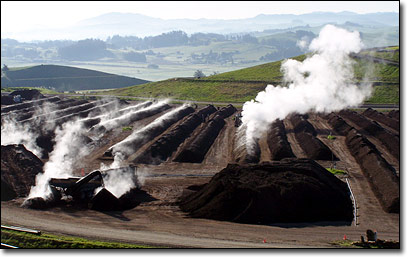
Sonoma Compost's composting operation.

On Thursday at the National Heirloom Exposition, Will Bakx, soil scientist and operations manager of Sonoma Compost, gave a rapid fire lecture on the nitty gritty details of composting. Here's some of his useful tips:

Temperature and Turning
Compost should stay above 131ºF for 15 days to kill pathogens. Bakx recommended getting a thermometer to check the temperature every day during the initial period and using Sonoma Compost's handy Temperature/Turning Sheet (pdf) to keep track of the temperature of the pile. If the pile dips below 135ºF, turn it. If it doesn't get up to temperature, add more nitrogen containing materials. If it gets above 163ºF, add more carbon containing materials. After the initial turnings just let it sit unless you have to turn to add moisture.

Bakx believes that you should turn as little as possible, just enough to achieve that first period of 15 days above 135º F. I really like the simplicity of this method and will definitely use the turning sheet the next time I build a pile. I really makes it clear when you should turn and how often.

Moisture
Lack of moisture, according to Bakx, is the number one mistake made by beginning composters. He suggested an ideal moisture range between 40-­‐60%. You can check the moisture level using the following technique:
Take handful of material. Squeeze firmly
Water escapes: >60%
Shiny ball: 55%--60%
Ball remains when tapped: 50--55%
Ball falls apart when tapped: 45--50%
No ball forms: 40--45%
Unless hand feels powdery dry: <40 p="p">
Bakx has drip irrigation set up on his large windrows, something I might try with my pile the next time.

Pile Size
The mimimum size for a compost pile is 3 x 3 x 3 feet or larger.

Things not to add
  • Ash--our soils tend to be alkaline in California and ash will raise pH. A small amount is ok.
  • Cardboard--Bakx is afraid of the glues and said that he is very conservative about what he ads to his compost.
  • Toilet paper--because of metals (I've been unable to verify this--if any of you know about this issue, please leave a comment.
Alleopathic plant material such as eucalyptus leaves and walnut leaves, on the other hand, are ok to add. Bakx cited studies where plants were successfully grown in leaf litter made entirely out of eucalyptus leaves. He suggested keeping such alleopathic material to less than 15% of the pile.

Web links
Sonoma Compost's website: www.sonomacompost.com
Sonoma Compost's Simple Guidelines to Composting (pdf)
Sonoma Compost's Temperature/Turning Sheet (pdf)
An online carbon/nitrogen ratio calculator

Friday, September 07, 2012

Comopost, Compost, Compost


As if I didn't need a reminder of how important compost is to a vegetable garden, note the tomato above. It's on its way out, but it grew with no supplemental water in hard-packed clay soil contaminated with lead and zinc in a hot side yard. Why did it do well while the rest of my vegetable garden did not do as so good this summer?

Homemade compost.

I didn't have enough compost for the rest of the veggie garden so I bought some at a nursery. The homebrew compost obviously had much more life in it. 

And life is the point. Soil is a living thing. Plants, particularly vegetables, need microbial life to thrive.

For more on the importance of microbial life read the USDA's soil biology primer written by Dr. Elaine Ingham.

Friday, August 17, 2012

Does the scent of compost make bees angry?


I think I've stumbled upon a strange phenomenon: the smell released by turning compost pisses off bees. Yesterday was the third time this has happened to me. I took a sting just underneath my eye and another one to my right hand when I was turning a pile located about 15 feet away from a hive. Coincidentally, the same thing happened to a friend yesterday: he got stung while working with compost near a hive. Ordinarily our bees are reasonable about living in a small yard with humans--they are not even very aggressive when I open their hive. But apparently turning compost near them is a different matter.

I look like I've been in a fight. Lots of Benadryl today.

I have a theory. Bees are incredibly sensitive to odors and use them to communicate. Their alarm pheromones alert the hive to predators such as bears and people. Bee alarm pheromone consists of many different compounds. Interestingly, a lot of these compounds such as n-Butanol and Isoamyl acetate are byproducts of fermentation processes. I'm guessing that a number of these compounds are present in compost, and that when you turn a pile the act releases a cloud of compounds that mimic the bee's alarm pheromones, causing them to attack.

It turns out that other lifeforms like to mimic honeybee alarm pheromone. Some species of orchids mimic bee alarm pheromone in order to attract pollination services. Small hive beetles, who raid beehives for their pollen, apparently bring with them a yeast that causes a fermentation process that mimics alarm pheromones. The small hive beetle's fermented alarm pheromone, in turn, attracts more small hive beetles who quickly overwhelm the hive. These sorts of deceptive, symbiotic and parasitic loops in nature really amaze me. 

As a side note, I've only had compost pile related bee stings at this time of year, when honeybee numbers are at their peak and pollen and nectar sources are getting scarce (summer is hot and dry in Los Angeles and not much is blooming).

If you don't have a hive, I doubt random, foraging worker bees would go after you if you are just turning compost in your yard. But if you've got a compost pile and are thinking about installing a hive--or vice versa--I'd seriously consider keeping the two as far apart as possible.

Am I alone in noticing this compost/bee alarm pheromone issue?

Wednesday, June 27, 2012

Composting at the NATO Protests in Chicago


Have you ever gone to a concert or a convention or some other large event and marveled at the staggering amounts of waste generated? I've been particularly wishing more of that waste was composted. And what do you know? Just as I was thinking about this, guest Root Simple blogger Nancy Klehm happened to send me a post on this very subject. If only every event had a compost tsar! Here's Nancy:

I am obsessed with urban soil health, so when I got a phone call in mid May from Steven of the Seeds of Peace Collective, I realized a soil ship had floated in. Seeds of Peace is a collective of accomplished cooks and trained street medics, based in Missoula, who provide delicious home cooked food in support of non-violent social movements. They were in Chicago to set up a free community kitchen to serve thousands of NATO conference protestors. Steven said they needed my assistance with their food waste as they had already overwhelmed a small urban garden’s compost bin.

It was late, so I waited until morning and drove my pickup to their site – a parking lot between a community center and an auto parts store. The scene was impressive: a maroon biodiesel school bus with windows dressed in curtains screen printed with frying pans and butcher knives and the largest wok and cast iron pan I have ever seen. A purple tent stretched from the bus into the lot overhanging a to-code outdoor kitchen with multiple burner stoves, wash sinks, prepping area and boxes of produce, mostly organic. At least 12 people stood prepping food for the day. Gallons and gallons of salad and stir fry ingredients were being tossed and mixed in 30 gallon coolers with small wooden oars.


Every day for a week, I picked up the 100 or so gallons of food waste a day and provided them with extra large garbage cans to pour their waste into. Their kitchen was three miles from the rallying area. Once the food was prepared, they would pack a flat bed with it and a few tables and trundle off to the park to serve their healthy, delicious food free of charge.


One pick up was an entire garbage can of delicious looking chickpea and sweet potato curry that had fermented in the sun due to the police blocking their passage to the Park. It made me cry to compost that delicious looking curry. I had to use a couple of bales of straw and dumpstered cardboard from my carbon stockpile to take care of so much nitrogenous waste. Over the past month, the pile, well integrated and covered with a thick layer of straw reached thermophilic temperatures and now is in its mesophilic stage. Most of the food is just residual moisture now and the pile has dropped in volume by at least 20% due to composting and evaporation. So much future soil!

Thanks Steven, Sarah, Patrick and the rest of you of the Seeds of Peace Collective. May you meet with strong hearts and hands on the road.

Tuesday, May 08, 2012

Disconnect to Reconnect: Ditching the “Flushie” for a Composting Toilet

Image from the Wikimedia Commons

We're lucky to have another guest post by Nancy Klehm (see a nice interview with her on foraging here). Nancy visits us at the Root Simple compound at least once a year. What follows is an account of a plumbing misadventure she had on her last visit. 

To give you some context, ever since we've remodeled our bathroom and switched to a low-flow toilet we've had periodic backups. We think there is a low spot just within reach of our turlet snake. The toilet flushes OK most of the time, but at least once a week I've got to deploy that damn snake.

Here's Nancy:

I don’t use a flushie often, I made the decision to ‘go dry’ years ago, adopting the bucket toilet + sawdust system as it pairs nicely with my composting obsession and food growing habit.

I stayed at Erik and Kelly’s back in February. Their low flush toilet and antique piping can’t seem to handle even the most modest bodily donation. Once a flushing attempt proves unsuccessful, and immediately following the ‘oh no…’ guilty grimace, a light-hearted blame game plays out and then according to homestead rules, Erik snakes the toilet. The closet augur is kept on the front porch (to greet visitors?). Erik augers for a few minutes, flushes successfully, marches the tool back outside to air out and we settle back into our routines relieved that our burdens are flowing into the larger mystery of pipes and their soupy contents to the municipal waste treatment plant miles away.

But with Erik and Kelly out of town on one of the weekends during my stay, the daily chores of feeding the kittens, letting out the single hen to roam the yard and snaking, if so needed, fell on me. And yes, the toilet clogged and no, I did not assume the blame. I am regular enough (2-3x/day) as are Erik and Kelly for the record [editor's note: the editors demur from either acknowledging or disavowing the hypothetical frequency of their natural propensities.] to avoid creating such monsters and yet, the flushie needs snaking every day soon after the post-caffeine effect.

Using a closet augur looked pretty self-explanatory, but I decided to check in with YouTube University and watch ‘the pros’ do it. I was fortunate to find a true pro: Ramona’s Plumbing, a D.I.Y. plumbing site with 36 videos uploaded of Greg Chick, a licensed plumber in flipflops who walks you through fixing problems on a variety of topics including faucets, showers and yes, toilets.


I watched a 10:37 minute video of Greg dislodging a ‘soft blockage’ of intentionally placed, wadded paper towel. He was sensible and upbeat, but the bowl in the video was clean. The one I was working on was not. My tool was the poor cousin of the streamlined one Greg was using. So I opened the window wide, and with a burning candle and a wad of mugwort smoldering on the back of the tank, I swung the augur into the bowl and batted a foul. I closed the door and grabbed the phone. Fortunately, I managed to reach Erik and he coached me through my next attempt. My heart-rate jumped ugghing that augur coil into the tank. I yanked it out. There was a sloop. I flushed. Pooping in a bucket with sawdust ultimately feels more sanitary, sane and more manageable as very little can go wrong with such a simple system.

And, when I sat with cup of tea to write this, I had just snaked the toilet for the 6th time in three days. Sure I was glad to learn a new tool and this skill, as well as earn some more insight into the workings of water toilets and yet, snaking a toilet is one of the more compelling arguments for why I ‘go dry’.

Considerations for abandoning your flushie (and switching over to the bucket):
  • Your body’s nutrient should be returned to the Source and by that I mean Mama Earth. This has always been the way. Now is the opportunity to revisit this connection. 
  • Pooping into sawdust allows you to observe your waste, an indicator of healthy body function. This is commonly understood in the medical community be it Western, Aruvedic or Chinese.
  • Human waste is a source of healthy soil if properly composted. (subset of consideration #1) It is sane and safe to compost your human waste if you are a competent (read: very experienced) composter of other organic waste and have the place to do so that will not create a nuisance (aka SMELL) for your neighbors or family. 
  • Waste should not foul potable aka drinkable water. Waste treatment plants use chemical and loads of energy (gas and electricity). Electricity by the way, depending how it is generated also uses large amounts of fresh water. 
  • Greywatering your house is a much more enjoyable way to stretch into your plumbing fantasies than dealing with a clogged flush toilet. 
  • Your water bill will plummet. Toilet’s account for 30% of our daily water useage. 
  • It’s quiet. No one knows you are ‘using it’ even if you are on the phone. 
In other words, Disconnect to Reconnect, folks.

Since I haven’t been able to convince the most thoughtful people I know to join the dry movement, I am investing in a closet augur and taking this show on the road.

 <<>>

For more information on humanure composting, visit www.humanurehandbook.com

Friday, March 09, 2012

The Stages of Alchemy as a Metaphor for Composting


I've been struck, for a long time, at the connections between alchemy and composting. I thought it might be interesting to "thoughtstyle" on the alchemical process and what it has to teach us as a metaphor for composting. Though there's not universal agreement on this, western alchemy is often divided into four stages identified by color:

Nigredo or blackening
"The ever deepening descent into the unconscious suddenly becomes illumination from above" as Carl Jung put it. In other words, you have to go down to go up. When you work with compost you're literally working with poop, waste and trash.

Albedo or whitening
The nigredo stage is purified by the fire of thermophilic bacteria and transformed into the albedo or "whitening". The dark night of the soul has concluded as the trash (poop!) in our compost pile are now a living, breathing collective entity.

Citrinitas, the yellowing
Connected with the symbolism of the sun it's a reminder that all life, including the microbes, fungi and insect life of the compost pile are ultimately (somewhat tangentially in the case of fungi) connected to the solar power of the sun.

Rubedo, a reddening
At the final stage, the rubedo, a multiplication takes place - life pervades the compost pile in a highly concentrated form. Lead becomes gold and, in fact, everything the rubedo touches becomes gold. The same goes with our compost. Everything it comes in contact with is pervaded with microbial life.

At its heart, alchemy is a metaphor for spiritual change. When we compost, we're participating with and accelerating one of nature's miracles: the transformation of waste in to life. Compost, then, is the spiritual, life-giving transformation of the planet.

Thursday, February 16, 2012

Cat Poop Compost Installment #2

Drum full o' cat litter
WARNING: Human waste and cat waste contain dangerous bacteria.  I fully believe that composting is a safe and sane solution to a waste stream problem--that's why I'm writing about it, after all-- I also know that it can be handled badly. (The stories we hear!) So please, read up on the subject before starting. You should have a solid foundation in regular compost to begin with, because all the basics apply. Take a good composting class or find a compost mentor. Read the Humanure Handbook. For complete safety, all cat/human waste compost should be allowed to sit for two years, and it should not be applied to food crops (but it can go around fruit trees).

***

Last year at the end of July I posted about our experimental cat litter composting solution in The Cat Poop Portal post. It's been a while since we reported in, and I've received some gentle pokes from readers, so this is an update.

Long story short, it's going slowly. At the time of the last post we'd installed a 50 gallon drum in our side yard. That drum filled up fast. We have two indoor cats now (I think we only had one when this started) and they are slinky little poo machines. Also, we were using pine pellets which require a complete change-out more often than clumping litters, so we managed to fill the drum in about four months. That was faster than I expected, and a little disappointing, but there are two ways to ease this problem.

1) Changing litter, so we use less. Most clumping litters are either clay-based, which is not good for compost, or have sketchy chemicals in them. We've recently found World's Best Cat Litter, which is a clumping litter made of corn. I called World's Best to make sure there was nothing added to the corn, and they promised me that there's nothing added to the standard formula--the magic is all in the way the corn is processed. So yes, we're supporting Big Corn...but what are you going to do? The stuff works really well and is compostable. Now that we're using it we'll reduce our overall litter waste volume.  (Of note: our friend John, a madman with six cats, swears by Swheat Scoop, which is wheat based. I don't find it works for me, but he blames my litter management skills. It's an alternative.)

2) We're offloading half-finished cat compost to My Big Fat Worm Bin. Regular readers (and Vermicomposting workshop participants) might remember that composting expert Nancy Klehm had us add a good amount of mature cat litter compost to the mix when we built up the bedding material for the worms. She said she wouldn't want to foist raw cat litter on the worms, but when it was well broken down they could handle it.

The drum has been, shall we say, resting productively over the winter. Today I went and dug it up to see how it was doing. As with any pile, the stuff on top was less finished--it looked pretty much like a cat box. It isn't stinky, though, as long as I make sure all the cat poo is buried.

Down lower the material was more broken down. It's an interesting rusty orange color. But I didn't get the sense of lots of activity going on. It was a cool pile, and it showed very little insect life. This is not necessarily a bad thing. The pile is decomposing, just on a long timeline. But at this rate of decomposition I suspected it would need at least another year of sitting to be fully broken down, and then it would need to rest even longer for safety. Compost made from carnivore and omnivore poop needs a two year cycle to allow the pathogens to die off.

Digging down all I see is decomposing red sawdust

Wanting to move it along faster, I did what I'd do for any compost pile that was a little pokey: I turned it, and added nitrogen and water.* Shoveling 50 gallons of kitty litter is exactly what I want to be doing on any given Saturday! As I shoveled, I decided that if I didn't already have Mad Kitty Disease, I'd have it by the end of the day. As if to confirm this, Trout sat in the bedroom window over the poo-bin, wearing a peculiar, self-satisfied expression while he watched me slave away over his waste. (Phoebe didn't join in, because she doesn't admit to creating waste at all.)

Okay, he doesn't look smug here because he's wondering what I'm doing with the camera. Prior to this I assure you he he looked very smug.
But back to business. For those of you who are new to composting, turning a pile stirs everything up, increasing bacterial activity, making the materials hotter. This speeds decomposition. There's much debate over whether to turn or not to turn and how often to turn, and I'm not going into any of that right now, except to say that humanure piles are not usually turned, and I'd hoped not to do so with this catmanure pile, either, but necessity drives.

Just like turning, adding a nitrogen source to the pile heats it up. All compost piles are a balance between carbon and nitrogen sources, aka "greens and browns." Too much carbon and your pile is cool and slow. Too much nitrogen and its slimy and stinky. But if you get the balance right, you end up with lovely compost.

In kitty litter composting, the litter is the carbon and the urine and poo deliver the nitrogen. Starting out on this path, I had no idea how the natural carbon to nitrogen ratio in a cat box would play out. Now it seems to me that the ratio is carbon heavy. Cat litter materials, such as compressed sawdust, are really dense carbon sources and need tons of nitrogen to balance them.

So my preliminary finding on this point is that it might be help to add extra nitrogen when you add a new layer of litter. Extra nitrogen could come in the form of green yard trimmings, veg scraps, urine, fresh horse manure, etc. Today, though, I decided to add alfalfa meal because we had some wasting away in the garage. Alfalfa meal is ground up alfalfa. It's used as a natural fertilizer and top dressing, and is high in nitrogen. Generally speaking, I think nitrogen should be free, but if you don't have a lot of scraps/trimmings/spare urine around, you could do worse than to have some alfalfa meal on hand to perk up your compost pile if it's gone carbon heavy.


Mixing in the alfalfa meal and water

When it was all done, I thought my pile looked a little more loved, and I think it's going to heat up nicely. I was able to move ten gallons of the more mature compost over to the worm bin, but the barrel is still pretty close to full.

Adding the kitty compost to the worm bin

For the near future we'll probably be able to send about half our litter to the barrel, and the other half will have to go to the landfill. Eventually we'll get rid of this big mass of pine litter, and I hope that by using the clumping litter will keep the bin from filling up quite so fast, and will somehow reach cat:compost equilibrium.


*To be clear, I added water because the pile was dryish, not because water in itself is a magic activator to be used in all circumstances. If a pile is too wet, I'd blend in dry stuff while turning. The goal is for the materials in the pile to be about as wet as a wrung out sponge.

Tuesday, December 27, 2011

Other People's Poo: Biosolids in the Garden

It's people!

Why not use city compost in your garden? Ecological designer Darren Butler, at a class I was sitting in on, showed a soil report from a site that had used compost from the city of Los Angeles. LA's compost contain biosolids, a euphemism for sewage. The soil test showed high levels of:
  • zinc 196 ppm
  • copper 76 ppm
  • sulfur 5,752 ppm
The problem isn't human waste, it's all the other stuff that ends up in the sewer. I see a future when we'll be responsibly composting human waste (see Joseph Jenkin's website for how to do that). But watch out for that free city compost.

Update: A blog reader, Helane Shields, left an interesting series of links about biosolids in the comments. Thanks Helane!

Saturday, December 03, 2011

Quick Tip


I've learned that if I put a sheet or two of our otherwise useless weekly newspaper at the bottom of my counter-top scrap pail, dumping it out becomes much less gross. No more fuzzy, slimy things stuck to the bottom. Why did it take me so longer to figure this out?

Saturday, September 24, 2011

Vermicomposting Class


If you live in or around LA, we encourage you to take this unique class that we're hosting in the Silver Lake area. While it's pretty easy to get basic information on starting a worm bin, it's rare to be able to dig deeper, especially with a teacher as knowledgeable as Nancy Klehm.


GET YOUR LOOP ON!
A workshop on extreme vermicomposting for the city dweller.

October 23, 2011
9am – 1pm

Saturday, July 30, 2011

The Cat Poop Portal: Litter Box Composting, Installment #1

View up the side yard, looking toward the back yard. The new bin is all pretty and shiny.
Mrs. Homegrown here:

I posted about cat litter composting a while back, and got lots of interesting comments and suggestions. If you're researching the topic, I suggest you check out that post, the comments especially.

Since then, Erik and I have decided on the method we're going to try. We're just going to do straight up, classic composting, Humanure Handbook style. The only difference between this style and ordinary composting is that we'll let this compost rest for two years before we spread it, to be sure the bad beasties die off. And in case they aren't gone, we won't spread the finished compost around edible plants.

No, this is not orthodox practice. It is not considered "safe" to compost pet waste--all the standard advice tells you not to-- but we're doing it anyway, because we trust time and bacteria and worms and our own composting skills to make good compost out of cat litter. Also, the standard advice is mostly in reference to a home's one-and-only compost pile. You would not want to add cat or dog poop to your regular compost pile. It needs to be kept in a separate pile that is managed more carefully.

The biggest challenge in this scheme for us was figuring out where to put yet another compost container. Our yard is already overrun with barrels and bins. Worse, when we thought it through, we realized we needed room for not just one compost bin, but at least two, maybe three, because of the aging issue.You know, fill one up, set it aside, start on another. The barrels pile up!

The solution is our south-facing side yard. That "yard" is a 3 foot wide strip of sun-baked soil that no one ever sees. It's divided from our neighbor's side yard (also rarely used) by a hedge of tenacious jade plants. There is no access to the back yard from the side yard. It has been a wasteland for all the time we've been here. This year Erik put in two tiny raised planters there to see if he could grow hops on the side of the house. But it is still mostly unused, invisible space--perfect for compost bins.

The only problem was access. It's an awkward hike around the front house to get to that side yard. It would be no fun to have haul the dirty litter over there. This is where Erik's genius came to play. He decided to cut a hole in our back yard fence--a little section of fence convenient to our back porch-- and make a small door that will let us dump the litter directly into the barrel, which sits on the opposite side of the fence. We're already calling this the Cat Poop Portal (tm).

The Portal from the back yard, looking down on the drum

Saturday, June 18, 2011

Emergency Toilet Sanitation

The Humanure Handbook: A Guide to Composting Human Manure, Third EditionI was asked by our local neighborhood council to talk about emergency turlets for their public safety committee. Doing some preliminary research about what our government suggests concerns me.

FEMA and, it seems, all the state and local agencies I looked into rely on a poop in a bag, throw in some enzymes or bleach and throw it into a pit approach. In a short term emergency, a day or two let's say, this might work fine. But if the emergency stretched out longer I can see some potential problems. And the cynic in me sees an opportunity for a contractor to sell toilet and enzyme kits to government agencies.

So what's wrong with pooping in a bag? First off, it's disgusting, something I know from backpacking. I have a feeling people might avoid latrines set up with "poop bags" and go do their business behind a bush. And I have a feeling that the government experts suggesting this approach have never tried it themselves.

Secondly, those pits full of bags could become a serious biohazard should rats, let's say, start pulling the bags apart or should the pit get flooded.

As an alternative to the "poop bag" I was impressed with Joseph Jenkin's humanure approach that he explains in a series of videos he shot in Haiti after the earthquake. You can see those videos here. Essentially what Jenkins did in Haiti was to forage carbon material ("bagasse" or sugar cane waste) and use that as a cover material in the latrines. This eliminates smells and maggots. He also set up a large humanure compost pile in a refugee camp using the same bagasse material as the carbon source. The hot temperatures in the compost pile kill hazardous microorganisms in human poo. As long as you've got a carbon source you can keep Jenkins' sanitation system going indefinitely. With the FEMA approach you've got a problem when you run out of those bags and proprietary enzyme mixtures.

One problem with Jenkins' approach could be finding a carbon source in an urban area, but I think that's solvable (suggestions invited!). You also need water for the compost pile but it need not be potable.

I'm no sanitation expert and am interested in opinions on this topic, particularly those who have worked in emergency situations or in impoverished communities. What I like about Jenkins' approach is that it relies more on knowledge (how to compost, set up a latrine) than equipment. The job then is to spread that knowledge. Learning how to compost should be a skill everyone knows how to do.


Jenkins' Humanure Handbook: for purchase or free pdf download.

Tuesday, June 14, 2011

Are Pallets Safe to Reuse?

Now you know. Pallet parts have names.
As a fan and proponent of reusing pallets in building projects, such as chicken coops and compost containers, I'm often asked if I think they are safe to use given that shippers and manufacturers fumigate them with pesticides.

In the United States quarantine regulations require that pallets be treated with methyl bromide, a pesticide being phased out due to its adverse effects on the ozone layer. According to Mary Howland Technical Service Manager at Great Lakes Chemical Corporation, a supplier of methyl bromide,
Methyl bromide products are restricted use pesticides. A certified applicator license is required to purchase and use these products and strict adherence to label directions/requirements is mandatory. Under normal fumigation conditions methyl bromide is a gas and when the pallets are properly aerated according to label instructions, virtually no methyl bromide residue remains on the pallets and wood materials.
Now I'm not a methyl bromide fan and I find it's use as a soil fumigant in agricultural applications appalling.  But I'm not too worried about reusing pallets. That being said, a Tylenol recall was linked to the use of tribromophenol (TBP) to fumigate pallets. Though, depending on if you believe the trade organizations behind wood pallets or plastic pallets (they hate each other), the Tylenol recall may have had nothing to do with TBP which is not used to fumigate pallets in the US.

So, as with most issues on this blog, no easy answer. But I'm still not concerned about using pallets as a building material.

Sunday, June 12, 2011

More Pallet Composters


Thanks readers for sending links to some attractive pallet compost bins. The one above is at http://thriftify.wordpress.com/2009/03/12/easy-to-build-pallet-compost-bin/.


Another nice one at http://www.ecodaddyo.com/node/94, though I like to keep the bottom open and the compost in contact with the ground. Correction: the bottom is open on this composter.


It ain't made of pallets but it looks like it will work nicely and you sure can't beat the scenery. From Devon Morgan.

Friday, June 10, 2011

Compost Bin Project From Our New Book

Natural Home and Garden magazine has excerpted a shipping pallet compost bin project from our new book Making It: Radical Home Ec for a Post-Consumer World.

I've been using shipping pallets as a compost bin for a few years now and they work great. A compost pile, in my humble opinion, should be a minimum of a cubic yard in order to jump start the heat and microbial life that makes for good compost. Nail together a couple of pallets and you've got a cubic yard sized pile. 


I've got two bins, side by side, but wish I had three. Mine also look like hell since I put them together in a hurry. I much prefer the bin the folks at Motuv in Kansas City created:


To answer ahead of time a question that always comes up--am I concerned about contaminated pallets? In short, no. A longer explanation will have to wait for another blog post.

Leave a comment on how you store compost. And if you've got an aesthetically pleasing bin I'm especially interested. Leave a link to a photo.

Friday, June 03, 2011

Cat Litter Composting

Pocket Nitrogen Generator
 Mrs. Homegrown here:

Apologies to you googlers looking for solid answers. This is what Erik calls a probe. I've decided to compost our kitten's litter box waste, and this is how I plan to go about it. However, I'm sure I'll learn a lot as I go, so this post isn't instructional. I will post a report once the system gets going.

The real reason I'm posting is because I'd love is to hear from any of you who do this already--tips are much appreciated! I'm particularly interested in finding a good brand of litter that composts well.

The basic gist:

Okay, first, anyone who's gone through Composting 101 knows they say not to put pet waste, especially dog and cat waste, in your regular compost bin. This is because cat and dog poop contains pathogens. We never composted our late dog's waste, and for 12 years we sent at least two big plastic bags of poop to the landfill every day. Parents who use disposable diapers got nothing on me in terms of environmental guilt.

Now we've got this cat, and I'm looking in her litter box and seeing nothing but carbon and nitrogen. I can't stand it. I'm disregarding Composting 101 rules because I know this can be done, if done carefully. Over the years I've learned to be amazed by the Cleansing Power of Compost & Time, especially since we started doing some humanure composting. Check that link for more info on Jenkins' good work in that area--research, technique, message boards, etc. It's all there. Human, cat and dog waste are all more tricky to work with than your more benign chicken and bunny waste. This isn't something one should do in a half-assed way, but it is possible.

The plan I'm going to follow is the basic humanure model, which is classic composting, but with lots of attention and care, followed by a 2 year rest period for the full bin, during which time worms and bacteria do their scrubbing magic to help remove any lingering nasties. When the first batch is done, I'll have a sample lab tested, just out of curiosity.

Whatever I do, I won't spread my finished compost on food crops, but instead under our trees and around our perennials. 

I have considered doing this via a worm bin, but as I understand it, the worms don't like the fresh pet waste--and understandably, too! They like to come in when it's broken down a bit. I'll definitely add worms to the bin when the rest period begins. But if anyone has a pet-waste worm bin, let me know how that's going!

Now I have to find a spot for (yet another) bin of poo in our yard.

(Do I hear the soundtrack to Deliverance playing, or is that just my imagination?)


Update: Read what I decided to do in The Cat Poop Portal

Wednesday, April 06, 2011

Deep Bedding for Chickens

We've got about 5-6" of loose stuff on the floor of our chicken run. Underneath that, it's black gold.

Around this time of year, folks are getting chickens. Some for the first time. So I figured it was time to talk about deep bedding again. I know we've written about it before, in our book, or on this blog, but this advice bears repeating:

Nature abhors bare ground. 

Line your chicken coop and run with a thick layer of mulch.


Doing this is called "deep bedding."

Deep bedding solves a whole lot of chicken-related problems in one easy step:
  • It goes a long way toward controlling odor. 
  • It reduces flies (it not only absorbs poop, it actually fosters parasites that kill fly eggs)
  • It makes the coop area much more attractive to look at. 
  • It gives the chickens more to do (ie scratch) which keeps them happy, which keeps them from developing bad behaviors
  • It saves you work, because you don't have to clean it out very often. Maybe not at all. Depending on your set up.
(This is a little off topic, but in a similar way we also advocate thick mulch over any bare ground in your yard. It will improve the soil, encourage worms, discourage weeds, conserve water, etc. If we had lots of spare time, money and a big truck, we'd drive around LA dumping mulch on the many, many parched landscapes that desperately need it.)

    How deep? What do I use?

    The deeper the better. Say 4 or 5 inches to start, and you will add more to that as it breaks down. As to what to use, you can use any dry organic matter--leaves, husks, straw, dry grass clippings, pine needles. We use straw, and a lot of dead leaves fall into the run, too.

    If you want to use straw, try this: just toss a few flakes* of straw into the center of the coop, and the ladies will do all the work of distributing it for you. Scouts honor. Go away, come back in an hour, and it will be so level and even, it will look like you spread it yourself.

    Start to think about your chicken coop/run as a compost pile rather than as an animal enclosure. That is what it will become. The chickens break down the bedding material, all the veg scraps you give them, and their own manure, through their constant scratching. Over time, the floor of the coop and/or run becomes a deep soft deposit of compost. Ours is sort of like quicksand. We throw all sorts of stuff in there--kitchen scraps, huge stalks of bolted lettuce, armloads of nasturtium, squash rinds--whatever goes in vanishes within a day or two. The hens peck at it until all the good stuff is gone. Then they trample it. Then they bury it. It all becomes one.

    Wear and weather break down the bedding, so you will need to add fresh material every so often. You may also choose to harvest the compost that accumulates in the run. When you do so is up to you. We don't harvest more than once a year, but your mileage may vary. When you do clean it out, replace what you took with lots of new bedding.

    You will probably want to transfer what you harvest into a compost pile to finish up before it goes into your garden.


    Note: The hen house is different

    Our hens don't spend any of their waking hours in the hen house, except to visit in the laying box. This means they never scratch around in there, which means this whole "living compost" system just doesn't work in the house. The poop remains where it falls beneath the roost, untouched. Because of this, we have to clean the house out regularly. To make clean up faster, we don't use straw or leaves inside--though we could--instead we use wood shavings, because those scoop out fast and easy, like a cat box. The soiled litter goes into our compost pile.

    Hens so hot, they had to be put behind bars!

    *Flake, a vocab word: Straw bales are compressed in such a way that when they are unbound, they come apart in sections about 4 or 5 inches thick. These are called "flakes."

    Sunday, March 13, 2011

    Hugo, humanure and nettles

    One of the original illustrations to Les Misérables (1862)
    Mrs. Homegrown here:

    Anne, our neighbor with the pea-ravaging Chihuahua, brings to our attention the fact that Victor Hugo was a humanure enthusiast, and in fact dedicates long passages of Les Misérables to it.

    This is taken from Volume V, Book 2 (The Intestine of the Leviathan), Chapter One, provided by Project Gutenberg:
    Paris casts twenty-five millions yearly into the water. And this without metaphor. How, and in what manner? Day and night. With what object? With no object. With what intention? With no intention. Why? For no reason. By means of what organ? By means of its intestine. What is its intestine? The sewer.

    Twenty-five millions is the most moderate approximative figure which the valuations of special science have set upon it.

    Science, after having long groped about, now knows that the most fecundating and the most efficacious of fertilizers is human manure. The Chinese, let us confess it to our shame, knew it before us. Not a Chinese peasant—it is Eckberg who says this,—goes to town without bringing back with him, at the two extremities of his bamboo pole, two full buckets of what we designate as filth. Thanks to human dung, the earth in China is still as young as in the days of Abraham. Chinese wheat yields a hundred fold of the seed. There is no guano comparable in fertility with the detritus of a capital. A great city is the most mighty of dung-makers. Certain success would attend the experiment of employing the city to manure the plain. If our gold is manure, our manure, on the other hand, is gold.

    What is done with this golden manure? It is swept into the abyss. 

    Saturday, February 26, 2011

    Build a Worm Tower

    Host: Leonnie Shanahan. More info: www.ecofilms.com.au

    Mrs. Homegrown here:

    One of our commenters on the compost debate, Nick H., offered up a link to a great video about worm towers, so we thought we'd share. A worm tower is a wide (at least 50cm dia.) pipe sunk halfway into the ground, with access holes on the lower half to allow the worms to come and go. Food and bedding is dropped in the top, which is kept capped.

    We happen to have worm & compost expert Nancy Klehm staying with us this weekend, and she explained to us that this particular technology makes a lot of sense for hot, dry climates (note the video comes from Australia), because it's sunken and it allows the worms to distribute themselves in the cool soil during the day. Conversely, I can imagine this wouldn't be such a great thing in rainy climates as it could easily flood.