 Chicory mania continues here around the casa with a grid of some of the many varieties available at Seeds from Italy. At the risk of turning into a chicory blog, we'd also like to augment Wednesday's chicory post with a link to a recipe for chicory and beans posted by Homegrown Revolution reader Sognatrice, an American living in Southern Italy. Grazie!

Friday, December 28, 2007
So Much Chicory, So Little Time
Chicory mania continues here around the casa with a grid of some of the many varieties available at Seeds from Italy. At the risk of turning into a chicory blog, we'd also like to augment Wednesday's chicory post with a link to a recipe for chicory and beans posted by Homegrown Revolution reader Sognatrice, an American living in Southern Italy. Grazie!


Wednesday, December 26, 2007
Cichorium intybus a.k.a. Italian Dandelion

Our illegal parkway garden has got off to a slow start this season due to low seed germination rates. We've compensated with a trip to the Hollywood farmer's market to pick up some six-packs of seedlings. One plant we made sure to get is Cichorium intybus, known in Italian as "cicoria" or chicory, but somehow, in the case of leaf chicory, mistranslated as "Italian dandelion," probably because the leaves resemble the common dandelion weed, Taraxacum officinale (a relative which is also edible).
Both Cichorium intybus and its weedy cousin share a powerfully bitter taste that took our supermarket weaned taste buds some time to get used to the first time we tasted this plant. Changing the cooking water a few times if you boil Italian dandelion is one way to deal with the bitterness, but we prefer to just throw it together with some fat in a frying pan, such as olive oil and/or pancetta. We also add some hot pepper flakes for a nice hot counter-punch. Italian dandelion makes a good companion to balsamic vinegar marinated pork or game (squirrels perhaps--they've been stealing our lemons!).
The big taproot this perennial plant has means that it can bust through crappy soil. The bitter root can also be ground up to make a coffee substitute or flavor additive. Never having tried this we're a bit sceptical, especially since it lacks caffeine, but it's worth an attempt this coming year.
Since we purchased seedlings we have no idea what cultivar we're growing, but seeds are available from Seeds from Italy, which has an astonishing number of varieties.
Friday, December 21, 2007
Greywater Linkage
 Outlaw water activists the Greywater Guerillas have added a nice set of examples to their website showing some creative greywater strategies. As figuring out how to get greywater out to your garden depends a lot on, say, if your shower is higher than your bamboo grove, it's great to see some real world examples.
Next step around our little crackhouse will be to figure out how to reuse our shower water. The GGs have given us some ideas . . .
Wednesday, December 19, 2007
We Are the Festival!

Here in Los Angeles we've got a number of lame Christmas traditions including the low-rent Hollywood Christmas parade and the L. Ron Hubbard Winter Wonderland (no joke). But the lamest of all has got to be the Department of Water and Power's annual Christmas light show, which turns one of our few parks into a exhaust clogged traffic jam during the holiday season. Worst of all the city bans bikes from the light festival in spite of the fact that it takes place on a public street. The city's ban is a direct violation of state law.
Thankfully the folks at IlluminateLA are planning to swarm the festival this Friday. Ride your bike and join them at the Mulholland Fountain at Riverside Drive and Los Feliz Boulevard at 7:30 p.m. From there the plan is to ride through the festival and take back the streets!
Unfortunately, Homegrown Revolution will be hob-knobbing with our publisher and won't be able to attend, but we'll be on call and ready to put down our cheese plate to bike over just in case a certain city council member needs to be taught a lesson.
Saturday, December 15, 2007
Using Greywater from your Washing Machine
 With our current bad drought conditions it makes no sense to pour perfectly good water down the sewer. So we just joined the greywater underground with our illegal washing machine surge tank, and the installation was a piece of cake.
We built our washing machine surge tank based on the design in Art Ludwig's book Create an Oasis with Greywater. The purpose of the surge tank is to prevent the built-in pump in the washing machine from burning out, which might happen if you tried to pump the water through pipes. The tank also slows down the flow of water going out to the garden, allowing more time for it to percolate into the soil. In addition the tank lets the water cool a bit, should we run a load in hot water.
 Bottom of barrel showing fittings
 Top of the barrel where the hose from the washing machine comes in
When we do a load of laundry the waste water that collects in the barrel flows immediately out the garden hose and down towards the front slope of our little compound. Ludwig warns against keeping grewater around as it will quickly turn septic. We use Oasis Biocompatible detergent which is manufactured specifically for greywater systems. Regular "eco" detergents, while not harmful to aquatic plants, often contain substances that will kill terrestrial plants so you must use a greywater specific detergent.
Our next step will be to figure out some plantings that will take advantage of our laundry schedule, and to construct some simple earthworks and mulch basins to accommodate the water flow. Right now we just let the water percolate into the front slope, and our rosemary and Mexican sage look a lot healthier for it.
Wednesday, December 12, 2007
Chicken Guantanamo
 So you want your own backyard hens? Some time ago Homegrown Revolution reader Toby asked about what it takes to keep chickens. While we're far from being experts we thought we'd share what we've learned so far and welcome comments and suggestions from poultry keeping readers to add to and amend our advice. In our opinion the first step in keeping a backyard flock is to figure out where you're going to house them.
We'll get into more detail over the next few months, but for now we thought a few pictures might help explain what we've come up with. The two main purposes of chicken housing are to protect them from predators and to protect your garden from destruction by your chickens. The more room and foraging area your chickens have the happier they will be. Give them access to your whole yard however, and they will munch and scratch down every plant they find edible behaving, as the Petaluma Urban Homesteaders put it, "like a pack of delinquent teenagers".
Our chicken housing consists of three zones. Zone one is the hen house--that aluminum structure on the right in the photo above. It contains a roost for the chickens to sleep on at night and a nesting box for the hens to lay their eggs in.
Zone two is a secure run covered in 1/2 inch hardware cloth--the area left of and below the aluminium sided hen house. We used hardware cloth because chicken wire will not prevent raccoons from reaching in and eating a chicken through the fence (we can't help but admire the fact that chicken wire isn't really good for keeping chickens). And as our doberman has been known to tree large families of raccoons, we took no chances and ran the hardware cloth across the entire bottom of the run buried a foot underground to keep these critters from burrowing underneath. The run also gives our hens access to dirt as well as a way for us not to have to be around to lock them up in the hen house when it gets dark.

 Zone three is a mobile structure made of PVC pipe covered with bird netting and butted up against the coop and secure run so that the hens can move between all three zones. We used to let the hens free range around the yard, but a recent near miss with a hawk, the general devastation of our herb bed, and chicken poo all over the back porch where they took to roosting on lazy afternoons, convinced us to restrict their movements at least while unsupervised. This PVC structure can be shifted around a bit to let the hens work different parts of our small backyard. It will keep out hawks but it's not raccoon proof, so the girls must be back in zone two's more secure run (nicknamed "chicken Guantanamo") when it starts to get dark or we're not around.
The PVC structure replaces a more permanent enlarged run we built out of scrap wood we found under the 101 freeway. As you can see from the photo below, this structure was an aesthetic disaster, with all the appeal of a dirty mid-town mini mall. We took one look at it after it was complete and decided to demolish it the next day. If only all those mini mall developers in the 80s would have come to the same conclusion.
 We'll describe our hen house, run and "zone three" in more detail once we know everything works out. So far, we've got eggs and no raccoon, skunk, owl or hawk casualties. For those looking for detailed plans check out Judy Pangman's book Chicken Coops: 45 Building Plans for Housing Your Flock. We loosely based our coop and run on one of the designs in Pangman's book. Stay tuned for more details including our ongoing attempt to stay one step ahead of those bad-assed LA raccoons.
Friday, December 07, 2007
SUSTAINABLE LA @ Farmlab/Under Spring
 Join Homegrown Revolution for the SUSTAINABLE LA film fest at the Farmlab/Under Spring. Curated by the fine folks at the Echo Park Film Center, the program will take place Saturday, December 8 at 7 pm. The evening begins with a potluck dinner so please bring food to share.
Approximate Program Times:
This Is The LA River: 7:30
Sustainable LA Shorts: 8:30
More info: www.farmlab.org
On the program will be Homegrown Revolution's short about how to build a self-watering container as well as comrade Elon Schoenholz's "You Can't Compost Concrete" and a little something from the Wolfpack Hustle kids.
From the announcement:
Sustainable LA is a celebration of Angelinos engaged in the green revolution. The one-hour program consists of short films on a variety of topics including urban gardening, environmental awareness and community activism. In keeping with the grassroots nature of many of these organizations, emphasis is on issues awareness, practical information exchange and hands-on participation.
Thursday, December 06, 2007
And on the Seventh Day Petals Fell in Petaluma
 The ducks of Petaluma Urban Homestead
We also had the privilege of meeting the inspiring Trathen Heckman of Daily Acts, publisher of the journal Ripples. If that wasn't enough, Suzanne took us to an open house at the Center for Regenerative Design to see the wonders of permaculture applied to the breathtaking northern California landscape.
We're back and fired up to work on our own humble plot here in Los Angeles which is looking a little neglected after a busy fall. More soon . . .
Saturday, December 01, 2007
Breaking News

Today at approximately 11:50 AM, after a morning of god-awful screeching, our Rhode Island Red, Stewpot--who is in the foreground of the picture above--laid her first egg--that is, our very first homestead egg.
Go Stewpot!
Of course this event would happen when Mr. Homestead is out of town & in possession of the camera. The lay site was a difficult to access cranny behind the coop. It may not have been photograph-able anyway, but I will report that the egg was deposited quite attractively in a shallow bowl of yellow and brown leaves. I got it while it was still warm, having come out to see what this most recent and particularly loud round of screeching was all about. Stewpot walked away from her egg with nary a look back. The egg was amazing in the hand--warm and heavy and almost pulsing with life.
To mark this historic day, I did what I could to record the blessed egg: I scanned it alongside a Trader Joe's grade A brown for comparison, which resulted in the mysterious, murky image you see below.
Stewpot's egg is smaller than the commerical egg, but it is her first. Her egg looks the same color at first, but close up it is covered with tiny brown speckles, whereas the Joe's egg is more monotone.

Monday, November 26, 2007
Off to Baghdad by the Bay
 Homegrown Revolution is heading to San Francisco in our PPV on art business for a few days and to visit our comrades at Petaluma Urban Homestead. On our return we'll post about our new illegal greywater strategy and our evolving thoughts on chicken housing. In the meantime check out our musings on guerrilla gardening over at Realty Sandwich.
Thursday, November 22, 2007
It's always been fun to stick it to the Man
 The folks from Dough on the Go! were over the other night and reached into a box of slides we found years ago at a thrift store and never looked at. That box turned up these images showing a previous generation enjoying the "water of life" coming out of what appears to be two different home built stills. Homegrown Revolution applauds the DIY spirit (so to speak) and these images seem an appropriate way to begin the dreaded holiday season.
For info on how to build your own still read our earlier post, or check out our esoteric notions on distillation at Reality Sandwich.


Tuesday, November 20, 2007
Our Rocket Stove

Low-tech is the new high-tech, and the best example of the low-tech revolution is the miraculous rocket stove--a stove that makes it possible to cook with small twigs--no logs needed! Best of all rocket stoves are easy to build. We liked the idea so much that we decided to build a permanent one just off our back deck for entertaining and as a backup to our gas stove should an emergency take out our utilities.
The rocket stove was developed for use in poor nations where wood used for cooking has led to the vast, wholesale, deforestation of large swaths of the earth's surface. Rocket stoves can be built out of metal or masonry and consist of a L shaped tube, at the bottom of which you place your wood. The chimney effect creates a highly efficient, largely smoke-free burn. There's no need to cut down a tree to cook your dinner--all you need is a few small branches or twigs.
Before we built the rocket stove we considered making a cob oven, a mud domed wood fired oven in which you can cook bread and pizza. There's a trend in the eco-world to build cob ovens and we felt a certain pressure to keep up with the eco-Joneses. We started to build the base for one and then began to think about how often we would actually build a fire, especially considering that it has to burn for several hours before a cob oven gets hot enough to cook in. Also, where would we get the logs? And how good is it to burn such a fire and contribute to Los Angeles' already smog choked air?
Staring at the bricks we had scavenged to build the base of cob oven, we realized that we could re-purpose them for a permanent backyard rocket stove that we would actually use. Furthermore we realized that our rocket stove could burn some of the palm fronds that regularly tumble down from the iconic palm trees that line our old L.A. street.
Here's the materials we used:
36 bricks
4-inch aluminum stove pipe elbow
4-inch stove pipe
ash (scavenged from park BBQs)
1 tin can
50 pound bag of premixed concrete for the base
mortar mix
grill (scavenged)
 The first step was to make a small foundation for the rocket stove. We fashioned a 18 by 18-inch by 4-inch slab with 2 x 4 lumber and a bag of premixed cement. Folks in cold places will need to make a deeper foundation to avoid frost heave.
Next we built a brick cube, leaving a small hole for the bottom of the stovepipe. For advice on how to build with brick we recommend taking a look at this. As you can see our masonry could use some more practice, but the results are not too bad--we like to think of our stove as being a bit "rustic". You can avoid the hassle of brickwork by making a simpler rocket stove--check out these two instructional videos, one for a metal model, and another version using bricks. We chose brick largely for aesthetic reasons and we're satisfied with the results.
The next step is to put the pipe together fitting the elbow up into the longer pipe, and sized so that the top of the pipe is just below the bottom of the grill. Check out our earlier post for a video that can help with this part of the assembly. Serendipitously, on a bike ride, we found a grill in the middle of Sunset Boulevard that fit the opening in our brick rocket stove exactly.

You pour the ash into the completed brick cube to fill the space between the pipe and the inside wall. The ash acts as insulation to increase the efficiency of the stove. You could also use vermiculite but note that sand or soil will not work. Insulation works because of small pockets of air between particles, hence the need for ash or vermiculite, which are also non-combustible. We used a piece of scrap sheet metal with a 4-inch circular hole cut in it to keep the ash from spilling out the gap between the pipe and the squarish opening at the bottom.
 Lastly you use a tin can sliced down the side and flattened out to form a shelf which you insert into the elbow at the bottom of the stove. Note the drawing above for the shape of the shelf. You put your twigs and kindling on this shelf and start the stove up with newspaper underneath the shelf. As the twigs burn you push them in over the edge to keep the fire going.
Our first test run of the stove was very successful--we boiled a pot of water and cooked some eggs in a a pan. The fire burned cleanly with
 little smoke except during start up. For more info on rocket stoves check out the Aprovecho Research Center.
And please people don't burn wood inside and watch out for embers. Make sure you put the fire out completely when you are done cooking!
Wednesday, November 14, 2007
Hen Pecked in Missoula
 Apologies, for the poultry fixation this past month, but we had to link to this story. It seems Missoula Montana is currently in the midst of a urban chicken controversy. New West Network's Anne Medley and Jonathan Stumpf profile the dust-up in this video.
Tuesday, November 13, 2007
It Quacks Like a Duck

The Happy Ducks of the Petaluma Urban Homestead
A surprise phone call we received this week, after some musings of our appeared in Ripples Magazine, added one more bike/poultry fetishist to the list. The voice at the other end of the line was an old comrade of ours, one of the proprietors of Petaluma Urban Homestead, who we know from Mr. Homegrown Revolution's post grad school sojourn in the dull city of San Diego. In the ten years since we lost contact it turns out that our lives have taken similar paths, including the appreciation of Xtracycles and poultry.
Except that the folks at Petaluma Urban Homestead have had the brilliance of exploring the world of ducks in addition to chickens. The Petalumans correctly describe the garden destroying power of chickens as "like having teenagers around". As much as we enjoy our chickens we can confirm this. On their blog the Petalumans describe some of the virtues of the less destructive duck:
Bill Mollison once said something like, "You don't have a snail problem. You have a dearth of ducks". Well, he's certainly correct. Our neighbors are now bringing us their snails and asking if they can borrow our ducks for a day. Even the kids at the local elementary school garden collect snails for us. It's a family event to come through our back gate and feed the ducks what they've gathered.We've added the Petalumans to our comrade list to the right so that you can keep up with their activities, which include a recent honey harvest from their backyard beehive. In the meantime we'll get around to describing our theories of chicken housing and the construction of what we call "Chicken Guantanamo" soon.
Sunday, November 11, 2007
Stop Shopping
 Photos by Fred Askew
 We had planned to issue an anti-Christmas harangue, but this holiday season we'll leave it to the Reverend Billy and the Church of Stop Shopping. The Homegrown Revolution mailbox received its first plea for publicity this week with an invite to a preview screening of the Reverend Billy's new documentary, What Would Jesus Buy. We'll keep to talk of compost and chickens and leave the film criticism to the folks at Cahiers du Cinema, but we'll make an exception for What Would Jesus Buy. We enjoyed this movie immensely for its anarchic stick-it-to the-Man attitude, and Reverend Billy's tireless efforts to exorcise the demons of Wal-Mart, Starbucks, and Disney.
What Would Jesus Buy opens on November 21st in Los Angeles at the Sunset 5 theater. Check the What Would Jesus Buy website for listings in other cities and for a preview.
Now part of Reverend Billy's message is about shopping locally so we'd be remiss by not highlighting our comrade Doug Harvey's upcoming Christmas themed screening at the Echo Park Film Center on December 15th at 8 p.m. Doug will be showing experts from the suppressed and highly challenging Star Wars Holiday Special that will stop the shopping urges of even the most credit addicted shopaholic.
Saturday, November 10, 2007
Doing the doo-doo with you

Tim Dundon, also known as the "King of Compost" and "Guru of Doo-Doo", dropped off a three cubic yard load of what he calls a "weapon of mass creation"--a fragrant mass of horse dropings and stable bedding. Dundon, who has a tendency to speak in rhymes and spontaneously break out into song, also left us with quite a load of his philosophy, spending an hour on our porch weaving a stream of consciousness revolving around his core belief, that delivering his compost is a way of spreading the life force to counter what he sees as our death obsessed culture.
 Dundon's views his compost, which he alternately calls "Doo-Doo", "craptonite" and "craptonium", as a key component in a visionary life-affirming world view which he hopes to spread to schools and prisons. And with the writers strike is on, Dundon hopes that someone will create a reality TV show to help dissemenate his message. At one point, between digressions about the evils of the pharmaceutical industry, Sung Myung Moon, his brother who belongs to the Bohemian Grove, the Illuminati (which he hopes to counter with his own "Illumipotty"), he suggested teaming up with Yoko Ono. If that reality show ever happens with Yoko as the co-star you can bet that Homegrown Revolution will hook up the TV again.
Part of Dundon's justified paranoia stems from his multiple run-ins with the "Man" over the past few years. Dundon ran afoul of the law and neighboring yuppies for tending what he called Zeke’s Heap, a 40-foot-high mountain of compost in west Altadena. An article in the LAWeekly covers the whole colorful saga including a trial in which Dundon in the guise of one of his alter-egos, "Zeke the Sheik", fought marijuana charges,
"In a floor-length caftan and a blue headdress, Zeke spoke only in rhymes — including a 20-minute statement that kept the room in stitches. One prosecutor claimed it was “the funniest, most hilarious” trial he had ever experienced. Dundon was facing up to six years in prison, but was sentenced to 18 days in jail. Since then, he says, he’s heard that a law professor at UCLA uses State of California v. Dundon as a case study to suggest that “the right rhyme for the right crime will get you less time.”For us we're hoping that Dundon's compost will give life to the dead soil excavated and spilled out on the front slope of our house during extensive foundation work that we had to complete earlier this year to keep our 87 year old house from sliding down the hill. Dundon says that his "Doo Doo" becomes a sort of life-giving satellite of the Garden of Eden he has created around his own house. We were able to share some of this compost with the CEC (Chief Executive Composter) of Elon Schoenholz Photography who dropped by and ended up literally shoveling shit and helping us carry some of it up the front slope. Thanks Elon! And thanks Tim for spreading life and love.
Make sure to visit Tim's website - www.2doo.com.
Here's a video from the 2Doo website:
Wednesday, November 07, 2007
Mahonia gracilis - Mexican Barberry
 One of the biggest challenges at the Homegrown Revolution compound has been finding useful plants that will grow in our shady backyard. Not having to provide supplemental irrigation would be another definite plus. Unfortunately very few plants fit those stringent requirements.
We came across some seeds recently for a plant called Mahonia gracilis or Mexican Barberry, but there's very little information about this medium sized shrub, native to Mexico (or China depending on which source you believe). The Plants for a Future database report states that the plant grows in dry ravines of pine forests and produces an edible berry. But as usual most other sources don't comment on the edibility of the fruit.
To add to the paucity of information and general confusion, some botanists argue that the family name is incorrect and that it should be called Berberis gracilis. Some sources place it on a deep shade list, while others say it needs dappled sun.
We'll throw it open to all the Homegrown Revolutionaries out there. Do any of you have experience with this plant?
Monday, November 05, 2007
Out of Water!
 There's nothing like a utility outage to make one ponder the various Mad Max type scenarios that might play out when the power goes out for good and legions of zombified TiVo addicts stumble out onto the streets in search of the last remaining supplies of Doritos. Of all the utility outages we've experienced in our shabby 1920s bungalow, this weekend's water outage was the most annoying. Other than the intenets, a couple of lights and our kitchen mixer, electricity is not something we're big users of and, thanks to the many camping stoves we have, we're prepared to go without natural gas for a while. But water is a different matter.
Late last Thursday night our water pressure began to drop. By Sunday night nothing more than a trickle of water would come out of any of our faucets. We checked the little spinning red triangle indicator on the water meter to see if water was flowing (and perhaps leaking somewhere) but the triangle was motionless. We checked the shutoff valve at the street, turning it off and on, also to no avail. One of the few sensible things the previous owners did was replace the galvanized pipe with copper so we knew that corrosion was not the problem. We asked our neighbors if they had a problem and they said no. Finally, we called the Department of Water and Power on Friday and it was Monday morning before anyone showed up. By that time, mysteriously, the water began flowing again. The DWP worker checked the pressure, said it was fine, and shrugged when we asked what the problem might have been. We welcome comments from readers who want to speculate on the cause of this outage as we like to know how things work or fail around here.
While we have a few gallons of water around in case of an earthquake this episode was a wake up call that we may need to keep more water than the couple of plastic tubs we have in the garage. We also don't want to count on the water in the water heater and the back of the toilet. And when it takes three days to get service we can only imagine how long it would take in a large-scale disaster.
The whole notion of depending on our dysfunctional local government for anything in an emergency is foolish. Our friends at IlluminateLA helped run the emergency shelter at a local high school after the Griffith Park fire earlier this year. While it turned out that the emergency shelter was not needed, the Illuminaters discovered that the food supplies have to be trucked in from the San Fernando Valley, a not too promising scenario when you consider how bad the roads are here on an ordinary day not to mention when a couple of bridges come down in an earthquake.
 This leaves us pondering keeping water in steel drums, which we first learned about in Aton Edward's book Preparedness Now!, the first book in Process Media's Self-Reliance series (our book the Urban Homesteader, due out in May, is the third in this series). It's one of the more expensive options in water storage, with new drums costing several hundred dollars, but avoids the problem of an off taste that plastic can impart. But while there's something to be said for avoiding all sources of potential crankiness when the shit cometh down, stainless steel drums are above our meager budget at this point. For now we'll probably have to go with a new 55 gallon plastic drum, though if enough of you buy our book we'll spring for the steel. Homegrown Revolution readers can hole up in the garage with us and share our water when those snack-crazed zombie hoards come stumbling down the street. Consider it a promise.
Thursday, November 01, 2007
Safety Films Night
 Homegrown Revolution, in support of the ongoing two-wheeled revolution, is putting on an evening of vintage bicycle and traffic safety films at the Echo Park Film Center on Sunday November 4th. It's a special benefit for the Los Angeles County Bicycle Coalition. Watch as little Jane and Johnny take to the streets for the first time to learn the rules of the road. But bring your motoring friends as well, since we’ll also serve up a selection of classic driver’s safety films. We’ll round out the evening with a few bicycle related shorts and oddities from the world of educational films.
The Los Angeles County Bicycle Coalition (LACBC) is a membership based advocacy organization working to improve the bicycling environment and quality of life in Los Angeles County through advocacy and education. The LACBC envisions a Los Angeles County that is a great place for everyday, year-round cycling with bicycles accepted as an integral part of our transportation system, culture, and communities.
Admission is $10 with all proceeds going to support the LACBC.
Sunday November 4th
Time 7:30 pm and 9:30 pm
The Echo Park Film Center is located at 1200 North Alvarado Street @ Sunset Blvd. Map
This ain't a safety film and we won't be showing this gem on Sunday, but it reminds us that we need to write about the aesthetics of urban homesteading. Something about the three-way nexus of Germans, country music, and "new wave" speaks to the notion of growing food and keeping livestock in the city:
Monday, October 29, 2007
Capparis spinosa - Capers
 Capparis spinosa
But if we've learned anything universal about growing food it has been to work with nature rather than against her, or as we prefer to say--don't fuck with nature. For those of you who live where it gets cold, fucking with nature means trying to grow a fig tree. For us it meant trying to grow a lawn, a foolish water-wasting mistake we made in our pre-SurviveLA days. Working with nature means finding plants that belong in a climate similar to your part of the world. We're not native plant fascists and will gladly source plants from other similar climates, but we don't believe in nursing sickly plants that can't take our heat, or need lots of water.
This season we've pledge not to be tempted by the allure of the seed catalogs. We're going to grow edible and useful plants that thrive in Mediterranean places. Thankfully that includes a lot of interesting options, some of which we already have--figs, artichoke, grapes, prickly pear cactus, rosemary, thyme and lavender.
One new addition that we're planting from seed is Capparis spinosa, commonly known as capers. Every year we make faux capers from nasturtium seed pods, but this year we thought we would start the real thing. The caper bush is an attractive plant that tolerates bad soil and dry conditions, in short perfect for the front slope of our little hilltop compound.
But nature could still screw with us. Capers are notoriously difficult to start from seeds (which we ordered from Trade Winds Fruit). According to Purdue University's Center for New Crops and Plant Products,
"Caper seeds are minuscule and are slow to nurture into transplantable seedlings. Fresh caper seeds germinate readily - but only in low percentages. Dried seeds become dormant and are notably difficult to germinate and therefore require extra measures to grow. Dried seeds should be initially immersed in warm water (40°C or 105°F ) and then let soak for 1 day. Seeds should be wrapped in a moist cloth, placed in a sealed glass jar and kept in the refrigerator for 2 - 3 months. After refrigeration, soak the seeds again in warm water overnight."We'll also need to wait a few years before we have a crop. But if our capers manage to establish we'll be letting nature work for us.
UPDATE
It looks like we may be fucked, so to speak (sorry for the potty talk--too many cocktails tonight perhaps). Homegrown Revolution reader Brian writes:
"you are brave. but potentially foolish. this thing is one of the toughest plants i've ever grown in the south bay. i eventually ordered a tiny little plant, i think from papa geno. anyway, good luck with the seed, i know i wasted 2 years on them before i caved and went for the cutting. even now, this thing is fickle. so far, my little plant is on year 3, ( so, year 5 of my project ), is about a foot in diameter, and i get about 15 flowers a summer. about enough for one dinner of puttanesca. still, i persist! go forth and conquer!"
UPDATE II
Brian was right! Many months later I have an inch tall, very weak seedling. Lesson: plant first, blog later!
Wednesday, October 24, 2007
Take Back Your Time
 Today, October 24th, is Take Back Your Time Day which, according to the website www.timeday.org, is "a major U.S./Canadian initiative to challenge the epidemic of overwork, over-scheduling and time famine that now threatens our health, our families and relationships, our communities and our environment."
So take it easy out there.
Tuesday, October 23, 2007
Tree Spinach - Chenopodium giganteum
 For most of the country planting time is far off but for us, here in the Homegrown Revolution compound in Mediterranean Los Angeles, it's time to start the winter garden. The billowing clouds of apocalyptic smoke from the fires ravaging the suburban fringes of our disaster prone megalopolis are the only thing that keeps us inside today, giving us time to contemplate one of the seed packets that has crossed our desk, Chenopodium giganteum a.k.a "tree spinach".
The Chenopodium family encompasses what less enlightened folks call "weeds" such as lambs quarters (also edible we'll note), but also contains cultivated crops such as Quinoa and Epazote. Tree spinach is a tall, hardy annual that easily reseeds itself and can become invasive--but we give extra points for the combination of invasive and edible.
Tree spinach contains saponins and oxalic acid, substances which the Plants for a Future database notes can cause nutritional and medical problems. Note to all the raw food fetishists out there--cooking takes care of both oxalic acid and saponins.
We ordered our tree spinach from Trade Winds Fruit but it's also carried by Seeds of Change. We'll post a full report if and when we get our first harvest.
See the update on our first harvest.
Friday, October 19, 2007
Homegrown Revolution at the Alt-Car Expo
 Homegrown Revolution will be making an appearance at the Alt-Car expo this Saturday October 20th at 10:30 a.m. to pimp for the bicycle as an alternative to the electric and ethanol cars crowding the improvised showroom at the Santa Monica Airport. We'll be joined on a panel discussion by Jennifer Klausner of the Los Angeles County Bicycle Coalition and Joseph Linton of Livable Places. The panel is entitled "Getting out of the Box". He's what we're gonna say:
We don't ride bikes because they are good for the environment--we ride them simply because they are fun and unlike a car, each mile we go makes us stronger physically and more alert mentally. Riding a bicycle puts us in touch with the spaces we live in and the people who inhabit those spaces. As the Situationist Guy Debord said,
"Traffic Circulation is the organization of universal isolation. In this regard it constitutes the major problem of modern cities. It is the opposite of encounter, it absorbs the energies that could otherwise be devoted to encounters or to any sort of participation.”By riding a bike we break out of the isolation and anger that a box on four wheels stuck in traffic breeds.
 The bicycle is the most elegant of all human inventions. Repair and maintenance are within the grasp of virtually everyone. Parts are understandable and, for the most part, interchangeable. With each pedal stroke, legs, heart, lungs and mind grow stronger.
Riding a bicycle is something you can do now. You need not wait for a future of expensive electric vehicles or technical innovations that may never come. The bicycle has a proven 150 year plus record of dependability.
 You need not wear Lycra and, as the picture above proves, sometimes skin-tight clothes can be a very bad idea. You don't need to be an athlete or have special clothing or equipment. Just jump on and roll.
In Southern California we don't have the excuse of bad weather. Conditions are perfect for year-round cycling and the terrain is mostly flat. It's a bit hilly in Homegrown Revolution's neck of the woods, but these hills build character.
 We're what you might call "car-light". Between Mr. and Mrs. Homegrown Revolution we still have a battered 1994 Nissan Sentra which spends the overwhelming majority of its time sitting in the garage collecting dust. Around the time we got rid of our second car we put together an Xtracycle. While it's hard to improve on the basic design of the bicycle, the Xtracycle is a great way to haul cargo. We can easily pack just as many groceries on this bike as we used to in the Sentra.
The chief objection that we hear is that cycling is not safe. We used to use this excuse not so long ago before we hopped back on our bikes. We respond by saying no it isn't safe, but neither is any other mode of travel. Cycling is definitely what Socrates would call, "the considered life"--it demands your full attention. But there are ways to minimize the danger and maximize the fun. Two good sources: the League of American Cyclists Road 1 class and Robert Hurst's excellent book, The Art of Urban Cycling Lessons from the Street. Route choice, i.e. going out of the way if you have to to choose mellow streets, will also greatly reduce the hassle of dealing with impatient and distracted motorists.
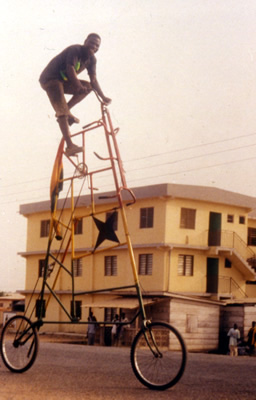
We'll close our brief presentation with this image of a Ghanaian welder who created this tall bike. To ride it he first pushes it to get it going, climbs up high enough to turn the pedals with his hands and, once he has enough momentum, jumps up in the seat. It symbolizes for us not only the shear joy of riding a bike, but a future that will be more about techniques than technologies. As Daniel Pinchbeck said,
"Instead of envisioning an ultimately boring 'technological singularity,' we might be better served by considering an evolution of technique, of skillful means, aimed at this world, as it is now. Technology might find its proper place in our lives if we experienced such a shift in perspective–in a society oriented around technique, we might find that we desired far less gadgetry. We might start to prefer slowness to speed, subtlety and complexity to products aimed at standardized mind."The bike is ready to go. That showroom full of electric cars, ethanol guzzling engines, and pie-in-the-sky fuel cells are all the dying gasp of a disastrous 20th century fixated on technology for technologies' sake. It's time to ride on.
Tuesday, October 16, 2007
An open letter to Trader Joes
 Dear Trader Joes,
First off we're not an animal rights activists, nor are we even vegetarians. We're just people who like honesty in packaging. So let's take a look at the carton for your Grade AA Cage Free eggs and assess the truthfulness of the illustration on its cover. Now conventional wisdom says that you are to be congratulated for selling only cage free eggs in contrast to many other food retailers who continue to sell eggs produced by hens living in cramped "battery cages". Battery caged chickens do not have the ability to stretch their legs, run around, or roost--activities that come naturally to all poultry. But what exactly does "cage free" mean? Unfortunately the USDA does not regulate the term cage free so its definition in terms of the actual living conditions of the hens who laid the eggs is uncertain. Perhaps you could redesign your packaging to give us an actual representation of where these eggs came from to clarify a few issues for us.
To save your marketing folks some time we've done it for you:
 First off we removed the chickens grazing in the open pasture since it's highly unlikely that these eggs came from chickens freely wandering outdoors and feeding on vegetation and insects. This might be called "pasture raised", though this is also a term not defined or regulated by the USDA (largely because the huge companies that control poultry farming in this country and whose political influence puts the USDA in their back pocket don't want to acknowledge that pasture raised eggs are superior to factory farmed eggs). It's a shame that your eggs aren't pasture raised especially since, according to a study conducted by Mother Earth News, pasture raised eggs contain 1⁄3 less cholesterol, 1⁄4 less saturated fat, 2⁄3 more vitamin A, 2 times more omega-3 fatty acids, 3 times more vitamin E and 7 times more beta carotene. It's too bad that the "all natural feed" that your package advertises does not provide the nutrients of a real pasture. And FYI--we also removed the rooster since that would signify that these eggs are fertilized, making us think that your package design folks were snoozing during their high school biology classes.
We replaced the picturesque barn with a windowless industrial shed to show the most prevalent housing for poultry and, more than likely, where these cage free eggs came from. The family poultry farm alluded to in your cover art has long since been replaced by huge industrial operations housing thousands of chickens in enormous sheds. Our relatives, living on a nearly century old family farm in Missouri, can no longer make a living from raising livestock and must supplement their incomes with construction work.
While we're happy these eggs do not come from hens dosed with antibiotics, when you pack that many chickens so close to each other you have to practice extreme bio-security. This is why we've added the image of the man in the clean suit which has replaced overalls as the modern poultry worker's garment of choice. Ironically this worker (probably an underpaid immigrant) must be extremely careful since these hens don't get antibiotics.
 Here's a picture of one of our four backyard hens. When she starts laying in a few months we will no longer be customers for your eggs. To use an old Italian expression, we like to "know our chickens". We suspect many of your customers share our concerns and will soon be joining our homegrown poultry revolution.
Perhaps we're wrong in our speculation about the conditions that produced these eggs. If so please send us a photo of the farm and we'll post a correction.
Regards,
Homegrown Revolution
Saturday, October 13, 2007
A Close Shave Part IV
 There are a few advantages to living in ugly old Los Angeles. Homegrown Revolution contributor Hairy Picfair, in an email commenting on our post about switching to an old-fashioned safety razor, reminded us that we can find replacement blades at Ross Cutlery, the shop where O.J. Simpson picked up a folding knife while shooting a commercial next door, just a month before the murder of his ex-wife. Ross Cutlery is located in the Bradbury Building where Rutger Hauer had his showdown with Harrison Ford in the thrilling conclusion of Blade Runner. Celebrity gossip aside, cutlery shops are a promising place to find alternative shaving supplies.
Mark, another HGR reader, writes to ask about alternatives to shaving creams. We've been testing out Colonel Conk Products' Almond Shave Soap with a cheap shaving brush. So far we're happy with this product and while we're disappointed that neither the container nor Colonel Conk's website lists the ingredients, we've sent a letter to the company to see if they will let us know what is in the soap. We'll report back when we find out.
Lastly, fellow bloggist and Starcrash scholar Doug Harvey writes to suggest a visit to a traditional barber for a professional straight-edge blade experience. We used to do this until a friend of ours started cutting our hair in exchange for lunches at pupusa joints. Perhaps we can get our volunteer hairstylist to take up the blade if we switch to three martini lunches at swankier digs.
To our international readers we apologize for the O.J. and pupusa references in this LA-centric post and we send our condolences to those about to undergo that thing called winter . . .
Tuesday, October 09, 2007
See Homegrown Revolution this Saturday!
 Homegrown Revolution has never been to Burning Man, but we're big fans of the movie The Wicker Man and we figure it's probably similar, which is why we're happy to announce that we'll be doing a brief appearance at the Los Angeles Burning Man Decompression this Saturday October 13th in support of our book The Urban Homesteader, due out next May from Process Media. The Burning Man Decom will take place on Sante Fe between the 4th and 6th Street Bridges in the Artist District deep in the beating heart of downtown Los Angeles (map). We'll be delivering a harangue sometime around 4 or 5 pm. Come out and see us and stay for the sacrifice!
Sunday, October 07, 2007
A Close Shave Part III
 Kurt Cobain once said, "The only way I would wear a tye-died T-shirt would be if it were soaked in the blood of Jerry Garcia." Being born around the same year as Cobain, our generational bias prevents us from donning tie-dye, friendship bracelets, or sandals. It also prevents us from cultivating a flowing beard, leaving us desperately hooked on shaving products.
As the alleged developer of the "loss-leader" business strategy King Gillette figured out that if you sold folks a cheap razor handle customers would have to come back for disposable razors for which you could charge an exorbitant price. Like desperate crack addicts we've been patronizing Gillette for years, plopping down ever more ridiculous sums for the latest "Mach-whatever" plastic multi-blade gimmick.
We finally decided to opt out of the Gillette trap and order up a retro safety razor from Lehmans. Here's a comparison of costs:
Gillette Mach 3: four blades for $10.59 or $2.64 a blade
Package of double-edged, stainless steel blades: ten blades for 4.95 or 49 cents a blade.
So far so good, but there's a catch. The fine folks at Gillette are a monopoly, as rapacious as the rail barons of the 19th century and completely dominate the shaving products industry. In a practice known as "slotting" large companies pay fees, sometimes as high as $25,000 per item, to reserve space on supermarket shelves and essentially eliminate the competition. The supermarket I checked did not have any blades other than Gillette--not even even Schick, and certainly not old-fashioned safety razors. So it appears that we may have to mail order replacement blades, and with shipping fees this will make the traditional safety razor gambit less appealing.
But we're stubborn and just can't give Gillette, now owned by Proctor and Gamble, any more of our money. The real way out of this dilemma is to take up the even more traditional straight razor but we've been warned about the learning curve on that strategy, not to mention the need to keep the blade sharp. Opinions dear readers? Any straight-edged razor types out there?
Subscribe to:
Posts (Atom)