Friday, August 31, 2012

New Zealand Spinach is the New . . . Spinach


Spotted in a neglected corner of our backyard: New Zealand spinach (Tetragonia tetragonioides). What's interesting is that it self-seeded and grew with no supplemental water in the middle of summer in lead and zinc contaminated soil.  We've never been able to grow regular (and unrelated) spinach here. But there's no stopping the New Zealand spinach. Due to the heavy metal problem we won't be eating this particular specimen, but when I build our new raised beds you can bet I'll sow some New Zealand spinach for next year.

Thursday, August 30, 2012

What Mountaineering Accidents Can Teach Us About Food Preservation

Would you eat pickles made by these two?

Each year the American Alpine Club publishes a book detailing all the mountaineering accidents in North America. The club's goal is simple, as they put it, "to help you learn from the mistakes of others."

I've often thought that the same approach should be applied to many of the activities we love in the homesteading movement, especially food preservation. Now, I think that home food preservation is very safe. Indeed, it's much healthier than eating commercially processed foods. But I find mistakes to be one of the best ways to learn. In the case of food preservation, like mountaineering, I'd prefer to learn from the mistakes of others rather than experience them myself.

As it turn out, food safety scientists do keep a close eye on, especially, botulism. With the increased popularity of home canning there have been a few botulism outbreaks in recent years. Botulism is very rare, but you definitely do not want to get a case of it (just read about the symptoms and treatment here if you don't believe me). Periodically, the Center for Disease Control publishes a review of all the cases. The last one looked at botulism incidents between 1990 and 2000.

The CDC's botulism review is informative. The majority of cases in the US are related to traditional meat fermentation practices of the Inuit in Alaska, compounded by the inappropriate use of modern materials such as plastic and glass. The leading cause of botulism in the lower 48 is, however, improper home canning. All incidents were low-acid foods, such as asparagus, canned without following proper procedures. I suspect most of these cases were people using a boiling water bath instead of a pressure canner. Other home cases involved storing low acid foods at room temperature (which is just plain dumb).

Four cases that stand out are related to storing garlic in oil at room temeprature. The National Center for Home Food Preservation now recommends the following if you want to preserve garlic in oil:
Garlic-in-oil should be made fresh and stored in the refrigerator at 40°F or lower for no more than 7 days. It may be frozen for long term storage for up to several months. Package in glass freezer jars or plastic freezer boxes, leaving ½-inch headspace. Label, date and freeze.
The take home from the botulism review is that the problem is rare and that home food preservation is very safe assuming you follow standard procedures, most notably using a pressure canner to can low acid foods. None, zero, zilch of the incidents were related to high acid foods such as jams and jellies.

Now go pickle something (and you won't need a pressure canner to do that!).

Wednesday, August 29, 2012

Learn How To Can For Free


Want to learn how to can? The National Center For Home Food Preservation has a free online course. Offered by the University of Georgia, the course covers canning of both high and low acid foods along with a general introduction to food preservation. While the class is free, you need to register here.

Happy canning!

Tuesday, August 28, 2012

Five Lessons We Learned About Lead in Soil


As regular followers of this blog may recall, we did some soil tests last year that revealed elevated levels of lead and zinc in our backyard. The cause? Most likely, paint from our 92 year old house and nearly a hundred years of auto exhaust and dust from brake linings.

Applying a little alchemy to turn lead to gold, I think the most productive thing I can do is to help get the word out about lead soil and how common this problem is in urban areas. Towards that end I though I would share five things that we learned from our backyard lead crisis:
  1. Buyer Beware. When you are shopping for a house do multiple soil tests. Once you buy the house it's too late. Real estate contracts in California (and I suspect elsewhere) have been loaded up with disclaimers about lead and old houses. I'm no legal expert, but I suspect it would be difficult to go after the seller given the lead clauses we signed in our ignorance.
  2. The dirt on soil labs. Choose a soil lab that gives detailed results and is willing to do some phone consultation. We used to recommend the cheap tests form UMass, but their results were significantly different than Timberleaf Soil Testing and Wallace Labs, which were more in line with each other. Both Wallace and Timberleaf give you more detailed reports and are both willing to chat on the phone. They cost more but are worth it.
  3. Raised beds.  Not much else to say other than those two words if you want to grow vegetables and have a lead problem. Right now I have a big compost pile going that I made with hay, straw and horse manure. I'll use this compost along with imported soil to fill the raised beds that I'm going to build this winter. And you can bet that I'm going to test that imported soil first.
  4. Philosophical lesson. The future health of the human species requires us to be a lot more conservative in the use of chemicals. Lead was known to be a problem since the Romans, but we went ahead and used it anyways in paint and in gasoline and the results have been tragic. Nassim Taleb has written eloquently about the need to approach complex systems like nature and the economy with an attitude of humility and admit our ignorance. When we fool around with complex systems we're asking for trouble.
  5. Rhetorical lesson. There should be a logical fallacy called the "appeal to technology." It's the idea that there just has to be a technological solution to every problem. This is a very common fallacy in our age. Some people have suggested that I try phytoremediation, the process of growing plants like sunflowers that accumulate lead. At the end of their growing cycle you pull the sunflowers and send them to a toxic waste dump.  Sadly, this is just not practical in a residential yard. I would have to pull every living thing, including a mature avocado tree, and grow nothing but sunflowers for the next 20 years. Others have suggested mushrooms as a remediation technique, but they don't grow well in this dry climate.  Lead is an element and it simply doesn't go away. Once it's in the ground it's in the ground. The best way to deal with it is not to use it in the first place. The city of Oakland is trying a more practical solution to deal with lead: applying fish bone meal to lead contaminated soil. Fish bones contain phosphates which bind up lead and make it less bioavailable to plants. Our soil tests indicate that we already have lots of phosphates in our soil, so I'm not sure if adding more would help.
Of all of these points I think the first is the most important. I'll repeat it again, if you are shopping for property get a soil test.

Monday, August 27, 2012

Film Industry Blocks Bike Lanes, City of LA Doesn't Care


Film industry trucks block bike lanes all the time here in Los Angeles, particularly along busy and fast moving Sunset Boulevard. Shutting down a bike lane on Sunset forces cyclists to merge into traffic that is sometimes going as fast as 50 miles an hour. It's a tragedy waiting to happen.

Not much room between a fast moving bus and a film industry truck.

As to the legality of blocking a bike lane I don't have a good answer, but in my opinion it doesn't matter. Even if it is legal, that doesn't make it right or safe. Is a film production worth a traumatic brain injury or a death?

Those of us who ride a bike in Los Angeles need your help. I want get the word out that:
  • Elected officials in the City of Los Angeles (in this case, Councilman Garcetti's district) do not take the safety of cyclists and pedestrians seriously enough.
  • The film industry values profits over human lives.
Please Tweet, Facebook and link to this post even if you don't live here. Appeals to the police department and elected officials in the past have done nothing to fix this problem. All we get are excuses and, once LAPD calls the film crew, hand made signs like the one below:


In Portland, Oregon cyclists get a detour:


To contact those responsible for this situation please email the following:

Film L.A. (the non-profit entity that coordinates and processes filming permits): info@filmlainc.com
Los Angeles City Councilman Eric Garcetti: contact form 

Like most cyclists here in LA, I also drive, walk and take public transportation so I understand this issue from all sides. We need equity in our transportation choices and we all need to stay safe.

UPDATE: Looks like the city has "fixed" the problem with slightly more official looking signs:


Too bad it's still dangerous. I guess it's going to take a death to fix this problem.

UPDATE 8/29/12: More coverage in The Eastsider and Streetsblog.

Sunday, August 26, 2012

Picture Sunday: Folding Window Box


Spotted on Homesteading's Facebook page: a fold out window box. I don't know the origin of this photo, but it looks to be a pretty clever idea.

Saturday, August 25, 2012

Saturday Linkages: From Plastic Bottle Kayaks to Canine Staircases

Kayak made from plastic bottles. Via Lloyd's blog.

DIY

How To Turn A Mason Jar Into A Fermenting Crock - FARMcurious

Kayak Made from Recycled Bottles in Argentina

Paper Bag Flooring

Shadowy Profiles  

Spicy Storage Solution Frees Up Stacks of Cupboard Space  

How To Cover Up Dings in Wooden Furniture Home Hacks  

Design

Forget Doggie Doors: Home Remodel Has Canine Staircase  

Beekeeping

Happy Bees Equals Happy Beekeeper, and How To Treat Bee Stings. -

Whatever happened to common sense? 

Not to be outdone by Canada, another city wants to ruin an urban garden. Please help!  

What do USDA inspectors do? Undercover video shutters another dairy cull slaughterhouse in Calif. | barfblog

Bakers Green Acres vs. Michigan DNR - Family Farm Under Attack:

Do companies really need babysitters? China stiff-arms FDA on jerky pet treat testing, reports show | barfblog  
  
Gardening

Letting Things Go in the Garden (on purpose)

Community 

A vivid account of life in The Late Suburban Age:

RT : Tourists & Angelenos alike will find this 1907 map of streetcar routes in LA most helpful:

For these links and more, follow Root Simple on Twitter:
 

Friday, August 24, 2012

Quebec Kitchen Garden Saved


From BoingBoing, an update on the Drummondville, Quebec kitchen garden, seen in the time lapse video above. City officials have backed down on asking for the garden to be removed.
Drummondville town officials announced the decision [Link is in French] this week during a special session of the Municipal Council to discuss the case. The decision could create a ripple effect in other cities worldwide as zoning laws are a constant debate in urban environments. Roger told us, “The Drummondville case was one of the highest profile examples of a local municipality challenging the right to grow food in one’s own yard. While it took place in Canada, it quickly attracted international media attention because of the garden’s beauty and productivity. The win is significant because it helps establish a precedent that other urban and suburban gardeners can refer to when similar challenges arise in other parts of the world.”

Thursday, August 23, 2012

Thrive: How Doughnuts Can Save The World


I flipped on the car radio the other day just as some new age guru was discussing why he thought that so many people don't have a lot of money these days:
Host: There is not lack of resources?
Guru: There is not. We will always be able to create more. And we don't need to know how or why. I see poverty as being this incredibly dangerous disease. I mean, how many horrible things are happening in the world today because of poverty? How many crimes are being committed? How many people are being killed or injured?
Host: Because of the belief in a lack of resources?
Guru: Exactly. If we all believe that we can create whatever we need as we need it that would go a long way to stopping crime, stopping oppression, theft and many other terrible things that happen in this world.
So apparently, according to this guru, we can imagine resources into being. This is precisely the sort of delusional thinking that John Michael Greer has warned will show up when oil and food start to get scarce. It's also the same feel-good philosophy that Barbara Ehrenreich critiques in her book Bright-Sided: How Positive Thinking Is Undermining America.You can find this cult of positive thinking on all sides of the political spectrum, both left and right. And it has, apparently, survived the 2008 economic meltdown in which it played a big role.

But the Nobel Prize for delusional thinking, however, should be awarded to Foster Gamble (of the Gamble family half of Proctor & Gamble) for being the auteur behind of one of the most bizarre documentaries I've ever sat through, Thrive What On Earth Will It Take? You can watch Thrive in its entirety on YouTube via the link. And if you're a connoisseur of so-bad-it's-good cinema and conspiracy theories, you really should take a look at this thing.


Most of the film takes place on a kind of interview studio/spaceship inspired, perhaps, by the one Carl Sagan deployed in Cosmos. But unlike Sagan, Gamble is not one to let inconvenient facts like the laws of thermodynamics interfere with all that free energy we can just will into existence. The central thesis of Thrive is put forth by an outsider physicist (sporting a sort of new age mullet) who explains that there's a form, resembling an oversized and transparent jelly doughnut that, when combined with one of Buckminster Fuller's geodesic shapes, can create energy out of thin air. Or, at least, that's what I think he said. Confirmation that this jelly doughnut energy thingy works is delivered by UFO abductees who witnessed (during anal probe sessions?) spaceships using the jelly doughnut energy vortex to fly around the galaxy. Further confirmation comes from crop circles, Nikola Tesla and a montage of perpetual motion machines.

Of course, oil companies, international bankers and Freemasons have stomped down their collective jack boots on the free energy generating jelly doughnut. David Icke, British sportscaster turned reptilian conspiracy theorist, is brought on to flesh out the geopolitical segment of Thrive. This segment culminates, for me at least, in the amazing revelation that seed companies are working on a spermicidal corn to control the human population.

Along the way we hear from Indian GMO activist Vandana Shiva and Deepak Chopra, which probably explains this disclaimer at the end of the film:


Personally, I'm thanking my lucky stars that Kelly and I ended up on the cutting room floor of a 2012 doc that came out last year, but that's another story.

So how does Gamble suggest we fight off the evil bankers/one world government? Thrive concludes in the same way a lot of more mainstream environmental documentaries end these days, with tepid suggestions about shopping for organic food, buying recycled yoga mats, "organizing" and switching to credit unions.

In a blog post entitled "Merlin's Time," John Michael Greer sums up what I wish mainstream eco-docs would conclude with (Thrive is so outre that, as a work of unintentional conceptual art, it should just stay as it is). Greer says that what we really we need to do is,
learn, practice, and thoroughly master a set of unpopular but valuable skills – the skills of the old appropriate tech movement – and share them with their neighbors when the day comes that their neighbors are willing to learn. This is not a subject where armchair theorizing counts for much – as every wizard’s apprentice learns sooner rather than later, what you really know is measured by what you’ve actually done – and it’s probably not going to earn anyone a living any time soon, either, though it can help almost anyone make whatever living they earn go a great deal further than it might otherwise go. Nor, again, will it prevent the unraveling of the industrial age and the coming of a harsh new world; what it can do, if enough people seize the opportunity, is make the rough road to that new world more bearable than it will otherwise be.
In that new world we'll have to grow and fry up our jelly doughnuts from scratch and they won't fly us around. Neither, thankfully, will they be made with spermicidal corn syrup.

Wednesday, August 22, 2012

What Do Microbes Have To Do With Homesteading?


So what are the activities that microbes make possible around the homestead? To name just four:
  • Fermentation
  • Beekeeping
  • Soil Fertility
  • Human beings
Pretty important stuff. In fact, new systems thinking, applied to our natural word, is demonstrating that things like human beings are really just symbiotic sacks of microbial life. An article in the Economist, "Microbes maketh man" discusses just how important microbes are to human health:
The traditional view is that a human body is a collection of 10 trillion cells which are themselves the products of 23,000 genes. If the revolutionaries are correct, these numbers radically underestimate the truth. For in the nooks and crannies of every human being, and especially in his or her guts, dwells the microbiome: 100 trillion bacteria of several hundred species bearing 3m non-human genes. The biological Robespierres believe these should count, too; that humans are not single organisms, but superorganisms made up of lots of smaller organisms working together.
Natural beekeeper Michael Bush has made the same argument about bees. Elaine Ingham has emphasized the importance of microbes in soil.

Mess with the complex interdependent relationships between microbes and people, soil etc. and you're asking for trouble. This, for me, is the argument against things like GMOs, Miracle Grow or conventional chemical beekeeping. We don't know enough, and probably never will know, how 100 trillion bacteria will react to our latest innovation. Best to be conservative when it comes to microbial life.

Looking forward to seeing more of this microbial paradigm shift in science.

Tuesday, August 21, 2012

How To Ice Glaze Fish

Frozen fish
Photo by Portable Soul

Ice glazing is a process of creating a thin layer of ice to help preserve foods, usually chicken or fish. Ice glazing prevents freezer burn and helps preserve texture and flavor. The big processors do it, but it can also be accomplished at home.

To ice glaze fish you need to do some pretreatment. You dip fatty fish in an ascorbic acid solution. Lean fish are pretreated in a brine. Once treated, you then put the fish in the freezer. Once frozen solid, you take them out of the freezer and dip them in ice water and put them back in the freezer. You repeat this process until there is a thin later of ice around the fish. Alternately, you can use a lemon-gelatin glaze. Full instructions for ice and gelatin glazing can be found on the website of the National Center for Home Food Preservation, an excellent resource for reliable, science-based recipes.

Ice glazing is a somewhat laborious process, so it's probably best reserved for that special catch. If you're in a hurry you can just freeze fish in a solid block of ice but, according to the National Center for Home Food Preservation, this will result in poorer quality. But it's better than just throwing fish in a plastic bag to dry out in the freezer.

Thanks to fellow Master Food Preserver Jake Mumm for this tip.

Monday, August 20, 2012

How To Dry Food With the Sun

Drying Apricots in Southern California--early 20th century style.

Dehydration is one of my favorite food preservation techniques. Drying food concentrates flavor and is a traditional technique in our Mediterranean climate. Best of all, drying food is one of the best applications for low-tech solar power. In many places, you can simply set food out under cheesecloth to dry in the sun.

But there's a catch to sun drying: humidity. Food dries best when temperatures are above 85º F and below 60% humidity. If you live in a desert, humidity isn't a problem. But in most other places in North America it's simply too moist to set food out under the sun. It will rot before it dries. In Los Angeles, due to the influence of the ocean, it's slightly too humid most of the year for sun drying to work well.

But there's an easy way to overcome humidity: convection, i.e. hot air rises. Most solar dehydrators take advantage of the passive movement of hot air to lower humidity enough to dry food. Here's a couple of solar dehydrators that harness this simple principle to dry food without electricity:

Appalachian Solar Dehydrator


This is the dehydrator I built with plans from Home Power Magazine. The plans and an improvement on the original plans are split between two articles in Issue #57 and Issue #69. You need to download and read through both articles before building this dehydrator. This dehydrator has performed well for us. The same design can also be modified to work as a rudimentary solar house heater. I had originally used a sheet of plastic over the collector, but have sinced replaced that plastic (which ended up spltting) with a door I was getting rid of.

Cardboard Box Dehydrator


Mother Earth News has plans for a Appalachian style dehydrator made from cardboard boxes. As long as you keep it out of the rain, this dehydrator should work just fine, and is a lot easier to make than the plywood version. I've never built one of these, but am interested in hearing from anyone who has. 

Eben Fodor Solar Food Dryer

Photo from Simply Resourceful

This design is by Eben Fordor, and is described in a book by Fodor called  The Solar Food Dryer: How to Make and Use Your Own Low-Cost, High Performance, Sun-Powered Food Dehydrator. I have not seen one of these in person, but the folks at Simply Resourceful built and blogged about their Fodor style dryer. If you've got a Fodor dryer, please leave a comment to let us know how it worked.


Solar Tunnel Food Dryer


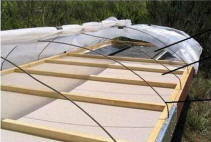
Builditsolar.com has a link to a solar dryer that's, essentially, a mini hoop house with ventilation. It's a scaled down version of the large hoop houses that small farmers use to dry fruit. Again, if you've used something like this, please comment.

Beware of Bugs

One drawback to outdoor drying is that you can often get infestations of flies and pantry moths. We've lost a lot of dehydrated tomatoes this way even though our Appalachian dryer has screens. I've even lost batches I've done in an electric dehydrator inside. Thankfully it's easy to kill larvae by sticking your dried food in the freezer at 0ºF for 48 hours. I'd recommend this step.

Further Reading

Build It Solar is one of my favorite resources. You can check out a couple of other solar dehydrator designs that are variations on the ones above on their Solar Cooking, Food Drying, Solar Stills and Root Cellars project page.

Sunday, August 19, 2012

Picture Sundays: Bike Rack With Bee Smoker


Bike Snob NYC predicted back in 2010 that beekeeping would be the new fixed-gear. Don't know where I found this picture (Facebook?) but it looks like bikes and bees are achieving a kind of synergy. I think this is a custom rack just for that handsome Dadant smoker, which like the design of the bicycle, has not changed much in a hundred years:

Dadant smoker in 1910.

Does this mean that Dadant will come out with a titanium smoker?

Saturday, August 18, 2012

Saturday Linkages: Making Things and Herding Ducks

Herding ducks. Via The Tangled Nest.

DIY
Simple Swiss fences for the homestead: via Practical Parsimony

Build-It-Solar Blog: Comparing the Performance of Two DIY Solar Water Heaters

Build-It-Solar Blog: Using Your Lawn Sprinkling Water to Cool the House...

New video series from MAKE: "DiResta":

Inspired By. . . SunRay Kelley

Cooking and Preserving
Canning 101: Learning to be Flexible

Step Up the S'more: 7 Ideas for Campfire Treats by Chris Rochelle: Chocolate Cake Baked in an Orange  

Fowl
How to Herd Your Chickens (or ducks)

For these links and more, follow Root Simple on Twitter:
 

Friday, August 17, 2012

Does the scent of compost make bees angry?


I think I've stumbled upon a strange phenomenon: the smell released by turning compost pisses off bees. Yesterday was the third time this has happened to me. I took a sting just underneath my eye and another one to my right hand when I was turning a pile located about 15 feet away from a hive. Coincidentally, the same thing happened to a friend yesterday: he got stung while working with compost near a hive. Ordinarily our bees are reasonable about living in a small yard with humans--they are not even very aggressive when I open their hive. But apparently turning compost near them is a different matter.

I look like I've been in a fight. Lots of Benadryl today.

I have a theory. Bees are incredibly sensitive to odors and use them to communicate. Their alarm pheromones alert the hive to predators such as bears and people. Bee alarm pheromone consists of many different compounds. Interestingly, a lot of these compounds such as n-Butanol and Isoamyl acetate are byproducts of fermentation processes. I'm guessing that a number of these compounds are present in compost, and that when you turn a pile the act releases a cloud of compounds that mimic the bee's alarm pheromones, causing them to attack.

It turns out that other lifeforms like to mimic honeybee alarm pheromone. Some species of orchids mimic bee alarm pheromone in order to attract pollination services. Small hive beetles, who raid beehives for their pollen, apparently bring with them a yeast that causes a fermentation process that mimics alarm pheromones. The small hive beetle's fermented alarm pheromone, in turn, attracts more small hive beetles who quickly overwhelm the hive. These sorts of deceptive, symbiotic and parasitic loops in nature really amaze me. 

As a side note, I've only had compost pile related bee stings at this time of year, when honeybee numbers are at their peak and pollen and nectar sources are getting scarce (summer is hot and dry in Los Angeles and not much is blooming).

If you don't have a hive, I doubt random, foraging worker bees would go after you if you are just turning compost in your yard. But if you've got a compost pile and are thinking about installing a hive--or vice versa--I'd seriously consider keeping the two as far apart as possible.

Am I alone in noticing this compost/bee alarm pheromone issue?

Thursday, August 16, 2012

Doomsday Preppers: Exploitative, Uninteresting, Unreal "Reality"


Doomsday Preppers, a series on the National Geographic channel, is part of a cloud of meaningless cable drivel that envelopes our national psyche like the smog that hangs over Los Angeles. In many ways Doomsday Preppers is indistinguishable from countless other low rent reality TV shows. Does anyone really sit down and watch this endless parade of house flippers, dance moms and custom motorcycle enthusiasts? Or is it all a kind of background, tranquilizing, electronic wallpaper?

I bring up Doomsday Preppers because many of its subjects are engaged in precisely the types of activities we write about on this blog and in our books: growing food, keeping livestock, building solar ovens, preserving food etc. And I finally got a chance to see the first episode and a few segments from later shows.

Of the three "compounds" profiled in the first episode, the most interesting was the family of Dennis McClung in Mesa, Arizona and the Kobler and Hunt families, who share a rural homestead. McClung has built an amazing tilapia farm in an old swimming pool in their backyard. They also have chickens and goats and have integrated the livestock into the greenhouse/tilapia project. It would have been interesting to see how the system McClung created works as a whole. But the producers were more interested in filming the family putting on gas masks and making duck weed smoothies. The Kobler and Hunt families operate what seems like a pretty normal rural homestead. What is unusual is their social arrangement: two families living together. It would have been interesting to explore that relationship. Instead the producers gave us endless scenes of the family shooting AR-15s.

Memo to the National Geographic folks: the internet has been bringing educational video content into living rooms for many years now, showing us how to actually grow tilapia, keep goats, etc. McClung, in fact, has his own website, gardenpool.org, which shows all the things I wanted to see on the TV show. Doomsday Preppers, on the other hand, has no redeeming educational content.

Living in Los Angeles, I know many people who work on reality TV shows. They have told me that, essentially, everything is staged and most details are simply made up. In Doomsday Preppers, the participants were forced to say that they were preparing for specific scenarios such as coronal mass ejections, rapid deflation or other variations on the zombie apocalypse. Producer Alan Madison puts words in his subjects mouths and commits the greatest sin of documentary film making, holding his subjects up for ridicule. In a comment on a review of Doomsday Preppers, McClung says,
I was the first person on the show. My family was edited out of context and coached to appear as if we believe in an imminent doomsday. We don't. I am highly disappointed in [producer, director] Alan Madison and Sharp Entertainment for producing a B.S. "reality" show and tarnishing the Nat Geo name.
Film maker Werner Herzog often plays loose with the details of his documentaries. He calls the practice the "ecstatic truth." He deploys the ecstatic truth when he thinks he needs to tell a story in a more compelling way than the actual facts of the situation allow. As a journalist, Mark Twain was also a fan of the ecstatic truth.

McClung's swimming pool aquaponics setup.

Doomsday Preppers is a kind of unecstatic truth. It bends the facts, exploits its subjects and tells an uninteresting story. Doomsday Preppers delivers the unconscious message of its cynical producer, that you are crazy if you don't just "act normal", consume and shop. It holds its subjects up for ridicule because they are self-actuated people and, hence, "different". The people profiled (victimized would be a better word) on Doomsday Preppers are actually getting up off the couch and doing something: growing food, building communities and making sensible preparations. My heart goes out to the people victimized by the producers of this show.

Thankfully, with inexpensive video cameras and editing software, we can make our own educational television. Many have already unplugged mass media and many more will follow. Good-bye National Geographic.

Wednesday, August 15, 2012

Know Maintanance

I have a new favorite gardening blog, Grounded Design by landscape architect Thomas Rainer. I especially enjoyed his provocative post, Why I Don't Believe in Low Maintenance Landscapes:
The low maintenance dogma reveals something about our culture: we don’t know how to BE in our landscapes. When someone asks me for “low maintenance,” what I hear is: “I don’t want to deal with this landscape.” Maintenance is nothing more than gardening, a personal investment into the landscape. I’ve long said that gardening is a relationship with a piece of ground. That relationship is the single most rewarding aspect of gardening. If the act of gardening is a relationship, then low maintenance gardening is code for “let’s just be friends.” Or “I’m just not that into you.” Low maintenance is permission to disengage, pull away, and let go. When we do that, our landscapes suffer. And so do we.
Rainer on Gardening in Small Spaces
I found out about Rainer via Garden Rant, who interviewed Rainer on the topic of small garden ideas. As we struggle with some design mistakes we made last fall, Rainer's advice really rang true:
Don’t bring a plant into that garden unless it has a striking form (spiky, billowing, vertical spire), strong foliage color (blues/golds/purples, etc), or a long season of blooms (2 month minimum).
We had to redo our yard after last year's lead soil reports (more on that in another post), and the design of our own space is a frequent source of marital disagreements. After reading Rainer's advice together we vowed, "plant drama, not couple drama." Looking forward to reading more from this gifted designer and writer.

Tuesday, August 14, 2012

Sandor Katz to Speak in Los Angeles

"Fermentation fetishist" Sandor Katz will be leading a hands on workshop here in Los Angeles on Wednesday September 19, from 7-10pm at:

Community Hall of Holy Nativity Church
6700 West 83rd, Westchester/LA 90045
$25 prepaid, $30 at the door - supports the ongoing work of the Environmental Change-Makers

Autographed copies of The Art of Fermentation available for $25

Space is limited -- Reserve your spot now!  Your check holds your place.
RSVP at http://envirochangemakers.org/events.htm

Your Essential Oil Toolkit


A few bottles of essential oils are an important part of the DIY toolkit, but some people don't ever try them because they are so expensive. I can't deny that they are pricey, but once you start using them, and you see how far they stretch and how many uses they can be put to, you'll start to understand why they'd be a bargain at twice the price. Best of all, the most useful oils (to my way of thinking) are the cheapest.

My picks are: lavender essential oil, peppermint essential oil and tea tree oil. These three would make a good starter set for anyone, and are also a good trio to take traveling with you. All of them are on the low end of the essential oil price scale.

[Ah! Before I go on, Erik reminds me that not everyone knows what essential oils are. He'd never heard of them before he married me. Essential oils are the distilled, concentrated scent essence of plants: "volatile aroma compounds" according to Wikipedia. They are also called volatile oils. Most are made processing fresh plant matter in a still, though some are made through other extraction processes. As scenting agents, essential oils are great alternatives to synthetic perfumes, and they play a role in the world of alternative medicine. I don't know about other parts of the world, but in my experience here in the U.S., they are sold in health food stores, in the cosmetic sections, in tiny bottles on special display racks. You can also order them online, where you can often get a better price by buying larger quantities. ]

The Picks:

Lavender Essential Oil: Soothing, universally appealing, and endlessly useful

Put a dab directly on the skin* to soothe itchy bug bites

Use it on small burns to speed healing and soothe the pain.

Mix a few drops with a cheaper, nuetral oil (olive oil will do) and massage it into the skin to ease tired, aching muscles. Try the same thing for sunburn.

Put a few drops in your hot bath to unwind

Lean over a steam bowl filled with hot water and a few drops of lavender for headaches, sinus problems, or just a really bad cold.

Pass a bottle around the car on a long trip when everyone is getting fractious, or use it on your own to survive your commute. Sniff and breathe.

Rub a few drops on your temples when before you go to sleep.

If you make your own balms and lotions and other potions, lavender is s very useful scent. If you can only have only one essential oil, this is it. It's a mild oil, it doesn't cause photosensitivity, and most people like the scent.**

Add a few drops to one of my olive oil lamps for scent.

You can also use it to scent homemade cleaning products. It is somewhat antibacterial.


*Unlike most other essential oils, lavender essential oil does not have to be diluted before applying to the skin.

**Even though lavender oil is pretty well received by most people, there's always going to be some people who don't react well to it. Test any new-to-you essential oil by dabbing a little on your inner arm and waiting to see if anything happens.  Pregnant women should be cautious of all essential oils.


Peppermint Essential Oil: The Workhorse

 If I had to choose just one scent for my homemade cleaning products, I'd choose peppermint, because a whiff of it is stimulating--and I need plenty of stimulation to clean the house.
  • Stir a few drops into a cup of baking soda to make a scented scrubbing powder
  • Mix baking soda, castile soap, and peppermint drops to make a scrubbing paste
  • Put a few drops in your mopping water
  • Add it to your vinegar & water cleaning spray
If you have an upset belly due to overindulgence, put a drop of peppermint essential oil into a quart bottle full of water and shake. No more than 1 drop! Too much will make you sick.You'll be surprised how strong one drop is. Sip on this. It should feel good. Don't force it down--if it's making your stomach upset, it's too strong. Dilute it more. Used sparingly, the peppermint oil really helps your shocked stomach relax. It's saved me after many a too-large meal, especially when I'm traveling.

Make a quick and dirty toothpaste by mixing a few drops of peppermint essential oil with a small amount of baking soda.

Put a drop on your otherwise empty toothbrush to really clean the moss off your teeth and tongue.

You can put a few drops in your bath for that nice "ahh" feeling--it opens the nose-- but be careful because too much of the oil on your skin becomes strangely and unpleasantly tingly. 

A drop or two in a steam bowl will help clear the nose and open the sinuses, ease headaches and even help nausea. Just a whiff out of the bottle will help all these things, too.

Apply a drop to your temples to ease a tension headache. Combine with lavender.

Note: Be careful applying peppermint essential oil directly to your skin--you may find it too intense, it might burn or itch. Always use the minimal amount necessary. You may want to mix it with a neutral oil and keep a little bottle of that on hand. It will prevent any discomfort and make your essential oil last longer.


Tea Tree Oil: The Panacea

Tea Tree Oil, or melaleuca oil, is distilled from the leaves of Melaleuca alternifolia, a tree native to Australia. It has a strong, camphor-like scent that people seem to either like or hate. It has impressive antiseptic, anti-fungal and antibacterial properties. I'd recommend a reading of the Wikipedia entry on it.  Tea tree oil is basically anti-everything,  so you use it when you want to kill bugs dead.
 
A note on buying it: in my experience, tea tree oil is not sold in the little racks alongside all the other essential oils. For some reason it is usually to be found somewhere else in the medicine/cosmetic section of a health food store, usually in larger bottles. Tea Tree Oil also pops up in drugstores sometimes--and it's even a standard fixture in our local Trader Joes.

Some of the tea tree oil products you find on the shelf are already diluted for specific purposes. If you buy it straight, consider diluting it with water or oil if you're going to put it on your skin. I don't have any problem with direct application, but it is strong stuff.

Some ideas:

Add it to any homemade cleaning solution when you want extra santitizing power.

Try putting some in a spray bottle filled with water or vinegar and using it on moldy or mildew items. I've used it very successfully on mildewed camping gear.

Apply it neat to pimples using a cotton swab. If it dries or irritates your skin, dilute it with a carrier oil, which is almost any plain oil, even olive oil. (No, olive oil won't make your pimples worse).

Use it on small wounds.

Use it in homemade deodorant preparations.

Mix a few drops in a bottle of water to make an antiseptic astringent. Shake before each use.

You're not supposed to swallow it, but you can dab it on cold sores.

Apply it to toenails with fungal infections. Apply it to warts. Try it on athlete's foot.  Apply to anything fungal.

It kills lice. You can mix it with oil and comb through the hair, or put it in shampoo.


Pet Safety Note: A couple of commenters have noted that tea tree oil and other essentials are toxic to cats and may also be to dogs. For more on this issue, see this article.  

In general, we are very cautious with our cats, and don't use essential oils on them, knowing that cats are unable to metabolize many substances that humans (and sometimes dogs) can tolerate.


Monday, August 13, 2012

Digger Bee Video


This beautifully shot video shows why it's important to leave some of your land open as habitat for solitary bees like the digger bee.
Via Bug Girl's Blog.

Sunday, August 12, 2012

Picture Sundays: Kangaroo Butlers


A prediction from 1965: kangaroo butlers. A prescient, peak oil aware alternative to those robots we were supposed to have by now? Via Paleofuture.

Saturday, August 11, 2012

Saturday Linkages: Now With Catagories (and Skateboarding Goats)


Design

Small Cabin Plans Online

How-To: Crackle Paint Finish with Elmer's Glue  

Flat pack live/work loft:

Events

Are you pressure cooking, yet?!? Free San Francisco Bay demos lure cooks to the pressure cooker  

Cookin'

Pickled Beets with Orange and Coriander. Excellent on a sandwich with goat cheese and pesto. via @nwedible

Growing chayote: Bury one fruit, get an epic plant

Small-garden ideas from Thomas Rainer | Garden Rant
 

Lesson Burned: Does Sunscreen Actually Reduce the Risk of Cancer?

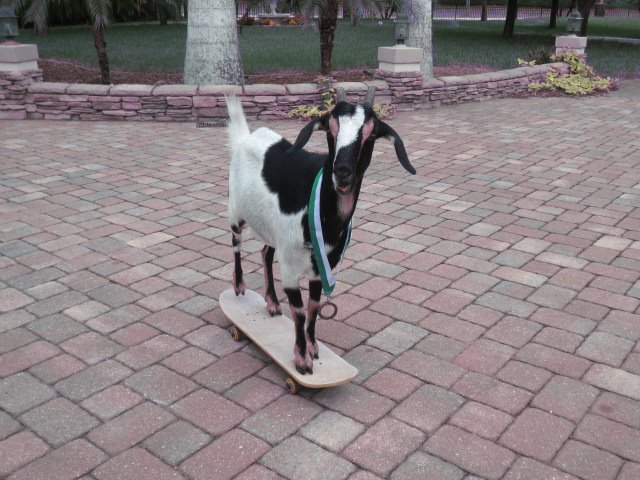
Skateboarding goat wins Guinness World Record (video):  

Road rage against cyclist--by an elephant. I reiterate my call for separated elephant lanes, preferably buffered. via @dudeonabike
Slicing vegetables with thrown playing cards:

Miami restaurant serves up (Salmonella) sushi, sashimi on naked models | barfblog:

For these links and more, follow Root Simple on Twitter:
 

Friday, August 10, 2012

A DIY Whole House Fan

Our DIY whole house fan.

How hot is our unairconditioned, uninsulated old house? Kelly has temporarily banned bread baking and I'm thinking of opening my own Bikram hot yoga franchise.

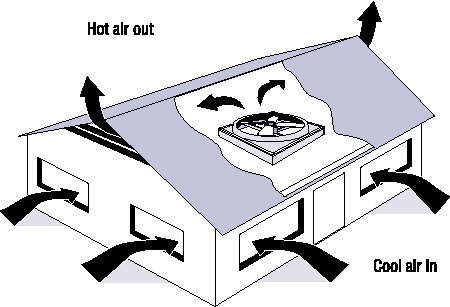
But seriously, a few summers ago I decided to install a whole house fan. What's a whole house fan? It's a large fan, mounted in the ceiling, that pushes hot air into the attic while simultaneously drawing cool air in from the outside. You turn on a whole house fan when the air outside is cooler than the air inside the house, usually in the evening. It works best in climates that have hot days and cool nights--like Los Angeles or many other parts of the Southwest.

Diagram from Gear Hack.

Whole house fans are usually placed in a ceiling towards the middle of the house. For us that's the hallway. Unfortunately, between the attic access door and the intake for the central heater, our hallway ceiling had no room to fit a standard whole house fan. And I'm cheap. So I decided to make a DIY version.

I picked up a shop type fan and installed it in a 3/4 inch piece of plywood cut to fit the attic door. It was a simple project and saved a lot of money. I think I spent around $30 for the fan and used a piece of scrap plywood. I added two handles to make it easier to remove the fan/door and access the attic. The final touch was to install an outlet in the attic wired to a switch hidden in a closet so that I can turn the fan on and off. When cooler weather comes around I simply swap out the attic fan for the normal attic door. Would a commercial whole house fan work better? Yes, but I try not to let perfection be the enemy of the good around here.

An attempt to use a bike pump as an air conditioner. Hot cat in background.

It's still damn hot at Root Simple world headquarters during the day. So maybe I will open that combination bakery/Bikram yoga franchise where you can eat buns while you tone your buns.

Thursday, August 09, 2012

How to Make a Native Bee Nesting Box


Back in the spring I made a native bee nesting box by drilling a bunch of holes in the long end of a 4 by 6 inch piece of scrap wood. I cut one end of the 4 x 6 at an angle so that I could nail on a makeshift roof made from a piece of 2 x 6. I hung the nesting box on an east facing wall or our house with a picture hanger.

I used three sizes of holes to see which ones would be most popular: 1/4 inch, 3/16 inch and 1/8 inch. All were moved into by, I think, the same native bee within days of putting up the box. This afternoon, when I went to check on the nest to take some pictures for this blog post, I was delighted to see a lot of activity. There were bee butts sticking out of the holes, as well as bees flying in and out. I think they are some sort of mason bee--extra credit to the person who successfully identifies the species:


They move fast, so I was only able to get these two blurry shots. No, they are not Chupacabras.

With the success of this primitive native bee box, I decided to make more nesting boxes to see if I could attract other solitary, native bees. I put this one together with some small pieces of bamboo that I found in a neighbor's trash can:


I think there's a great potential to create works of public art that double as insect nests. For a nice example of this idea see the "insect hotel" designed by by Arup Associates.

For general guidelines on how to build nesting boxes see this guide from the Xerces Society. 

We also have a project for a native bee box in our book Making It.

If you've built or seen a nice native bee box, leave a comment or a link.