Saturday, March 31, 2012

Saturday Linkages: Urine Soaked Eggs, Currents, Squirrels and School Gardens


Urine-soaked eggs a spring taste treat in China city:

Amazing wind map.

Equally amazing water current map:

Bald eagle, fox, and cat are porch friends:

HOWTO build a robotic squirrel-squirting water sentry-gun, with python:

Tips on running a school garden:

blog post: Freak Bike Friday: Bed Frame Bike

These, and more linkages, are from the Root Simple twitter feed.

Friday, March 30, 2012

Return of Recipe Friday! Spicy Korean Tofu

Ummm...Our food stylist is on vacation! This was lunch today. It would look much better if the tofu sheets were reclining whole on snowy rice and artfully sprinkled with green.

We've been eating a lot of this lately. It's Erik's favorite meal these days, in fact. I make it for him whenever he's grumpy and he perks right up. I like it too, and I especially like that it's fast cooking and I usually have all the ingredients on hand, so it's pretty effortless.

I know, I know--there's a lot of tofu haters out there, but this is really good--if you like spicy food.

The key to this is Korean chili powder, called Gochutgaru. You just can't substitute other pepper flakes. We always have this spice on hand because it's critical for making kim chi. (If you like kim chi you'll love this dish!)  If you have access to an Asian market, you'll find Gochutgaru there. It's sold in big bags and is pretty cheap. Look for bags full of fine red flakes with pictures of red peppers on the front.

Credit where credit is due: I'd eaten this style of tofu somewhere before and went looking for a recipe--and found one on the Blazing Hot Wok blog. This is an adaption of that, which was an adaptation from a cookbook, as I recall.

Ingredients:
  • 1 package of firm tofu (Silken tofu works too, see instructions at the end)
  • A few scallions/green onions, maybe 5 or more, depending how much you like them, chopped into 2 inch pieces.
  • This is not cannon, but you could also throw in another veggie along with the green onions for variety. Lately I've been adding in a few chopped asparagus spears into the mix.
       Sauce:
  • 3 Tablespoons of soy sauce
  • 3 Tablespoons water (equal amount to the soy sauce, however much you use)
  • 2 Tablespoons of Korean chili powder (This is a whole lot of spice, but we like it that way. You could use much less.)
  • 2-3 garlic cloves minced or pressed
  • 1 teaspoon of sugar
  • 1/2 teaspoon of sesame oil
  • Maybe some wine if you have a bottle open. See instructions.

      Optional:

  • Toasted sesame seeds or peanuts for topping. Sesame is more traditional, but we really like peanuts with this.


Prep:

1) Cut the tofu block in 1/4-1/3" slices. Press some of the water out of it by laying the slices out on a fresh kitchen towel or paper towels, putting more toweling on top and pressing gently with your hands--or by leaving it there under a weighted plate while you do the rest of the prep. This is not absolutely necessary, but the dish will come out better if you do it.

2) Chop up your green onions.

3) Combine the sauce ingredients above in a bowl. Since I use so much chili powder, the sauce can be pretty thick. For that reason I like to dilute it with a splash of wine (of any color) or water.

Cook:

Get out a big skillet. Heat a couple tablespoons of cooking oil in it and lay down the tofu slices. Cook them about 3 minutes each side over medium high heat, just so they're nice and hot. Then add the green onions and cook a minute or two longer to soften them a bit.

Then add the sauce and cook it all together until the sauce simmers, tuning the tofu pieces so they get sauced on both sides. At that point it's up to you to decide whether you want to cook the sauce down for a fairly dry presentation, or serve it right away while the texture is still "wet." Either way it will be good.

Serve this over short-grained rice. Top with sesame seeds or peanuts if you've got 'em.

Silken Variation:

Silken Variation? Is that some sort of feminine product or a Kama Sutra position?

Anyway, if you're a fan of silken tofu, as I am, you use that, too. You just do things in a different order. Heat up your skillet and add your green onion pieces and cook for a minute or so, then add the sauce and bring it to a simmer. Then add your silken tofu. Toss to cover with sauce then put a lid over the skillet, turn the heat down and let the tofu sort of steam/heat through gently. Takes about 5 minutes.

Thursday, March 29, 2012

A Food Forest in Los Angeles


The great thing about this blog is that I get to meet people like Ron Finley, profiled in the video above. Ron got busted for this garden (the city of Los Angeles requires all parkway plantings to be mowed to 2 inches). Ron is now leading an effort to get the rules changed. We wish him luck and hope that his garden inspires many others around the world.

Wednesday, March 28, 2012

A Rocket Stove Made From a Five Gallon Metal Bucket


The principle behind a rocket stove is simple--rather than cooking on an open fire, you burn wood in an insulated chimney. Rocket stoves are highly efficient and easy to make. They run on twigs, so you can avoid cutting down a whole tree just to cook dinner.

We've had a rocket stove made out of brick in our backyard for several years. The post we wrote on it in 2007 is--oddly--the most frequently searched post on this site. I figured that since there was so much interest in the topic it would be good to offer one that didn't require masonry work. Better yet, I figured that it should be portable, so I made it out of a five gallon steel paint bucket. (eta: for your googling pleasure, it seems retailers call these cans "steel pails" rather than buckets). The project took less than an hour to complete and I'm very pleased with the final result. We created a pdf with full instructions that you can download at the Internet Archive. What follows are some photos showing the building process:


Using a piece of 4" vent pipe and a 90ยบ elbow, I made the chimney. See the pdf for the exact dimensions.


I traced the outline of the vent pipe on to the lid of the bucket and cut this hole out with a jig saw. Tin snips would also have worked.


Using the vent pipe as a guide again, I cut out a 4" hole near the bottom of the bucket.


I used one part clay (harvested from the yard) to six parts vermiculite as my insulation material. Mixed with water, the clay holds the vermiculite together. I could also have used dry wood ash, but I had the vermiculite and clay on hand so that's what I went with.


With the vent pipe in place, I packed the insulation into the bucket and let it dry for a few days before putting the lid on.


I found a barbecue grill at Home Depot that rests on the top of the bucket to support a pot.


Next you want to get yourself a tin can, take off both ends and open it up with tin snips. Cut a piece to serve as a shelf in the mouth of the pipe. It should be about 4" long--so it sits forward in the mouth of the vent. The rear part of the vent, where the fire burns, is open. The twigs rest on top of the shelf, the lower half is for drawing air.


The last step was to add the new Root Simple stencil to the back.

Some fire tips from the little lady, our resident pyro:

A rocket stove isn't like a campfire--you don't throw on a big log and kick back. Cooking on it is intense and concentrated, best suited for boiling or frying. The best fuel source is twigs, small ones--I prefer pencil-sized twigs, and I never try to burn anything thicker than a finger.

To start a fire just shove some paper or other tinder under the shelf toward the back of vent. Lay some very thin twigs, pine needles or other combustibles on the shelf. Light the paper and watch it go. Start adding larger twigs to establish the fire. Of course, twigs burn fast and hot, so you have to keep adding more fuel. Also, the twig are burning from the back (the fire is concentrated in the bend) so as the fire consumes the sticks, you just keep shoving the unburned parts to the rear.

There's a balance between choking the vent with too much wood and having too sparse a fire. After a few minutes of playing with it you'll get the hang of things. If you're doing it right, there should be no smoke, or almost none. These things burn clean.


Let us know if you like the pdf and if you would like to see more similar instruction sheets (maybe in an ebook format) of these types of projects. There's also a good book on using rocket stoves as heaters:  Rocket Mass Heaters: Superefficient Woodstoves YOU Can Build by Ianto Evans and Leslie Jackson.

Tuesday, March 27, 2012

Lucius Annaeus Seneca on Living Within Limits


Writing in the 1st century AD, Seneca makes a good case for common sense limits:
Is it not living unnaturally to hanker after roses during the winter, and to force lilies in midwinter by taking the requisite steps to change their environment and keeping up the temperature with hot water heating? Is it not living unnaturally to plant orchards on top of towers, or to have a forest of trees waving in the wind on the roofs and ridges of one's mansions, their roots springing at a height which it could have been presumptuous for their crests to reach?
-Letter CXXII from Letters from a Stoic (Penguin Classics)

Apparently the Romans had a thing for ridiculous, energy intensive vertical gardening schemes. Perhaps it's what happens as empires trend towards the decadent and live beyond their means. It's hard not to see modern parallels. Witness what happened when an upscale hair salon planted a vertical garden on a south facing wall in Los Angeles.

I've come to much the same conclusions about the garden surrounding our own household. Growing blueberries in Southern California? I've done it, but who wants the extra effort to secure acidic soil and tend a potted plant? Maybe it's better to grow pomegranates here instead. They thrive in terrible soil with not much water.

I could thoughtstyle on about this but, as usual, Archdruid John Michael Greer beat me to it with a thought provoking interview on the C-Realm podcast about the creativity of living within limits. Have a listen and, on a similar theme, check out my new, most favorite, blog, Low-Tech Magazine.

Vale!

Monday, March 26, 2012

The World's First Lamp


Erik's link to the orange lamp on Saturday reminded me to post this. This is Project #1 in Making It, and we often open our lectures by building one of these, but I realize I've never talked about oil lamps here on the blog.

Forgive the somewhat atmospheric photo. What you're looking at is the simplest thing in the world: an oyster shell filled with olive oil and balanced in a small dish of sand. Three pieces of cotton string are lying in the oil with their ends poking just a little way off the side of the shell. Those are the wicks.

This is a shell lamp. This is perhaps what the first lamp ever looked like. (A Paleo-lamp?) At the very least, this is a fundamental human technology. When you build one, you're echoing the practices of so many cultures over so much history--from the flat clay oil lamps of Rome to the soapstone lamps of the Inuit to the the ghee-burning temple lamps in India.

Even if you don't buy all this romance, it's a good trick to remember next time you're in a blackout and running out of candles.


One reason I burn little shell lamps like this because I like candlelight, but candles are expensive, especially beeswax candles, which I prefer over petroleum-based candles. Since these lamps use olive oil or any cooking oil for fuel, they're a great way to us up those rancid or off-tasting oils which tend to clutter the back of our cupboards. I save the stale or otherwise suspicious olive oil from my herb-infused oil experiments for this purpose-- oil which I'd have to throw away otherwise. This makes my flame habit essentially free.

The shell lamp FAQ:
  • A lamp with a single wick burns approximately 1 tablespoon of oil per hour (burn time varies by wick size and number). You can easily top off the oil as it burns.
  • Anything cotton makes for a good wick: a bit of string or a shoe lace or a sliver of cotton rag work great. The wider the wick, the wider the flame. Also, I keep meaning to try a twist of mugwort--I hear that works.
  • Want more light? Add more wicks. The shell above has three.
  • Yes, you can add a few drops of essential oil for scent.
  • Adjust the flame height by lengthening or shortening the wick length. The oil doesn't get hot, so you can just poke your finger in the shell and push the wicks up or down.
  • Don't use lamp oil, kerosene, etc. as fuel--only cooking oils. Conversely, don't try to burn cooking oil in other types of oil lamps, like hurricane lamps. 
  • Stabilize tilting shells either by nesting them in one another or by putting them in little dishes of sand, salt or pebbles. I'm using a couple of oyster shells that I dragged home from an oyster bar right now because I broke my favorite shells, but in terms of restaurant-sourced shells, I prefer big mussel shells because of their depth. Scallop shells work well, too.
  • If you don't have a shell, you can use any shallow vessel. A jar lid works especially well if you dent one edge to make a little "V" for the wick to rest on. Lately I've been eyeballing ashtrays in thrift stores, wondering how well the cigarette rests would work as wick rests. 
  • Like any candle, the open flame can set things on fire, but if you knock one of these over it's not going to erupt into a conflagration of doom. Olive oil and other cooking oils have high flashpoints. All that will happen is that you'll stain your favorite tablecloth. The wick will most likely be snuffed out in the spill. If it doesn't get snuffed out, it will continue burning if it can continue to draw oil from the spill.

Sunday, March 25, 2012

Picture Sundays: Smokin' with the Rooster


I have no idea where this image came from--found it sitting in a folder on my computer. I think it, pretty much, speaks for itself.

Saturday, March 24, 2012

Saturday Linkages: Orange Peel Lamps, Axe Porn and Craft Rooms

From Portugal Smallholding a orange peel lamp.

Lamp made from an orange:

A clever planter made from an Asphalt Handbook:

Hand-made Axe porn:

Our friends at the Tangled Nest create an inspiring, low-budget craft room

And, yes, a toilet brush chandelier:

These, and more linkages, are from the Root Simple twitter feed.

Friday, March 23, 2012

Sign Up for the Root Simple Meetup


It only took six years, but I finally put together the beginnings of an events page for this website using Meetup.com. To see those listings go to the event page or check out sidebar on the right. You can also sign up for the Root Simple Meetup. Right now the Root Simple meetup will list events we're speaking at, workshops we're teaching and other goings on we find interesting. Most of the events will take place in the Southern California area.

To those of you outside of SoCal, I can't say enough good things about the Meetup interface. Unlike Facebook, which seems to exist to get us all to work for free harvesting marketing data, Meetup is about fostering face to face meetings.

Hope to meet many of you in person soon!

Thursday, March 22, 2012

Home Food Preservation Resources


I'm honored to have been included in this year's class of the Los Angeles Master Food Preservers, a program offered by our local extension service to train volunteers to teach food preservation in under-served communities. I thought I would share the textbook resources from the class as they are an excellent set of reference books for your homesteading library. And many are available for free online. Like all information from the extension service system, they are research based.

First off is So Easy to Preserve a large collection of recipes, everything from canning to dehydrating, all carefully tested and in line with current U.S. Department of Agriculture food safety recommendations. The book is put out by the University of Georgia's Cooperative Extension.


We also will be using the Complete Guide to Home Canning, put out by the USDA and available for free online. Lastly, there's the classic Ball Blue Book Guide to Preserving, a reliable introduction to the subject.


In addition to covering food safety issues, I like these carefully researched food preservation guides for their reliability. If I'm going to commit the time to doing a food preservation project I like a reasonable chance of success. While we learn from our mistakes, I'd prefer to have a few more jellies and a few less accidental "syrups".

You can connect with the Los Angeles Master Food Preservers on Facebook and via their blog.

Wednesday, March 21, 2012

The Most Beautiful Shed in the World


Located in the Willamette Valley in Oregon, this writer's shed designed by Erin Moore has some mighty fine details. According to a blog post on Float Architectural Research and Design,
The writing studio is designed to reveal the ecological complexity of the site to visitors and in this way it is successful: Small tunnels under the studio bring rare reptiles and amphibians into view through the floor-level window. The water collection basin that doubles as the front step draws in birds and deer. At midday, the silhouettes of these animals project from the water onto the interior ceiling. Windows on the west and north sides frame different bird habitats—the tops of fence row trees and the patch of sky at a hilltop updraft. The roof diaphragm amplifies rain sounds and the collection basin is a measure of past rainfall.


I've got shed envy.

Via Lloyd's blog.

Tuesday, March 20, 2012

Boycott Hollywood!

Photo by Carlos Morales from LA Streetsblog

In a story that made international headlines last month the film industry voiced its disfavor with a bright green bike lane the City of Los Angeles painted downtown. Hollywood's complaint? An editorial in the LA Times claims that "the green lane spoiled the shots that made Spring [Street] the perfect stand-in for Anytown, USA." To add insult to injury, film production vehicles regularly block bike lanes all over the city, without film companies getting the proper permits to do so.

It got me wondering what, exactly, do we need film companies for? Do we need the advertising they produce? Do we need violent movies and TV shows? Do we need their opposition, through legislation like SOPA and ACTA, to internet technology? I appreciate that many of my friends and neighbors work hard in this industry and derive their livelihood from it. But maybe, as media theorist Daniel Rushkoff would say, it's time for a break during which time we could rethink our relationship with mass media and its impact on our lives.

To that end I thought I would try an experiment and give up the products of the film industry for 100 days and use the spare time to study the classics and work in the garden. Maybe I'll finally get around to making some of my own how-to videos and podcasts and distribute them on that big bad internet  the film industry is so afraid of.

Is anyone else up for joining me in forgoing Hollywood's products for 100 days? Are you already on a media diet? Are you producing a new blog or podcast? Tell me your story in the comments:

Monday, March 19, 2012

Why I like being groped by the TSA

Gee, I don't know...do you think it's invasive? (and are those her shin bones that I see???!)

Erik and I fly very rarely, preferring Amtrak to the Theater of the Absurd otherwise known as TSA security. This week, though, I had to fly, and for the first time I couldn't opt for the metal detector, so I requested the grope both on the way out and on the way home. I am here to say it wasn't bad at all. In fact, I kind of liked it, and I'm opting for the grope from here on out.

Why do I object to the scanners? It's just wrong. The whole thing. For so many reasons. I figure you've got your opinion on them already, so I'm not going to belabor my reasons. I'm not here to change your mind, just to offer an alternative.

Why do I like the grope? Ah. Now that's more interesting. I've been thinking about my groping a lot, and I've come to the conclusion that it was perfectly logical for me to opt for the groping, considering my other lifestyle choices. It's organic, if you will. Sustainable and locally sourced security!  But seriously, when you choose to lead a more considered life, one closer to the ground, you often trade speed and convenience for what I can only call authenticity of experience. Sometimes that authenticity is messy or frustrating or slow, but it's solid and tactile and often unforgettable. When you're in it, you know you're alive. It's the difference between struggling to light a fire in the wind and watching one of those survivor shows. It's the difference from picking up take-out chicken for dinner and holding a hen in your arms as she dies.

Human touch is always charged. Always important. During my first pat down, I stood there, arms outstretched, thinking about how the TSA officer's energy and mine were combined at that moment. I wondered what secret communications were passing between our bodies--communications which would never rise to the level of the conscious. TSA Lady and I were in relationship. Human to human. And it's hard to articulate this, but that seemed important. It brought meaning my day, meaning and interest which I'd not have experienced otherwise.

I walked away from the grope smiling, skin still tingling a little from contact. I'd escaped the dehumanizing scanner technology and found a more meaningful, low-tech way to pass through airport security and I'd had an experience I could chew on for a while. I was satisfied. In the halls of Security Theater, you take what you can get.

The second search on the way home was almost identical to the first, equally positive. An odd moment of interest or intensity in an otherwise routine airport experience.

Though more than a week has passed since my last trip through security, I still remember both of the TSA officers who conducted my pat downs: their faces, their bored but professional voices and the gentle touch of their blue-gloved hands.

Of course, if the body search is done against your will or disrespectfully, it's going to be a really bad experience. And there's no denying that people have had plenty of bad experiences with the TSA since the Theater came to town. Perhaps next time I fly, I'll draw a mean spirited TSA officer and change my tune. But until then, I'm going to go to the airport a half hour earlier than I would otherwise, with my heart full of serenity, and I'm going to say, all bright and cheerful, "I'd like to opt for alternate screening, please."

After the break, a description of the pat-down, for those of you who might want to give it a try:

Saturday, March 17, 2012

Saturday Linkages: Yaks, an M16 Lamp and Hog Farm Explosions


An urban homestead meltdown in Arcata involving yaks, 24 foot meditation towers and unhappy neighbors:

M16 lamp -

And . . a lamp made out of used coffee filters:  

The Apocalypse will be a lot like flying coach:

Mysterious hog farm explosions stump scientists

For more of this wackiness, subscribe to the Root Simple twitter feed.

Friday, March 16, 2012

Top Tasting Tomato Varieties

Sakura Honey, image from the Master Gardeners of Frankly County

It's the time of year to start figuring out what tomatoes to plant here in the northern hemisphere. How about using taste to decide? The Master Gardeners of Franklin County Pennsylvania do a taste test every year. Here's the top ten from last year's results:

1 Sakura Honey
2 Red Pearl
3 Five Star
4 Principe Borghese
5 Old Brooks
6 Arbason
7 Fabulous
8 Heritage Hybrid
9 Cherokee Green
10 SX 605

The top three (all grape varieties) are available from Johnny's Selected Seeds. See the full results of the taste test here.

Also, if you're still looking for inspiration, review the comments on our recent giveaway post. Folks left their favorites there, and their regions--it's a treasure trove of climate-specific information. We should make a chart out of it our something. 

Link thanks to Ken Druse's Real Dirt Podcast. 

Thursday, March 15, 2012

Finding an Urban Homestead on Craigslist

Backyard of the "Lee Street Homesteaders"

You know the urban homestead thing has caught on when the phrase shows up in a Craigslist rental ad:

Imagine... living at the edge of a city and at the edge of modern society. Growing your own food and medicine in your backyard. Raising poultry and harvesting your own eggs. Brewing your own beer and kombucha. Fermenting your own raw sauerkraut and pickles. And living within sight of and easy access to all the modern amenities of a chic urban wonderland. If this is your dream for your next home, look no further.

The Lee Street Organic Homestead is seeking a new partner in urban uprising. We're looking for someone who wants a room and a little slice of the post-American dream. What we have to offer: a bright bedroom with a large walk-in closet for your personal space. A shared bathroom for your bathing needs. A large, well-stocked kitchen for your culinary pleasures. A comfortable living room with a record player instead of a television. A large garage bursting at the seams with all manner of bicycle fixin's so that you never have to go to a shop again. And a sunny organic garden with a fire pit, compost, drip-irrigation, chickens, and fertile earth waiting for you to grow whatever you want. Other useful toys we have: a dishwasher, a washer and dryer, a clothesline, a fireplace, a bread machine, a wireless router with smoking fast internet, and a deep-fryer (one of us is a southerner).

We are not a co-op - we cook our own meals and live our own busy lives, but we all pitch in to maintain our little homestead. If you don't mind occasionally turning the garden water on, feeding the chickens, and turning the compost, then this could be beautiful. If you like to drink Budweiser and watch teevee at 3 a.m., well, you can do that in the comfort of your room.

Your roommates will be as follows: a 31 y.o. park ranger who inhabits the upstairs and likes to identify birds by ear and spot clean the floors, a 34 y.o. medic and bike mechanic who likes to brew beer, drink it, and then go on 300-mile rides, and a 30 y.o. outdoor educator who likes to pet her cat and sew up organic undies from reclaimed t-shirts. The last two will be your downstairs co-inhabitants and bathroom buddies.

We are an organic and natural household - meaning we avoid chemical cleaners, reuse, recycle and compost adamantly, and generally try to live easy on the earth. We are looking for a roommate who does the same. You rent will be $650 + utilities, which run from $30 - $60, depending on the season. The room will be available on April 1st.

So if you're looking to live in Santa Cruz, CA it looks like you'll have the three "Bs" taken care of: bikes, bird watching and beer. And kudos for the imaginative ad copy, not to mention of cats and organic undies.

I suspect we'll be seeing more of this kind of informal but intentional housing as the great recession winds on. Not a bad idea to have roommates with skills!

Wednesday, March 14, 2012

Some Thoughts on Mead


I've had mixed success with making my own mead. One batch I made was OK and a few others tasted, as Mrs. Root Simple put it, "like a desperate white wine substitute for a zombie apocalypse." Last year I attended a mead tasting put on by America's first homebrew club the Maltose Falcons. Somehow I neglected to blog about it, so better late than never, here's what I learned:
  • If you want decent mead you have to brew it yourself. We tasted a lot of homebrew meads along with commercial meads.  Many of the homebrew meads were excellent. All of the commercial meads tasted like camping fuel. I was, frankly, surprised that anyone would go to the trouble of labeling, distributing and selling some of the awful store bought meads we tasted. I tried yet another horrible commercial mead at the natural foods convention I blogged about on Monday.
  • In my opinion, the best homebrew meads at the tasting were carbonated. The carbonation helps accent the aroma of the honey that can sometime get lost in a flat mead. 
  • The best meads split the difference between dry and sweet. Too dry and you get that boring white wine taste. Too sweet and you've got cough syrup. Choosing the right yeast can strike that balance.
  • I've had good luck with a Narbonne Wine Yeast called Lalvin 71B-1122 Yeast.
  • I really enjoyed the orange blossom honey based mead my friend Steve Linsley made. Perhaps I'll prod him for the recipe and post it here one of these days.  
Have you made mead? If so, how did it go? What kind of honey did you use? Have you tried the recipe in our book Making It?

Tuesday, March 13, 2012

Eco Blogging, Tin Foil Hats and Convention Mania


Yesterday's post on the Natural Products Expo West reminded me that I never published a post I did on a large "Eco" convention I attended last year. I have a secret and embarrassing fondness for conventions of any kind. So, at the risk of never being invited to a convention again, here's that old post I failed to publish until now:

Most of the "eco" conventions I've attended in the past, to be honest, bring out a certain, how shall I put this, tin foil hat type crowd. At one I went to someone was zipping around the parking lot on roller skates with a gas powered fan attached to his back and promoting the idea as a serious transportation solution. So when I was invited to attend an eco convention last year as a blogger I hesitated until I realized I could score some free hemp milk swag.

Now this eco convention (which will remain nameless) was actually quite good. They had a bunch of great speakers and interesting exhibitors. Unfortunately, when I went to review my notes the next day I realized I had written down only the wacky stuff in the form of a diary. I chalk it up to the way my cynical Gen-X brain works. So, in the end, I guess I'm the one wearing the tin-foil hat. For what it's worth, here's what that diary contained:


10:15 AM Way overdue for a haircut I throw on my Eisenhower jacket and head down to the convention center on my bicycle. I look like a deranged bus driver crossed with German schlager singer Heino.


10:45 AM I step up to what I think is the press registration booth to get my name tag. Except that it's the press registration booth for a girl scout convention called "Girltopia" taking place in the adjoining exhibit hall . The Girltopia registrar looks at me as if I'm some kind of pervert and directs me the right direction. I contemplate sneaking into Girltopia later.


11:00 AM Los Angeles Mayor Villaragoasa takes the stage to tepid applause. Every time I see him he seems like he's been up late the night before (with a hot news babe?). He talks mostly about green initiatives at the port and tries to squeeze some enthusiasm out of the bored crowd saying, "You're supposed to be green, JESUS!" I guess, by taking the lord's name in vain, you could say that the mayor broke one of the ten commandments for sake of applause and maybe a few more the night before.


11:15 AM A Native American prayer is recited. Drumming begins and I duck out of the main stage and head over to the press tent for the press buffet (blogging has its perks). After a brief wait in the buffet line (time enough to peruse the press materials), I reach out and grab a gluten-free English muffin. The muffin is so hard, the texture of, literally, a hockey puck, that I sheepishly stick it back and grab a bagel. The buffet is sponsored by a vegan butter and cream cheese substitute concern. I spread a bunch of their cream cheese substitute on my bagel and sit down. The cream cheese substitute seems to be whipped coconut butter and tastes like, well, whipped coconut butter.

11:30 AM A panel discussion begins in the press tent. One of the panelists is the author of a book called Skinny Bitch. I make a mental note to come up with a snappier book title the next time I write one, though Emaciated Middle-Aged Blogger Dude just doesn't have a ring to it. Another panelist resembles Udo Kier and I have flashbacks to the giant deformed baby scene in The Kingdom.

11: 35 AM The problem with a press badge is that people are constantly gauging your credibility, looking at the badge then looking at your face. I find myself doing the same thing. Someone has a media badge that says, "Fit and Fun". Another says, "Mar Vista Patch." The latter makes me feel like the New York fricken Times. At least I'm working for myself for no pay.

11:45 AM I step into the booth of a light bulb manufacturer. I'm more excited by the dimmable LED lights than the sales rep. Maybe he needs a lunch break? I ask where you can get the bulbs. He shoots me a bored look and mumbles, "Home Depot".


11:50 AM I pass by a booth selling an inflatable hyperbaric chamber. Didn't Michael Jackson have one of these things? Does Udo Kier have one?

12:00 PM I see Joe Linton holding forth on a panel about the LA River. Joe and I used to lift weights together at the YMCA. If you're keeping score, Joe can bench press considerably more than I can. Maybe I need to spend some time in a hyperbaric chamber.

12:15 PM I step into the Inner Traditions book booth which is having a half-off sale and go nuts. I pick up a German herbalism book called Witchcraft Medicine: Healing Arts, Shamanic Practices, and Forbidden Plants and Prickly Pear Cactus Medicine: Treatments for Diabetes, Cholesterol, and the Immune System to add to my collection of prickly pear cactus books.

12:30 I'm still hungry--the bagel and whipped coconut butter just didn't fill this blogger's groaning stomach.  I head down the food sample aisle grabbing thoughtlessly at every sliced power bar and beverage available. So many are hemp based that I'm thankful the Root Simple H.R. department does not require a regular drug test. Everything that does not contain hemp seems to be acai based.

2:00 PM Lora Hall, aka Homegrown Neighbor, takes the stage and wows the crowd with her extemporaneous speaking. She and I are both hammy when handed a microphone. Colin Bogart, with the Los Angeles County Bike Coalition, delivers a talk at the same time. I find out later that Colin got into Girltopia next door and I grill him later for details. 


4:00 PM I walk down the last aisle in the hall. There is a "Red Tent" set up for those beset by the monthly visitor. I'm so tired I consider asking if I can go in and lie down. It just so happens that I had been "thoughtstyling" with Mrs. Root Simple the night before about making a Red Tent that we could set up at our book appearances. She found the line of conversation tedious and told me to shut up.

4:30 PM I head with Colin and some bike folks to a downtown douchebag bar in the hideous Staples Center to talk bikes and get further information about Girltopia.

6:30 PM I arrive at the Root Simple Compound and collapse in a pile of swag. It takes several days to digest all those hemp and acai power bars.

Monday, March 12, 2012

Vital Farms: Pasture Raised, Organic Eggs at Whole Foods

Image from the Vital Farms blog.

Over the weekend I attended the Natural Products Expo West, a massive health food industry convention. Yes, indeed, Fabio was in attendance selling some sort of powdered supplement and I may have seen Ziggy Marley packing up his own bottles of "Coco'Mon" coconut oil. Such are the indignities one encounters on the downward arc of a career in reggae music or romance book cover modeling.

Out of the nearly 2,000 exhibitors of, frankly, health food store junk food, one stood out: Vital Farms, purveyors of eggs from pasture raised hens. The overwhelming majority of eggs in this country are laid by chickens crammed into small cages or, arguably worse, crammed into big sheds.  "Free range," "cage free" and "organic," mean absolutely nothing. What makes Vital Farms different is that the eggs they sell were laid by chickens who live outside, during the day, on pasture. Their spokesperson offered to let me tour the farms they contract with, something that, I doubt, any of the big egg producers would offer.

The Cornocopia Institute gives them a "five egg (exemplary)" rating, citing their rotational grazing methods, abstinence from the practice of beak trimming and year round outdoor access for the hens. Vital Farms contracts with several farms in Texas, Oklahoma and Georgia. Their eggs are available nationwide at Whole Foods and they have expanded into meat chickens.

Now, hopefully, I can recover from the spectral celebrity hallucinations induced by downing hundreds of free samples of things like pro-biotic frozen pizza (I'm not making this up) and caveman power bars. Perhaps a pasture raised egg omelet will wipe away my aรงaรญ berry hangover.

Thanks to Dale Benson for suggesting attending this event and for driving, spending a half hour finding a parking space and pointing out Ziggy Marley or someone who resembled Ziggy Marley packing up those bottles of coconut oil.

Sunday, March 11, 2012

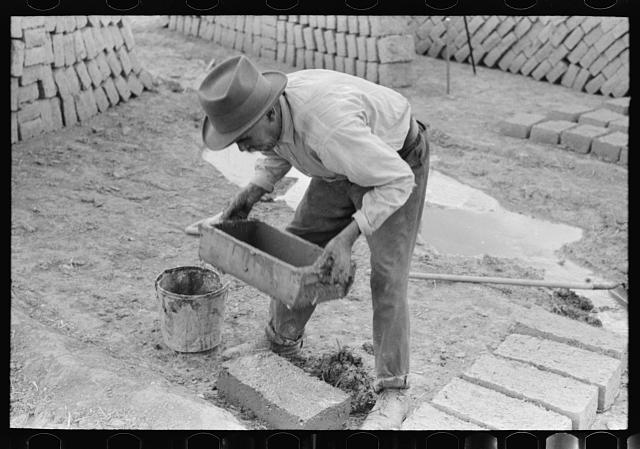
Picture Sundays: Makin' Adobes


From the Library of Congress image archive "Spanish-American removing form shaped adobe brick. The adobe brick is next dried by the sun. Chamisal, New Mexico. July 1940."

This is exactly what I've been doing in my spare time for a few weeks now in preparation for an upcoming earth oven workshop. I'm on adobe #50--45 more to go!

And, from the same archive, an adobe chicken coop:


"Scene in the adobe brick chicken house of Mr. Bosley, Bosley reorganization unit, Baca County, Colorado."

Saturday, March 10, 2012

Saturday Linkages: Audio Jars, Cutting Glass Bottles and Assorted Rants


E.B. White's letter to the ASPCA responding to his failure to pay a dog tax:

Audio Jar - Open Source Speaker Housings:

Bread geeks bring native wheat species back to Los Angeles | 89.3 KPCC via

Working Undercover in a Slaughterhouse: an interview with Timothy Pachirat via

Easy way to cut glass bottles:

Frugal food: 10 DIY tips to save money while eating better and healthier - Boing Boing via

These, and more linkages, are from the Root Simple twitter feed. 


Friday, March 09, 2012

The Stages of Alchemy as a Metaphor for Composting


I've been struck, for a long time, at the connections between alchemy and composting. I thought it might be interesting to "thoughtstyle" on the alchemical process and what it has to teach us as a metaphor for composting. Though there's not universal agreement on this, western alchemy is often divided into four stages identified by color:

Nigredo or blackening
"The ever deepening descent into the unconscious suddenly becomes illumination from above" as Carl Jung put it. In other words, you have to go down to go up. When you work with compost you're literally working with poop, waste and trash.

Albedo or whitening
The nigredo stage is purified by the fire of thermophilic bacteria and transformed into the albedo or "whitening". The dark night of the soul has concluded as the trash (poop!) in our compost pile are now a living, breathing collective entity.

Citrinitas, the yellowing
Connected with the symbolism of the sun it's a reminder that all life, including the microbes, fungi and insect life of the compost pile are ultimately (somewhat tangentially in the case of fungi) connected to the solar power of the sun.

Rubedo, a reddening
At the final stage, the rubedo, a multiplication takes place - life pervades the compost pile in a highly concentrated form. Lead becomes gold and, in fact, everything the rubedo touches becomes gold. The same goes with our compost. Everything it comes in contact with is pervaded with microbial life.

At its heart, alchemy is a metaphor for spiritual change. When we compost, we're participating with and accelerating one of nature's miracles: the transformation of waste in to life. Compost, then, is the spiritual, life-giving transformation of the planet.

Thursday, March 08, 2012

Earth Based Finishes for Walls

Kurt demos proper hawk and trowel technique.

I just spent a blissful weekend in the California desert learning earth based finish techniques from adobe master Kurt Gardella. Some observations:
  • Earth plastering is not something you can learn from a book. It takes practice and hands-on experience. In this excellent workshop we got three full days of learning the techniques both for indoor and outdoor surfaces.

Clay, sand, wheat paste and prickly pear juice as an exterior plaster.

  • There's no simple recipe for earth based finishes since clay and sand have different properties depending on where they come from. You figure out the right proportions of clay/sand/straw by doing test patches. Too much clay and the surface will crack. Too much sand and it wont stick to the wall when you try to trowel it on. Straw can be used to strike a balance. We did a second scratch coat on the first day that ended up cracking badly. We tried to add more sand but that made the plaster too hard to trowel on. The solution was to add more straw, which allowed us to keep a higher clay content in the mix, while preventing the coat from cracking when it dried.

Kurt shows how to work over the final mud plaster coat.

  • Earth based walls have an indescribable, almost metaphysical presence. I had been in the small desert cabin we plastered when it had wood paneling. Once the walls were filled with cob and the plaster coats applied it had a weightiness that's difficult to describe in words. Some other advantages: it absorbs sound, regulates humidity and is a good insulator. Drywall seems flimsy in comparison. There's something about traditional plastering techniques (even the lath and plaster of our 1920s house) that give a room a comforting feeling. Of course, plastering with a hawk, trowel and darby take a lot of skill and time which is why they are seldom done anymore. It's a pity.

Image from japanesetrowels.com

  • The Japanese make the best trowels. And, yes, there is a japanesetrowels.com. The flexible ones are especially nice for finish coats. But they ain't cheap.

Fermenting prickly pear.

  • Rotted prickly pear cactus juice, combined with some wheat paste, makes an amazing stabilizer when mixed with adobe. The mucilaginous texture of prickly pear gives adobe a stability that helps it resist water penetration. To extract the cactus juice you chop up prickly pear, put it in a bucket with some water, and let it ferment for a few weeks. We used a prickly pear stabilizer in a mix that covered the top of a cob oven.

If you're interested in learning adobe techniques Kurt Gardella will be coming to LA to teach a class on oven building. More info here. Some plastering will be done in the course of the oven class.  There's also a nice book on the subject: Using Natural Finishes: A Step-by-Step Guide.

One last thought: Working earth plaster by day and sleeping in a cozy desert cabin with a copy of the Odyssey is just about as perfect a life as I could hope for. Thank you Meredith and Doug for your hospitality!