One of the most difficult lessons to learn about gardens is that they are not permanent. As Heraclitus says, "all things are flowing."
The best gardeners I know don't suffer the attachments to plants that I do. They are much more ruthless. If a tree is in the wrong place it gets cut down. If two plants are too close together one gets ripped out.
What Pierce's disease looks like.
I'm trying to get the hang of this lack of attachment. This fall I get to rip out a grape vine that has graced our entrance arbor for a few years now. It's a muscat of Alexandria that produced a few delicious grapes before succumbing to incurable Pierce's disease. I planted this vine thinking that it was a resistant variety. It's not. The leaves, drying from the outside and the stems with alternating dark brown patches are telltale signs of Pierce's. It's gotta go and I've already ordered a climbing rose to replace it.
So radical gardeners, what are you changing out this coming year?
I'm working on a dry climate version of a keyhole garden with an integrated compost bin for our own yard (it will be lower to the ground rather than raised). With our alkaline soil I'll also skip the ash. But, in principle, it will be similar to this one.
The other day I was reading a message board where people from all
over were talking about how their gardens had done this year. Most of
them had trouble, and most of them blamed the strange weather. Now, of
course, we can't know the weather was truly to blame in each and every
failure--but temperature shifts, unseasonable heat and cool do play
havoc in the garden. It got me to thinking about climate change and how
gardeners might be able to hedge their bets to make sure they get a
harvest every season.
Climate change creates
unpredictable weather, and unpredictability is a terrible thing for a
gardener. Ensuring success, I think, will have to do more and more with
identifying and perhaps even breeding tough-ass, locally adapted
plants. Plants that are known survivors can form the backbone of your
garden. Each year you can try to plant tender favorites, exotics,
delicate plants of all sorts, whatever you want--and if the roll of the
weather dice falls in your favor, you may harvest those plants. But that
backbone of tough plants will be there, so you'll have something fresh
for your table no matter what.
Now, just what those
plants are is going to vary by location. I'm going to list off some
survivors for Southern California. Please chime in with your location
and your favorite, bomb-proof plant!
SoCal Survivors:
Prickly pear cactus. When the Armageddon comes, I'm sure we'll be
living off of this while serving our mutant cockroach overlords.
Arugula. As a winter crop--it doesn't like summer heat.
Artichoke. Everyone in SoCal should have one in their yard.
Cherry tomatoes. Cherries don't seem to be nearly as susceptible to
the various tomato maladies. Climate change or no, they are an important
backup to big tomatoes.
Swiss chard. The most amiable of all greens.
Fruit trees. They aren't bothered by much here in this mild
climate--but this wouldn't be true somewhere where, say, a late frost
could wipe out a crop. However, I think our chill hours are dropping in
SoCal so I'd recommend very low chill hour trees, like figs and
pomegranates, over more borderline trees like apricots.
And, we're very lucky to live in the ideal climate for avocados.
Credit where credit is due: this is a post by Mrs. Homegrown--due to a computer glitch it got posted by Señor Homegrown.
What I like about author and permaculturalist Toby Hemenway is that he does a lot better job, frankly, of explaining permacuture than do the founders of the movement, Bill Mollison and David Holmgren. Hemenway is a better writer and demonstrates how permaculture's abstract designs principles can apply at the household and neighborhood level. His book, Gaia's Garden, A Guide To Home-Scale Permaculture ought to be on everyone's bookshelf.
Last Thursday at the National Heirloom Exposition Hemenway gave a talk entitled "Redesigning Civilization: How Horticulture Can Save Us." What he meant by "horticulture" is not, say, propagating begonias. Rather, he defined horticulture as gardening, the kind of gardening some indigenous people did when they influenced the landscape to produce useful and edible plants. In other words, what we in the West would call permaculture. This is in contrast to agriculture which Hemenway considers to have a destructive influence on ecosystems, human health and culture.
Hemenway also, justifiably, critiqued some corners of the urban homesteading movement for promoting an egocentric self-sufficiency--"MY food on MY land" as he put it--a kind of industrial farming on a household level. While "self-sufficiency" appears in the subtitle of our first book (our publisher's idea), it's not a term we use. Kelly and I always emphasize, like Hemenway, the importance of community. We are much more comfortable with the title "gardener" rather than "farmer". We need farmers, of course, but I'd like to think of urban homesteading as being more about small scale, permacutural type projects that involve both individual and group efforts.
The takeaway from Hemenway's talk for me was the importance, especially in urban areas, of integrating community in any permacultural design project. After showing what everyone reading this blog knows, that our modern world is in big trouble, Hemenway ended on a positive note. With small scale, thoughtful design we can go a long way to solving some pretty big problems.
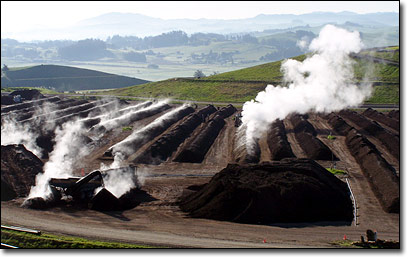
On Thursday at the National Heirloom Exposition, Will Bakx, soil scientist and operations manager of Sonoma Compost, gave a rapid fire lecture on the nitty gritty details of composting. Here's some of his useful tips:
Temperature and Turning
Compost should stay above 131ºF for 15 days to kill pathogens. Bakx recommended getting a thermometer to check the temperature every day during the initial period and using Sonoma Compost's handy Temperature/Turning Sheet (pdf) to keep track of the temperature of the pile. If the pile dips below 135ºF, turn it. If it doesn't get up to temperature, add more nitrogen containing materials. If it gets above 163ºF, add more carbon containing materials. After the initial turnings just let it sit unless you have to turn to add moisture.
Bakx believes that you should turn as little as possible, just enough to achieve that first period of 15 days above 135º F. I really like the simplicity of this method and will definitely use the turning sheet the next time I build a pile. I really makes it clear when you should turn and how often.
Moisture
Lack of moisture, according to Bakx, is the number one mistake made by beginning composters. He suggested an ideal moisture range between 40-‐60%. You can check the moisture level using the following technique:
Take handful of material. Squeeze firmly
Water escapes: >60%
Shiny ball: 55%--60%
Ball remains when tapped: 50--55%
Ball falls apart when tapped: 45--50%
No ball forms: 40--45%
Unless hand feels powdery dry: <40 p="p">
Bakx has drip irrigation set up on his large windrows, something I might try with my pile the next time.
Pile Size
The mimimum size for a compost pile is 3 x 3 x 3 feet or larger.
Things not to add
Ash--our soils tend to be alkaline in California and ash will raise pH. A small amount is ok.
Cardboard--Bakx is afraid of the glues and said that he is very conservative about what he ads to his compost.
Toilet paper--because of metals (I've been unable to verify this--if any of you know about this issue, please leave a comment.
Alleopathic plant material such as eucalyptus leaves and walnut leaves, on the other hand, are ok to add. Bakx cited studies where plants were successfully grown in leaf litter made entirely out of eucalyptus leaves. He suggested keeping such alleopathic material to less than 15% of the pile.
Here's a handy little tip. I'm pretty sure I heard it first from Mr. Jack Spirko:
Save the root ends of your green onions (aka scallions) -- the parts you cut off when you're cooking. Plant those, roots down, under about an inch of soil and they will generate new green onions. Keep this cycle going throughout your growing season and you should have an endless supply of green onions for your table. It's much easier than starting from seed!
Green onions are shallow rooted, so work very well in pots. Also, they're so unobtrusive and easy to grow that you can just tuck them here and there in your garden--anywhere that gets water--and forget about them until you need them.
As if I didn't need a reminder of how important compost is to a vegetable garden, note the tomato above. It's on its way out, but it grew with no supplemental water in hard-packed clay soil contaminated with lead and zinc in a hot side yard. Why did it do well while the rest of my vegetable garden did not do as so good this summer?
Homemade compost.
I didn't have enough compost for the rest of the veggie garden so I bought some at a nursery. The homebrew compost obviously had much more life in it.
And life is the point. Soil is a living thing. Plants, particularly vegetables, need microbial life to thrive.
A lot of magic happens in the "dead" parts of a garden. Flowers gone to seed feed birds. Dead stalks support important insect life--from spiders to pollinators. Fallen leaves and sticks give habitat to lizards and toads and mushrooms and myriads of invisible creatures.
Yet dead growth is not attractive to the human eye, and around about this time of year we're all itching to make a clean sweep of all that brown stuff. I know I am, but this morning I was grateful that I've procrastinated thus far, because I saw a flock of tiny little gnat catchers (adorable!) feasting on whatever tiny bugs live on the scraggy stand of fennel standing in our front yard, and a couple of hours later I found a flock of house finches enjoying the withered heads of our long, long dead sunflowers. I almost cut those stalks down yesterday, and am so glad I didn't.
It's a balancing act. If your garden is in your front yard you pretty much have to be tidy to appease the neighbors. If you have a small back yard, like we do, it's hard to avoid the temptation to clear the decks, because everything is right in your face. Blessed are those with big yards, because they might have the option to keep the areas closer to the house tidy while allowing the "back 40" to go to seed.
I guess all you can do is keep the little creatures in mind and put off the clean up as long as you can. Leave dead leaves and sticks on the ground year round. Designate small corners as wilderness. The more you support all levels of life in your garden, the more your garden will thrive.
Spotted in a neglected corner of our backyard: New Zealand spinach (Tetragonia tetragonioides). What's interesting is that it self-seeded and grew with no supplemental water in the middle of summerin lead and zinc contaminated soil. We've never been able to grow regular (and unrelated) spinach here. But there's no stopping the New Zealand spinach. Due to the heavy metal problem we won't be eating this particular specimen, but when I build our new raised beds you can bet I'll sow some New Zealand spinach for next year.
As regular followers of this blog may recall, we did some soil tests last year that revealed elevated levels of lead and zinc in our backyard. The cause? Most likely, paint from our 92 year old house and nearly a hundred years of auto exhaust and dust from brake linings.
Applying a little alchemy to turn lead to gold, I think the most productive thing I can do is to help get the word out about lead soil and how common this problem is in urban areas. Towards that end I though I would share five things that we learned from our backyard lead crisis:
Buyer Beware. When you are shopping for a house do multiple soil tests. Once you buy the house it's too late. Real estate contracts in California (and I suspect elsewhere) have been loaded up with disclaimers about lead and old houses. I'm no legal expert, but I suspect it would be difficult to go after the seller given the lead clauses we signed in our ignorance.
The dirt on soil labs. Choose a soil lab that gives detailed results and is willing to do some phone consultation. We used to recommend the cheap tests form UMass, but their results were significantly different than Timberleaf Soil Testing and Wallace Labs, which were more in line with each other. Both Wallace and Timberleaf give you more detailed reports and are both willing to chat on the phone. They cost more but are worth it.
Raised beds. Not much else to say other than those two words if you want to grow vegetables and have a lead problem. Right now I have a big compost pile going that I made with hay, straw and horse manure. I'll use this compost along with imported soil to fill the raised beds that I'm going to build this winter. And you can bet that I'm going to test that imported soil first.
Philosophical lesson. The future health of the human species requires us to be a lot more conservative in the use of chemicals. Lead was known to be a problem since the Romans, but we went ahead and used it anyways in paint and in gasoline and the results have been tragic. Nassim Taleb has written eloquently about the need to approach complex systems like nature and the economy with an attitude of humility and admit our ignorance. When we fool around with complex systems we're asking for trouble.
Rhetorical lesson. There should be a logical fallacy called the "appeal to technology." It's the idea that there just has to be a technological solution to every problem. This is a very common fallacy in our age. Some people have suggested that I try phytoremediation, the process of growing plants like sunflowers that accumulate lead. At the end of their growing cycle you pull the sunflowers and send them to a toxic waste dump. Sadly, this is just not practical in a residential yard. I would have to pull every living thing, including a mature avocado tree, and grow nothing but sunflowers for the next 20 years. Others have suggested mushrooms as a remediation technique, but they don't grow well in this dry climate. Lead is an element and it simply doesn't go away. Once it's in the ground it's in the ground. The best way to deal with it is not to use it in the first place. The city of Oakland is trying a more practical solution to deal with lead: applying fish bone meal to lead contaminated soil. Fish bones contain phosphates which bind up lead and
make it less bioavailable to plants. Our soil tests indicate that we
already have lots of phosphates in our soil, so I'm not sure if adding
more would help.
Of all of these points I think the first is the most important. I'll repeat it again, if you are shopping for property get a soil test.
From BoingBoing, an update on the Drummondville, Quebec kitchen garden, seen in the time lapse video above. City officials have backed down on asking for the garden to be removed.
Drummondville town officials announced the decision [Link is in French] this week during a special session of the Municipal Council to discuss the case.
The decision could create a ripple effect in other cities worldwide as
zoning laws are a constant debate in urban environments. Roger told us,
“The Drummondville case was one of the highest profile examples of a
local municipality challenging the right to grow food in one’s own yard.
While it took place in Canada, it quickly attracted international media
attention because of the garden’s beauty and productivity. The win is
significant because it helps establish a precedent that other urban and
suburban gardeners can refer to when similar challenges arise in other
parts of the world.”
So what are the activities that microbes make possible around the homestead? To name just four:
Fermentation
Beekeeping
Soil Fertility
Human beings
Pretty important stuff. In fact, new systems thinking, applied to our natural word, is demonstrating that things like human beings are really just symbiotic sacks of microbial life. An article in the Economist, "Microbes maketh man" discusses just how important microbes are to human health:
The traditional view is that a human body is a collection of 10 trillion
cells which are themselves the products of 23,000 genes. If the
revolutionaries are correct, these numbers radically underestimate the
truth. For in the nooks and crannies of every human being, and
especially in his or her guts, dwells the microbiome: 100 trillion
bacteria of several hundred species bearing 3m non-human genes. The
biological Robespierres believe these should count, too; that humans are
not single organisms, but superorganisms made up of lots of smaller
organisms working together.
Mess with the complex interdependent relationships between microbes and people, soil etc. and you're asking for trouble. This, for me, is the argument against things like GMOs, Miracle Grow or conventional chemical beekeeping. We don't know enough, and probably never will know, how 100 trillion bacteria will react to our latest innovation. Best to be conservative when it comes to microbial life.
Looking forward to seeing more of this microbial paradigm shift in science.
I think I've stumbled upon a strange phenomenon: the smell released by turning compost pisses off bees. Yesterday was the third time this has happened to me. I took a sting just underneath my eye and another one to my right hand when I was turning a pile located about 15 feet away from a hive. Coincidentally, the same thing happened to a friend yesterday: he got stung while working with compost near a hive. Ordinarily our bees are reasonable about living in a small yard with humans--they are not even very aggressive when I open their hive. But apparently turning compost near them is a different matter.
I look like I've been in a fight. Lots of Benadryl today.
I have a theory. Bees are incredibly sensitive to odors and use them to communicate. Their alarm pheromones alert the hive to predators such as bears and people. Bee alarm pheromone consists of many different compounds. Interestingly, a lot of these compounds such as n-Butanol and Isoamyl acetate are byproducts of fermentation processes. I'm guessing that a number of these compounds are present in compost, and that when you turn a pile the act releases a cloud of compounds that mimic the bee's alarm pheromones, causing them to attack.
It turns out that other lifeforms like to mimic honeybee alarm pheromone. Some species of orchids mimic bee alarm pheromone in order to attract pollination services. Small hive beetles, who raid beehives for their pollen, apparently bring with them a yeast that causes a fermentation process that mimics alarm pheromones. The small hive beetle's fermented alarm pheromone, in turn, attracts more small hive beetles who quickly overwhelm the hive. These sorts of deceptive, symbiotic and parasitic loops in nature really amaze me.
As a side note, I've only had compost pile related bee stings at this time of year, when honeybee numbers are at their peak and pollen and nectar sources are getting scarce (summer is hot and dry in Los Angeles and not much is blooming).
If you don't have a hive, I doubt random, foraging worker bees would go after you if you are just turning compost in your yard. But if you've got a compost pile and are thinking about installing a hive--or vice versa--I'd seriously consider keeping the two as far apart as possible.
Am I alone in noticing this compost/bee alarm pheromone issue?
The low maintenance dogma reveals something about our culture: we don’t know how to BE in our landscapes. When someone asks me for “low maintenance,” what I hear is: “I don’t want to deal with this landscape.” Maintenance is nothing more than gardening, a personal investment into the landscape. I’ve long said that gardening is a relationship with a piece of ground. That relationship is the single most rewarding aspect of gardening. If the act of gardening is a relationship, then low maintenance gardening is code for “let’s just be friends.” Or “I’m just not that into you.” Low maintenance is permission to disengage, pull away, and let go. When we do that, our landscapes suffer. And so do we.
Rainer on Gardening in Small Spaces
I found out about Rainer via Garden Rant, who interviewed Rainer on the topic of small garden ideas. As we struggle with some design mistakes we made last fall, Rainer's advice really rang true:
Don’t bring a plant into that garden unless it has a striking form
(spiky, billowing, vertical spire), strong foliage color
(blues/golds/purples, etc), or a long season of blooms (2 month
minimum).
We had to redo our yard after last year's lead soil reports (more on that in another post), and the design of our own space is a frequent source of marital disagreements. After reading Rainer's advice together we vowed, "plant drama, not couple drama." Looking forward to reading more from this gifted designer and writer.
Have you ever gone to a concert or a convention or some other large event and marveled at the staggering amounts of waste generated? I've been particularly wishing more of that waste was composted. And what do you know? Just as I was thinking about this, guest Root Simple blogger Nancy Klehm happened to send me a post on this very subject. If only every event had a compost tsar! Here's Nancy:
I am obsessed with urban soil health, so when I got a phone call in mid May from Steven of the Seeds of Peace Collective, I realized a soil ship had floated in. Seeds of Peace is a collective of accomplished cooks and trained street medics, based in Missoula, who provide delicious home cooked food in support of non-violent social movements. They were in Chicago to set up a free community kitchen to serve thousands of NATO conference protestors. Steven said they needed my assistance with their food waste as they had already overwhelmed a small urban garden’s compost bin.
It was late, so I waited until morning and drove my pickup to their site – a parking lot between a community center and an auto parts store. The scene was impressive: a maroon biodiesel school bus with windows dressed in curtains screen printed with frying pans and butcher knives and the largest wok and cast iron pan I have ever seen. A purple tent stretched from the bus into the lot overhanging a to-code outdoor kitchen with multiple burner stoves, wash sinks, prepping area and boxes of produce, mostly organic. At least 12 people stood prepping food for the day. Gallons and gallons of salad and stir fry ingredients were being tossed and mixed in 30 gallon coolers with small wooden oars.
Every day for a week, I picked up the 100 or so gallons of food waste a day and provided them with extra large garbage cans to pour their waste into. Their kitchen was three miles from the rallying area. Once the food was prepared, they would pack a flat bed with it and a few tables and trundle off to the park to serve their healthy, delicious food free of charge.
One pick up was an entire garbage can of delicious looking chickpea and sweet potato curry that had fermented in the sun due to the police blocking their passage to the Park. It made me cry to compost that delicious looking curry. I had to use a couple of bales of straw and dumpstered cardboard from my carbon stockpile to take care of so much nitrogenous waste. Over the past month, the pile, well integrated and covered with a thick layer of straw reached thermophilic temperatures and now is in its mesophilic stage. Most of the food is just residual moisture now and the pile has dropped in volume by at least 20% due to composting and evaporation. So much future soil!
Thanks Steven, Sarah, Patrick and the rest of you of the Seeds of Peace Collective. May you meet with strong hearts and hands on the road.
I spotted some nice front yard gardens while I was out for a walk the other day. Check out these finds:
Above, these gardeners have used some scrap lumber as retaining walls to allow them some extra soil depth for planting. In this small front yard bed they're growing beautiful kohlrabi (my new favorite vegetable), some climbing beans and a few different kinds of squash. Keeping a veggie garden doesn't have to be either complicated or expensive. Neighborhood gardens like this are really what inspired us when we started out. They taught us to plant boldly, to plant casually, and to plant anywhere we wanted.
This yard above delighted me. It seems they've given up on their lawn and instead have planted an army of caged veggie seedlings in orderly rows across their front yard. Not pictured is a little strip of established food garden at the front of the yard. It looks like they wanted more room and said, "To heck with the lawn!" I'm going to keep checking progress on this one.
In this front yard, the lawn has been replaced with drought tolerant perennial shrubs and grasses arranged around gravel paths. It's very pretty. I like that the landscaper included some artichoke plants in the mix, proving that gardens can be edible and stylish. Many people don't know that artichokes open into huge, striking purple flowers if you don't harvest them for food--so it's win/win either way. And bees adore artichoke flowers. They roll around in the thick pollen like gangsters in cash.
Graham stirs the vat with his "witchy stick" --which is tinted many beautiful shades of blue.
One of the primary lessons of gleaned from my Shibori Challenge is that cotton is difficult to dye with natural dyes, whereas wool and silk take these colors beautifully. Know your materials!
Building on that, I've also figured out that the reason indigo dye is the favored dye for shibori techniques is because indigo gets along very well with cotton (and other plant fibers) and the dyeing characteristics of indigo are ideal for shibori. In fact, the idiosyncrasies of indigo probably led to the development of shibori, way back in the mists of time. So, if I want to make shibori patterned cotton cocktail napkins, as was my challenge to myself, I may as well fall in with thousands of years of tradition and dye with indigo.
Book reading and Internet surfing are all well and good for gathering knowledge, but to learn an unfamiliar process, nothing works better than to find someone who knows what they're doing and go watch them. That way, you learn via a pleasant form of osmosis, rather than by frowning at at a glowing screen.
Our friend Graham Keegan dyes with indigo and sells his beautiful canvas and leather creations in his own Etsy shop. He kindly invited me to come to his studio and watch him dye some test swatches yesterday.
What follows are pictures and notes which I hope will help other indigo beginners sort things out.
Here's a stack of stuff he's working on :
And here's some silk he dyed with bougainvillaea flowers. The two tone effect is just how it happened to dye. You rock, Graham!:
Its origin is unknown. It might come from Bountiful Garden seed, or perhaps Franchi.
It volunteered in a corner of one of our backyard beds, in a bed we were resting. We didn't water it. It grew all summer long anyway, despite having no rain at all. In fact, it grew huge and lush. We never harvested it, though, because it was growing in our lead contaminated soil. So we continued to ignore it and it continued to thrive.
It sucked up the winter rains and grew even bigger. Then, early this spring, as part of our whole "dealing with the lead" problem we tore out the two raised beds in Lead Central in order to dig out the clay beneath them to make adobe bricks. By this time SuperChard was so magnificent I couldn't kill him (around this time I began to anthropomorphize the chard), so I trimmed off his outer leaves (some of which were as long as my arm) and transplanted him into a self-watering container (SIP).
I knew that transplanting such a big, established plant would be difficult, but by this time I really wanted to harvest this plant's seed. So I told him that I wanted to preserve his genetic legacy--what plant doesn't want that?--and praised his beauty, and babied him through the transition.
SuperChard adapted beautifully to life in a container and quickly grew back to full size. We took him with us to our various gigs, both to show people what a SIP was and to blow their minds with the beauty of chard. I wish I had a pic of SuperChard in full leaf. In the photo above all his energy has gone into the flower, so the leaves are a sad shadow of their former glory. Basically, SuperChard used to look like an exotic, pampered tropical plant. One that did not mind rattling around in our hatchback and getting dragged all over tarnation.
Chard reproduces in its second year, and SuperChard's time has come. He began to bolt with our first heat wave and has sent up a huge flower spike. He drinks like crazy to support the SuperSpike--so we fill the SIP reservoir daily.
I'll be sad to say goodbye to SuperChard, but I will be collecting his seed. And I do believe we will have to keep our promise to him and spread his genetic diversity far and wide by sending his seed across the country to be stewarded by our readers.
So what edible/useful plants pop up in lead contaminated soil along a hot, dry alternately sun-baked and deep-shaded south side of a house in Southern California? After dumping a load of compost along our side yard, mother nature is doing her own food forestry experiment. This month the following things popped up out of that load of compost:
stinging nettle
cardoon
tomatoes
nasturtium
fennel
sunflowers
Elsewhere in the yard, New Zealand spinach has popped up on its own. I doubt the stinging nettle or nasturtium will hang on for long (it's out of season for those plants here). But I'm willing to bet that the tomatoes, New Zealand spinach, fennel and cardoon will take. Because of the lead, the only thing I would eat of that bunch are the tomatoes (fruit usually does not take up heavy metals). Still, I think bio-activity in the soil in the form of microorganisms and plants will, over a very long period, help remediate that contamination.
More and more, I'm drawn to vegetables that easily re-seed themselves and grow without any fuss. And knowing when to plant things can be tricky, so watching nature's own timing can provide important clues. I've taken to moving some of these self-seeded plants to our raised beds. And I've pledged to take better notes (this blog post, for instance) to keep a record of what comes up on its own and when.
So tell us where you are and what's sprouting on it's own this spring in your garden?
We're lucky to have another guest post by Nancy Klehm (see a nice interview with her on foraging here). Nancy visits us at the Root Simple compound at least once a year. What follows is an account of a plumbing misadventure she had on her last visit.
To give you some context, ever since we've remodeled our bathroom and switched to a low-flow toilet we've had periodic backups. We think there is a low spot just within reach of our turlet snake. The toilet flushes OK most of the time, but at least once a week I've got to deploy that damn snake.
Here's Nancy:
I don’t use a flushie often, I made the decision to ‘go dry’ years ago, adopting the bucket toilet + sawdust system as it pairs nicely with my composting obsession and food growing habit.
I stayed at Erik and Kelly’s back in February. Their low flush toilet and antique piping can’t seem to handle even the most modest bodily donation. Once a flushing attempt proves unsuccessful, and immediately following the ‘oh no…’ guilty grimace, a light-hearted blame game plays out and then according to homestead rules, Erik snakes the toilet. The closet augur is kept on the front porch (to greet visitors?). Erik augers for a few minutes, flushes successfully, marches the tool back outside to air out and we settle back into our routines relieved that our burdens are flowing into the larger mystery of pipes and their soupy contents to the municipal waste treatment plant miles away.
But with Erik and Kelly out of town on one of the weekends during my stay, the daily chores of feeding the kittens, letting out the single hen to roam the yard and snaking, if so needed, fell on me. And yes, the toilet clogged and no, I did not assume the blame. I am regular enough (2-3x/day) as are Erik and Kelly for the record [editor's note: the editors demur from either acknowledging or disavowing the hypothetical frequency of their natural propensities.] to avoid creating such monsters and yet, the flushie needs snaking every day soon after the post-caffeine effect.
Using a closet augur looked pretty self-explanatory, but I decided to check in with YouTube University and watch ‘the pros’ do it. I was fortunate to find a true pro: Ramona’s Plumbing, a D.I.Y. plumbing site with 36 videos uploaded of Greg Chick, a licensed plumber in flipflops who walks you through fixing problems on a variety of topics including faucets, showers and yes, toilets.
I watched a 10:37 minute video of Greg dislodging a ‘soft blockage’ of intentionally placed, wadded paper towel. He was sensible and upbeat, but the bowl in the video was clean. The one I was working on was not. My tool was the poor cousin of the streamlined one Greg was using. So I opened the window wide, and with a burning candle and a wad of mugwort smoldering on the back of the tank, I swung the augur into the bowl and batted a foul. I closed the door and grabbed the phone. Fortunately, I managed to reach Erik and he coached me through my next attempt. My heart-rate jumped ugghing that augur coil into the tank. I yanked it out. There was a sloop. I flushed. Pooping in a bucket with sawdust ultimately feels more sanitary, sane and more manageable as very little can go wrong with such a simple system.
And, when I sat with cup of tea to write this, I had just snaked the toilet for the 6th time in three days. Sure I was glad to learn a new tool and this skill, as well as earn some more insight into the workings of water toilets and yet, snaking a toilet is one of the more compelling arguments for why I ‘go dry’.
Considerations for abandoning your flushie (and switching over to the bucket):
Your body’s nutrient should be returned to the Source and by that I mean Mama Earth. This has always been the way. Now is the opportunity to revisit this connection.
Pooping into sawdust allows you to observe your waste, an indicator of healthy body function. This is commonly understood in the medical community be it Western, Aruvedic or Chinese.
Human waste is a source of healthy soil if properly composted. (subset of consideration #1) It is sane and safe to compost your human waste if you are a competent (read: very experienced) composter of other organic waste and have the place to do so that will not create a nuisance (aka SMELL) for your neighbors or family.
Waste should not foul potable aka drinkable water.
Waste treatment plants use chemical and loads of energy (gas and electricity). Electricity by the way, depending how it is generated also uses large amounts of fresh water.
Greywatering your house is a much more enjoyable way to stretch into your plumbing fantasies than dealing with a clogged flush toilet.
Your water bill will plummet. Toilet’s account for 30% of our daily water useage.
It’s quiet. No one knows you are ‘using it’ even if you are on the phone.
In other words, Disconnect to Reconnect, folks.
Since I haven’t been able to convince the most thoughtful people I know to join the dry movement, I am investing in a closet augur and taking this show on the road.


 ought to be on everyone's bookshelf.