 She's feathering in and looking like . . . a chicken.

Friday, June 29, 2007


Tuesday, June 26, 2007
The Real Injera
 Homegrown Revolution was delighted to receive a comment from "Watch Woman", who is from Ethiopia, reacting to the injera recipe we posted earlier,
 From my experience of baking injera, the baking soda/powder, self-rising flour or commercial yeast alters the real taste & texture of teff injera. I say, the restaurants here in the US have the look alike of the injera, but far from the real taste & texture of injera. Sorry but the truth. Just by using one of your starters you can bake good decent injera. No need to add the baking powder/soda.Trust me. See, the reason injera is always sour dough back home is, that it will take some of the bite out of that spicy rather hot stew (doro-wote- spicy, hot chicken & hard boiled egg stew ).Best of all, if you go to Watch Woman's blog she has posted her own recipe for injera and we can't wait to try it!
I remember, once I invited a friend of mine (American of course) for lunch. Served this real doro-wote hot, I mean this was the real deal, real hot. Only I forgot to warn him. I remember his face turned pink & his eyes red, bulged out. O my God, what was I thinking? Well my first culture shock. That was some 27 years ago. Now I do not make doro wote that hot myself. I guess ---when you live in Rome, ---as the Romans,
Sunday, June 24, 2007
Whole Wheat Sourdough Starter Recipe
 Back in March we showed how to make a sourdough starter with white flour. This month we converted a white starter over to whole wheat and have baked many successful loaves of bread with it. The reason that we have to do this conversion rather than starting out with whole wheat flour is that whole wheat tends to get moldy before the beneficial cultures have a chance to take over.
You can use our "Not Very Whole Wheat Loaf" recipe to bake loaves with a whole wheat starter by simply substituting it for the white flour starter. You'll end up with a loaf that's about half white, half whole wheat.
To convert a starter from white flour to whole wheat flour do the following:
1. Begin with your white flour starter. Our recipe for creating a white flour starter is in a previous post.
2. Instead of feeding your white flour starter with the usual routine of a half cup of white flour and a half cup of water each day switch to feeding it a half cup of whole wheat flour and a half cup of water.
3. After about a week you will have "converted" your white starter to a wheat starter--hallelujah!
As we emphasized with our recipe for white starter, you must feed the starter every single day or it will begin to rot. This is particularly important with whole wheat flour which will go bad much more quickly. If you can't keep up with the feeding you can temporarily store the starter in the refrigerator, but for no more than two weeks with whole wheat starter. White starter will last in the fridge for longer.
If this turns your crank, you can sit around your compound watching your sourdough starter bubble while geeking out on Cornell Professor Steven Laurence Kaplan's book Good Bread is Back, which details the revival of sourdough bread making in France in the early 1990s. Kaplan notes that sourdough,
"rises less than a dough made with baker's yeast and also more slowly. Its crust is thicker. It keeps significantly longer. It has greater nutritional value, partly because it is richer in certain vitamins and enzymes that are by-products of lactic fermentation, and it contains less phytic acid, which blocks mineral absorption."So get that starter going and forget about that crap bread at the supermarket!
Thursday, June 21, 2007
Nuts!
 As of fall 2007 truly raw almonds will no longer be available in the US or Canada, because the USDA, FDA, and the California Almond Board has released a marketing order that all almonds be pasteurized. This is due to two recent salmonella outbreaks, the cause of which, in Homegrown Revolution's opinion, is the usual poor factory farming practices. But it gets worse, according to the folks at the Weston A. Price foundation,
There is an even bigger issue. The FDA has decided not to tell the consumer the truth about this processing step. The almonds you will buy in Wholefoods this fall may still say "raw almonds but they will have been subjected to high heat and a five log kill step...that they are calling Pasteurization". This lie is being permitted by the marketing order!!But there's even more bad news since pasteurization, according to the Almond Board of California, involves a choice of steam, high heat or, we kid you not, highly toxic and carcinogenic propylene oxide once used as a racing fuel, an insecticidal fumigant and an ingredient in thermobaric weapons. Thank you Almond Board and FDA!
But it turns out we all may have been buying pasteurized and bad tasting almonds all along without knowing it. Hidden in this little reported story is the dirty secret of how Trader Joe's is able to offer cheap nuts. According to D & S Ranches, which runs a group of orchards in California's San Joaquin Valley,
The Almonds that you see in retail stores, particularly the big chains, and membership stores, are usually very inferior for a number of reasons.The other moral here is to incorporate nut trees into your landscaping. Why plant a useless ficus tree when you can plant something that will provide food? And come harvest time you wont need to mix in any racing fuel.
First, they are almost never a single variety, but rather a "mix" of many different Almonds. They are rarely sized for uniformity or inspected for quality and they contain a large portion of broken and scratched nuts and are mostly smaller nuts. This reduces the wholesale costs on the nuts and increases the profit for the store..
But the biggest problem is the transportation and storage. They are usually not stored properly and are exposed to odors around them in warehouses that contain everything from cases of motor oil to TV sets. They have endured truck rides around the country, in and out of long storage periods in hot warehouses or “distribution centers”. Proper industry standard cold storage is critical to maintain nut quality, and large chain stores do not have the facilities, the expertise, and frankly don’t care very much about, proper storage.
Recently large chains like Trader Joes and Costco have begun obtaining "pasteurized" Almonds This is a disaster. It effectively destroys all the delicate Almond Flavor, but it has one big benefit. It allows enormous profit for the store. This is because, "just any old nuts" including ones that are years old, imported from unknown sources and perhaps not USDA inspected, of questionable quality, to be "thrown into the pasteurizer machine" and the resulting nuts can be made safe for human consumption! They are tasteless and terrible, but you can safely eat them, and you will be happy to know that you are helping the share holders of that big corporate chain, because they bought the nuts for a fraction of what quality fresh nuts would cost.
Monday, June 18, 2007
Selling the Revolution
“Revolutionary urbanists will not limit their concern to the circulation of things and of human beings trapped in a world of things. They will try to break these topological chains, paving the way with their experiments for a human journey through authentic life.”So it's got singing hippies and it's basically an ad, but we just can't help but love this mini-doc about the creators of our fun and useful Xtracycle:
-Guy Debord “Situationsit Thesis on Traffic”
Sunday, June 17, 2007
A New Source of Fuel

Homegrown Revolution comrades, the Yes Men have pulled off a rather nice stunt:
June 14, 2007
FOR IMMEDIATE RELEASE
EXXON PROPOSES BURNING HUMANITY FOR FUEL IF CLIMATE CALAMITY HITS
Conference organizer fails to have Yes Men arrested
Text of speech, photos, video: http://www.vivoleum.com/
GO-EXPO statement: http://newswire.ca/
Contact: fuel@theyesmen.org
More links at end of release.
Imposters posing as ExxonMobil and National Petroleum Council (NPC) representatives delivered an outrageous keynote speech to 300 oilmen at GO-EXPO, Canada's largest oil conference, held at Stampede Park in Calgary, Alberta, today.
The speech was billed beforehand by the GO-EXPO organizers as the major highlight of this year's conference, which had 20,000 attendees. In it, the "NPC rep" was expected to deliver the long-awaited conclusions of a study commissioned by US Energy Secretary Samuel Bodman. The NPC is headed by former ExxonMobil CEO Lee Raymond, who is also the chair of the study. (See link at end.)
In the actual speech, the "NPC rep" announced that current U.S. and Canadian energy policies (notably the massive, carbon-intensive exploitation of Alberta's oil sands, and the development of liquid coal) are increasing the chances of huge global calamities. But he reassured the audience that in the worst case scenario, the oil industry could "keep fuel flowing" by transforming the billions of people who die into oil.
"We need something like whales, but infinitely more abundant," said "NPC rep" "Shepard Wolff" (actually Andy Bichlbaum of the Yes Men), before describing the technology used to render human flesh into a new Exxon oil product called Vivoleum. 3-D animations of the process brought it to life.
"Vivoleum works in perfect synergy with the continued expansion of fossil fuel production," noted "Exxon rep" "Florian Osenberg" (Yes Man Mike Bonanno). "With more fossil fuels comes a greater chance of disaster, but that means more feedstock for Vivoleum. Fuel will continue to flow for those of us left."
The oilmen listened to the lecture with attention, and then lit "commemorative candles" supposedly made of Vivoleum obtained from the flesh of an "Exxon janitor" who died as a result of cleaning up a toxic spill. The audience only reacted when the janitor, in a video tribute, announced that he wished to be transformed into candles after his death, and all became crystal-clear.
At that point, Simon Mellor, Commercial & Business Development Director for the company putting on the event, strode up and physically forced the Yes Men from the stage. As Mellor escorted Bonanno out the door, a dozen journalists surrounded Bichlbaum, who, still in character as "Shepard Wolff," explained to them the rationale for Vivoleum.
"We've got to get ready. After all, fossil fuel development like that of my company is increasing the chances of catastrophic climate change, which could lead to massive calamities, causing migration and conflicts that would likely disable the pipelines and oil wells. Without oil we could no longer produce or transport food, and most of humanity would starve. That would be a tragedy, but at least all those bodies could be turned into fuel for the rest of us."
"We're not talking about killing anyone," added the "NPC rep." "We're talking about using them after nature has done the hard work. After all, 150,000 people already die from climate-change related effects every year. That's only going to go up - maybe way, way up. Will it all go to waste? That would be cruel."
Security guards then dragged Bichlbaum away from the reporters, and he and Bonanno were detained until Calgary Police Service officers could arrive. The policemen, determining that no major infractions had been committed, permitted the Yes Men to leave.
Canada's oil sands, along with "liquid coal," are keystones of Bush's Energy Security plan. Mining the oil sands is one of the dirtiest forms of oil production and has turned Canada into one of the world's worst carbon emitters. The production of "liquid coal" has twice the carbon footprint as that of ordinary gasoline. Such technologies increase the likelihood of massive climate catastrophes that will condemn to death untold millions of people, mainly poor.
"If our idea of energy security is to increase the chances of climate calamity, we have a very funny sense of what security really is," Bonanno said. "While ExxonMobil continues to post record profits, they use their money to persuade governments to do nothing about climate change. This is a crime against humanity."
"Putting the former Exxon CEO in charge of the NPC, and soliciting his advice on our energy future, is like putting the wolf in charge of the flock," said "Shepard Wolff" (Bichlbaum). "Exxon has done more damage to the environment and to our chances of survival than any other company on earth. Why should we let them determine our future?"
About the NPC and ExxonMobil: About the NPC and Exon Mobil
About the Alberta oil sands: About Alberta oil sands
About liquid coal: Sierra club on liquid coal
Saturday, June 16, 2007

Thursday, June 14, 2007
A Recipe for Injera

One the many searches that leads folks to this cranky web site is the topic of the Ethiopian sponge bread known as injera. We think we know what's going on. People go out to dinner at an Ethiopian restaurant and come home wondering how to make the bread, leading to a fruitless search of the internets for a recipe and our old post about one of the ingredients, teff flour.
 The recipe we used comes from the excellent book Wild Fermentation by Sandor Ellix Katz. This is a life changing recipe book that every urban homesteader should own--so go out and buy a copy!
So here's how we made injera based on Katz's recipe:
Ingredients
2 cups sourdough starter (check out our post on an easy way to keep and maintain a sourdough starter)
5 cups lukewarm water
2 cups whole-wheat flour
2 cups teff flour (an Ethiopian grain available from Bob's Red Mill at Whole Foods)
1 teaspoon salt
1 teaspoon baking soda or baking powder (optional)
Vegetable oil
1. Mix the sourdough starter, flours and water. The result should resemble a pancake batter.
2. Ferment in a warm place for 24 hours.
3. Just before you cook add the salt.
4. Katz gives several options with the baking powder/soda. He says that if you like the sour flavor and don't mind a less bubbly bread skip the baking soda. We like sour, but we thought the final result was too sour so we added the baking soda. Katz says that using baking powder will provide leavening but leave the dough sour. Again, we recommend adding some baking soda.
5. Stir well and let sit for a few minutes after adding baking soda or powder.
6. Heat up a pan and and lightly coat it with oil.
7. Spread the batter thinly in the pan and cook on one side only. Cover the pan and cook the injera over medium heat.
Injera works as both bread and utensil and the batch we made tasted better than what we've been served in restaurants.
Tuesday, June 12, 2007
The Rag and Bone Man

Loyal Homegrown Revolution reader Ken M wrote us with a challenge for us to figure out what can be done with old rags. Ken says that he's made a rag rug once and proposes the intriguing idea of "patching a pair of jeans with rags for so many years that eventually every single thread from the original has been worn away and replaced by rags." This sounds a bit like a poetic inversion of Yoko Ono's "Cut Piece", in which she sat motionless on stage and invited the audience to slice off bits of her clothing.
So what to do with the rags?
1. Compost them--cotton rags will decompose just fine.
2. Mulch--a layer of cotton will make a good first layer. We've used newspaper in the past with organic material on top, but in our dry climate here in LA the newspaper can actually prevent water from getting to the soil when it rains. We're guessing that cotton might work better.
3. Household cleaning--this is obvious, but we do go through quite a few rags with our too few household cleanings, not to mention keeping the bicycle chains clean.
4. Paper making--one traditional method of paper making begins with fermenting cotton rags in water for a few weeks and then beating them to a pulp with hammers. The rag and bone man pictured above is collecting rags for paper making (the bones went to make glue and other things). The contemporary version of the rag and bone man are the thift stores that ship our old clothes to the third world putting local garment makers out of business.
Ken also speculates about weaving rags, which as this website shows, yields some attractive results. The thought of weaving with rags reminds us of the late "Slim" Sirnes, a resident of the bizarre ghost town of Goldfield Nevada, who Homegrown Revolution was privileged to have met up with a few years ago. Sirnes found a way to shred aluminum cans and weave them on a loom of his design creating a unique metallic fabric that he used as a building material and to make art. Watch Slim in action here.
Sunday, June 10, 2007
Why Urban Farm?
It's been a challenging week at the Homegrown Revolution compound. We lost one chick, bringing our nascent flock down to two. We decided that since chickens are social animals to add two more in case of other unforeseen problems bringing our total up to four. Such are the cycles of life and death on the new urban homestead.
Bryan Welch, who raises livestock and is also the publisher and editor of the always informative Mother Earth News, wrote an editorial in the February issue called "Why I Farm" in which he says,


Bryan Welch, who raises livestock and is also the publisher and editor of the always informative Mother Earth News, wrote an editorial in the February issue called "Why I Farm" in which he says,
"There’s a Buddhist wisdom in the stockman’s cool compassion. The best of them seem to understand that our own lives on this Earth are as irrefutably temporary as the lives of the animals, and that we should provide as much simple comfort and dignity to our fellow creatures as we can. After all, aren’t simple comfort and dignity among the most important things we wish for ourselves and our children?"It is with this desire to know the food we eat--if just for eggs in our case--that we've begun our own urban small stock journey. Welch concludes his essay eloquently, "I have a lot more death in my life than I did before. And, ironically, that’s part of the reason why I feel like I have a lot more life in my life. That’s why I farm."
Thursday, June 07, 2007
The Homegrown Revolution Chickens

Some very difficult to photograph chicks have arrived at the Homegrown Revolution compound courtesy of East Valley Tack and Feed. We have just three to start with--an Araucana, a feisty Rhode Island Red, and a Barred Rock. We'll describe the luxurious coop, dubbed "Chicken Guantanamo", and our improvised brooder later . . .
Wednesday, June 06, 2007
Plastic or Wood?
 Some time ago the folks at the FDA and USDA recommended that we replace our wooden cutting boards with plastic ones (such as the fine Elvis model on the right). This injunction rose out of rising fears of salmonella and e-coli poisoning in our food, which are, by the way, the signature bacteria of our deplorable factory farming system. But that's another rant.
This rant is about the boards. So as we were saying, it was out with the nasty, old-fashioned, disease harboring wood boards, and in with the shiny space age boards. We fell for it. The Homegrown Revolution compound boasts a set of plastic boards (though not Elvis ones). And now what do we find out? Researchers at both UC Davis and the University of Wisconsin, Madison have discovered that plastic is not only quite good at harboring bacteria, so good that the small cuts in a cutting board are uncleanable by any means but also, and this is the kicker, wooden boards actually kill bacteria.
Researchers inoculated plastic and wooden boards with raw chicken juice fortified with bacteria. Within three minutes 99 percent of the bacteria on the wooden boards had vanished, while the bacteria on the plastic boards remained healthy. Puzzled, the researchers left the boards to sit overnight. The next morning the plastic boards boasted a healthy and increased bacterial population, while the wooden boards tested bacteria free.
FDA Bastards! Could they not have run this simple test before scaring us into buying the plastic boards? Did the plastic industry pay them to make that recommendation?
This just drives home what we already knew, and what just proves more true every passing day: plastic sucks. It is a dreadful mistake of the last century which has to meet its end this century--though of course the plastics we've already made will haunt us for all eternity. [Editors note: Mr. Homegrown Revolution is not crazy about plastics either but not quite as zealous, noting that Mrs. Homegrown Revolution typed this missive on a device made almost entirely of plastic. Steve Jobs has yet to come out with an iBook made from bamboo and corn husks. That being said, this haunting video about the impact of plastic on the ocean drives home the point that we need to drastically cut back our consumption of plastics and only use them for essentials]
Okay, these are the new rules. We are going to phase as many plastics out of the homestead as we can. We won't toss what we have in the landfill right now, but when it is time to replace it, this is how it's going down:
Wood and metal utensils instead of plastic
Glass storage containers instead of Tupperwear
Wool blankets instead of Polarfleece blankets
Down filling instead of polyester filling (even for allergy sufferers)*
Silk and wool fabrics for athletics instead of petroleum based technical fabrics
Sigg bottles instead of plastic water bottles
Sturdy reusable shopping bags instead of disposable shopping bags
Washable dish cloths instead of cellulose sponges
General avoidance of plastic packaging at the supermarket.
*Dust mites breed in much greater profusion in synthetic bedding than in down.
Tuesday, June 05, 2007
Rainwater Harvesting for Drylands
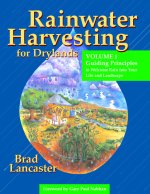
“The bricoleur, says Levi-Strauss, is someone who uses "the means at hand," that is, the instruments he finds at his disposition around him, those which are already there, which had not been especially conceived with an eye to the operation for which they are to be used and to which one tries by trial and error to adapt them, not hesitating to change them whenever it appears necessary, or to try several of them at once, even if their form and their origin are heterogeneous."Homegrown Revolution loves cheap low-tech solutions (not to mention pretentious quotes), which is why we especially like "bricoleur" and Tucson rainwater harvesting guru Brad Lancaster and his ongoing book series Rainwater Harvesting for Drylands. Volume one is already out and volume two is due out this summer. Landcaster's ingenious methods involve little more than careful observation and some work with a shovel. He suggests that harvesting rainwater begins with considering the flow of water from the highest point (which for most people will be the roof) to the lowest point in your yard and then simply figuring out simple ways to get that water to percolate into the ground to nourish your plants.
-Jacques Derrida
We're especially fond of his method of hijacking street gutter runoff and directing it with a small improvised check dam into a dug out basin in the parkway. We've watched our neighbor's lawn watering runoff for years and wondered if we could find a way to use that water. You can watch two videos showing Lancaster at work here. And a podcast here.
Friday, June 01, 2007
Growing Chayote
 On our morning dog walk Giovanni, one of our neighbors, kindly gave us a pair of fresh chayote off of his backyard vine which covers a trellis over his carport. Giovanni has wisely intertwined the chayote with an equally prodigious passion fruit vine making for a combo that produces many pounds of fruit all summer long.
Chayote (Sechium edule), for those not in the know, is a wonder plant of the gourd family hailing from Mexico and Central America. It has a mild slightly sweet cucumber-like taste. They can be boiled, pan fried, steamed, baked, pickled or chopped up and tossed raw in a salad. Though requiring a fair amount of water, it grows like a weed here and one vine can easily produce eighty pounds of fruit. Another mark in its favor is that Chayote is a perennial and, to top it all off, the young leaves and root are also edible and the tough stalks can be made into rope.
We started a chayote plant a few months ago by simply buying a few at our local market, letting it sprout on our counter top and then planting it in the ground. Since the fruit contains only one seed you don't need to extract it--you plant the whole thing. They are very susceptible to rotting when first planted so that may explain why we got only one out of three to grow.
Chayote is traditionally grown up over a trellis or roof and we're growing ours on a bare trellis that covers a deck in the back yard. We're hoping the chayote will give us a summer of both fruit and shade!
Subscribe to:
Posts (Atom)