Showing posts with label permaculture. Show all posts

Wednesday, October 17, 2012

Sources for Interesting Perennial Crops


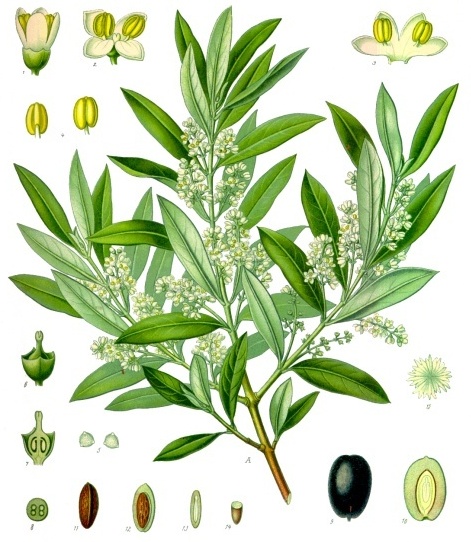
A fruitless search for a fruiting olive tree caused an existential crisis here at the Root Simple compound. With a few exceptions, most nurseries in Los Angeles cater to the mow and blow set. You're more likely to find parts for your leaf blower and a flat of petunias than anything worth growing. Good luck finding olives.

In the midst of my frustration I stumbled upon a interesting list, put together by the USDA, of retail nurseries and perennial crop resources. You can view that list here. Here's three sources I found particularly interesting from that list:

California Rare Fruit Growers Member Nurseries and fruit sources
CRFG members are always on the hunt for interesting varieties of fruits. Note that this list of nurseries covers the entire US, not just California.

Permaculture Activist plant sources
The website is somewhat of a graphic design nightmare, but if you're looking for unusual edible perennials, this would be the place to start.

Hop Roots - where to get them... 
Hoptacular! A list of hops nurseries from the Oregon State Hops Commision.

Also note that the USDA maintains a huge collection of fruit trees, nut trees and many other crops at thirty-two federally funded repositories around the United States. At least one of those facilities, the National Clonal Germplasm Repository for Fruit and Nut Crops in Davis, CA, will send out scion wood when available (researchers get first dibs). They appreciate a Fed Ex number so they don't have to pay for shipping. Of course you have to know how to graft and be ready with root stock.

Now if you can help me find a source of olive trees other than arbequina in Southern California, please leave a comment!

Wednesday, September 19, 2012

Toby Hemenway On How Horticulture Can Save Us

What I like about author and permaculturalist Toby Hemenway is that he does a lot better job, frankly, of explaining permacuture than do the founders of the movement, Bill Mollison and David Holmgren. Hemenway is a better writer and demonstrates how permaculture's abstract designs principles can apply at the household and neighborhood level. His book, Gaia's Garden, A Guide To Home-Scale Permaculture ought to be on everyone's bookshelf.

Last Thursday at the National Heirloom Exposition Hemenway gave a talk entitled "Redesigning Civilization: How Horticulture Can Save Us." What he meant by "horticulture" is not, say, propagating begonias. Rather, he defined horticulture as gardening, the kind of gardening some indigenous people did when they influenced the landscape to produce useful and edible plants. In other words, what we in the West would call permaculture. This is in contrast to agriculture which Hemenway considers to have a destructive influence on ecosystems, human health and culture.

Hemenway also, justifiably, critiqued some corners of the urban homesteading movement for promoting an egocentric self-sufficiency--"MY food on MY land" as he put it--a kind of industrial farming on a household level. While "self-sufficiency" appears in the subtitle of our first book (our publisher's idea), it's not a term we use. Kelly and I always emphasize, like Hemenway, the importance of community. We are much more comfortable with the title "gardener" rather than "farmer". We need farmers, of course, but I'd like to think of urban homesteading as being more about small scale, permacutural type projects that involve both individual and group efforts.

The takeaway from Hemenway's talk for me was the importance, especially in urban areas, of integrating community in any permacultural design project. After showing what everyone reading this blog knows, that our modern world is in big trouble, Hemenway ended on a positive note. With small scale, thoughtful design we can go a long way to solving some pretty big problems.

Monday, July 02, 2012

The Ecology Center of San Juan Capistrano


Kelly and I had the privilege of doing a short talk this weekend at the Ecology Center in San Juan Capistrano. If you're interested in Southern California food forestry, greywater, chickens, you name it, this is the place to visit. They have an amazing garden, classes and a well curated gift store. When people ask us how to design garden and house systems in SoCal, we're going to send them to the Ecology Center.

Tuesday, April 10, 2012

Introducing Nancy Klehm With Tips on Growing Jerusalem Artichokes

Photo by Ann Summa
We're very proud to welcome to the blog our good friend Nancy Klehm. Nancy is a radical ecologist, designer, urban forager, grower and teacher. Most importantly, unlike Kelly and I here in Los Angeles, she lives in a place subject that odd meteorological condition called "winter", namely Chicago. We asked her to write posts for us for on gardening in a four-season climate and to add her expertise to Root Simple. Nancy's website, where you can find listings for her upcoming classes and events is http://spontaneousvegetation.net/.

She keeps a garden in her yard, an empty lot next to her house and on her roof in addition to lots of indoor seedlings. She has 5 chickens (one is rooster) and 7 quail (5 bobwhite and 2 coturnix). She also grows and gathers in her neighborhood and maintains a half acre food forest west of the city. In her first post for Root Simple Nancy introduces her climate and offers some tips on growing Jerusalem artichokes:

Welcome to Zone 5
I live in what is known by the USDA as Cold Hardiness Zone 5. Chicago is 5B and my food forest is in 5A. If you don’t know, the map is based on minimum average temperatures and helps as a guideline for first and last frost dates: http://www.usna.usda.gov/Hardzone/ushzmap.html. In the Midwest, where winter is a serious endeavor, a zone 5 growing season’s frost dates are May 15 and Nov 1, meaning that is the bracket for growing more tender annual plants such as basil, tomatoes, melons, etc. We have had a mild winter and a very early Spring this year – almost a month ahead according to any record. As a true farmer said: ‘This is the warmest April on record.’ And it was still March when he said it.

In the past 10 days, dodging rain and wet soil, I have planted out potatoes, asparagus, peas, collards, chard, kale, radishes, carrots, beets, turnips, salsify, and cress. I have many vegetables, fruits, culinary and medicinal herbs sown and growing under lights indoors that have weeks ahead of them under 14 hours of artificial sun. But thankfully, I have already been eating out of my garden which is a loose collection of the cultivated and the forageable: asparagus, stinging nettle, dandelion, chickweed, dock, wild and French sorrel, parsley, pea shoots, garlic mustard, ground ivy, wild onion, horseradish leaves, wild carrot, hawthorn flower and burdock root. The hops are almost four feet high, the fruit trees are in heavy bloom and my pawpaw birthed 14 blossoms for the first time since I planted its seed seven years ago!

The problem with this early spring is that it is likely to freeze between now and may 15. Everyone I know who grows tree fruit commercially is a bit worried about the fast blooms so early in the season. We could lose our fruit if the weather snaps to 30 degrees.


Jerusalem artichokes – PLANT NOW!
I was given a lunch bag full of dirty Jerusalem artichoke roots a handful of years ago and now I have a stand that is at least 500 square feet. It is in the center of my food forest. The stand acts like a giant sponge to absorb the extra water that floods my growing area now that the natural hydrology has been interrupted by a nearby housing developer. The stand provides shade for toads and in wet times, muddy crayfish tunnel into the mud around its tubers. In August, the flowers are 10 feet tall. Every spring, I dig out 30-50 pounds of chokes from my ever expanding bed to keep them from overwhelming my young quince and apple trees, which they would if I didn’t.

Muddy chokes and a few worms.

Chokes are a delicious wild perennial food. Darn easy to grow, but can be a lot of work to dig and wash and are really tough to store well. They either mold or dry out quickly once out of the ground and, even if I keep them nice and muddy, I haven’t had the luck or skill to store then over two weeks. In other words, use them or process them immediately.

Washed chokes and wild carrots drying.

I almost broke my mother’s Kitchen Aid when I tried to make Jerusalem artichoke flour, an answer to my father’s diabetes and new anti-gluten faddists. I sliced them, dried the slices and then tried to use the Cuisine Art to chop them up. Wrong tool, so I went to the mixer. It beat on and on for 10 minutes. I threw a towel over the top of the entire machine to keep the fine clouds of dust down. I got flour as well as some hard bits which I sifted out. It was tasty, but given the work I had to do, I had to think of another approach. And this is coming from someone pretty intrepid athlete with food processing. Making sunchoke flour takes second place for me just after creating my own dried pectin from wild crab apple skins.

Note from Kelly for folks in dry climes: Jerusalem artichokes grow in LA, too. We blogged about them here, where you can see a picture of one growing (they look like small sunflowers on enormous stalks). Our patch didn't grow for more than one year because we decided we didn't want to water them.  I believe in a wetter place they can grow without inputs--indeed, they're hard to stop once they get going!-- but in a dry climate they do need some water.

Thursday, March 29, 2012

A Food Forest in Los Angeles


The great thing about this blog is that I get to meet people like Ron Finley, profiled in the video above. Ron got busted for this garden (the city of Los Angeles requires all parkway plantings to be mowed to 2 inches). Ron is now leading an effort to get the rules changed. We wish him luck and hope that his garden inspires many others around the world.

Sunday, February 20, 2011

Look To Mother Nature


While this clip is about the economy, I often think about it in relation to our burgeoning urban homesteading movement. Whenever I'm asked why we are engaged in the disparate activities chronicled on this blog, I point to Nassim Nicholas Taleb, author of one of my favorite books, The Black Swan.  In this clip he talks about how nature isn't centralized. Nothing in nature is "too big to fail." Nature depends on built in redundancy. It's adaptable, flexible, built to withstand shocks--Taleb's term for this is robustness.

He's talking about reforming financial systems, but we apply the same ideas when considering our overly centralized food system. All of us who grow a little food, bake, brew, keep small stock and bees--what have you--are part of the solution. By building community ties and practical knowledge we're creating a robust food production and distribution able to withstand shocks.

This is reason enough to do it, but as you all know, it's a whole lot of fun, too.

Just another reason why urban homesteading rocks.

Tuesday, August 17, 2010

The Pinnacle of Permaculture: Tending the Wild

Tending the Wild: Native American Knowledge and the Management of California's Natural ResourcesBook review: Tending the Wild: Native American Knowledge and the Management of California's Natural Resources by M. Kat Anderson, University of California Press, 2006

When the white man came to California, he found a verdant paradise: meadows thick with wildflowers and clover, stately groves of nut trees, abundant, healthy game and rivers full of fish. It was a land of endless bounty. The natives, often derogatorily called "Diggers" by the whites, seemed to live off this bounty in a lazy, hand-to-mouth sort of way.

Tending the Wild, a highly readable dissertation, takes this mythology apart. Anderson's argument is that the native people of California were active stewards of the land.
"Through coppicing, pruning, harrowing, sowing, weeding, burning, digging, thinning, and selective harvesting, they encouraged desired characteristics of individual plants, increased populations of useful plants, and altered the structures and compositions of plant communities. Regular burning of many types of vegetation across the state created better habitat for game, eliminated brush, minimized potential for catastrophic fires, and encouraged diversity of food crops. These harvest and management practices, on the whole, allowed for sustainable harvest of plants over centuries and possibly thousands of years."
Through extensive practical experience, the Indians had found a "middle way" between exploitation of the land and hands-off preservation of the land. They made use of the land, and in so doing, made the land better for all other creatures as well. They used resources, but managed to give back more. And in so doing, they shaped California.
"John Muir, celebrated environmentalist and founder of the Sierra Club, was an early proponent of the view and California landscape was a pristine wilderness before the arrival of the Europeans. Staring in awe at the lengthy visas of his beloved Yosemite Valley, or the extensive beds of golden and purple flowers in the Central Valley, Muir was eyeing what were really the fertile seed, bulb and green gathering grounds of the Miwok and Yokuts Indians, kept open and productive by centuries of carefully planned indigenous burning, harvesting and seed scattering."
Our favorite idea to come out of this book is the notion that plants and animals need people. This is the philosophy of the Native American elders Anderson interviews. Rather as plants need birds to scatter their seeds, plants rely on humans to thin and prune them, protect them and spread them. The elders imagined an active, reciprocal relationship of use between humans, plants and animals. For them, "wilderness" is a pejorative term. When land is untended, it turns feral and declines. In a thriving land there is physical and spiritual intimacy between man, plants and animals.

All this is to say that California, at first European contact, was a garden--a garden that had been loved, tended and built up for generations. And the first settlers and explorers couldn't see it. They saw a gift from God, one which they stripped bare in short order.

There is sadness in reading this, sadness in thinking of all that has been lost. But as Anderson contends, there is still a chance to preserve some of this knowledge. It lives on in the elders who remain whose grandparents remembered California before the gold rush. This book collects some of that knowledge, and talks about Indian management of certain species. While it cannot teach us everything, it provides a tantalizing vision of a non-exploitative yet productive relationship between man and nature, providing us a path for the future, if we can find the will to take it before it is too late.

Highly recommended read, especially for Californians, conservationists, gardeners, wild plant enthusiasts and those studying permaculture.

Tuesday, August 03, 2010

Urban Permaculture Survey/Interview

Attention urban/suburban permaculturists. I'm writing an article for Urban Farm Magazine on "urban permaculture" and I need your help. I've created a survey/interview for the article: click here to take the Urban Farm permaculture article survey. Please forward this link/survey to all your permaculture friends--send it out far and wide--work that Facebook! If you're critical of permaculture you are also welcome to take the survey. Thanks for your help!

Wednesday, March 18, 2009

The Sami Way

What's more impressive? That humans figured out how to live in the arctic or that we figured out how to collateralize debt obligations? As we deal with the consequences of the latter it's nice to reflect on those thousands of years spent herding reindeer. It's also comforting to know that there's still some folks left who know how to take care of reindeer even if they now use snowmobiles.

Homegrown Evolution had the privilege of meeting Nils Anders Kuhmunen today, along with a bunch of art students, in an arctic village in northern Sweden. Kuhmunen is a Sami, an indigenous people populating the northernmost parts of Scandinavia and part of Russia. The Sami tended reindeer for thousands of years. The pictures of our visit speak for themselves (though you won't be able to taste the delicious reindeer meat Kuhmunen served).


A wooden form of the traditional circular Sami hut.


Kuhmunen speaking eloquently about what can only be called arctic permaculture, life in touch with the cycles of life and the importance of context specific design.


And speaking of context, the smoke of the fire rising up through a hole in the roof. The dirt floor is insulated with a layer of burnt twigs, followed by moose skins and a top layer of reindeer fur. It works. It was bitter cold outside and toasty in the hut.

Kuhmunen and grandchild feeding the reindeer some lichen.

Not only does Nils Anders Kuhmunen herd reindeer, he also has a website.

Friday, May 23, 2008

Mistakes we have made . . .

There's a kind of boastful blogging style that, I'm afraid, we here at Homegrown Evolution have been guilty of. Simply put, we've failed to detail all our blunders. These mistakes and accidents, some funny, others painfully disappointing, have more instructional value than our successes. And oh, how many blunders there have been in the past ten years. It's about time to round up the top 6. I'm sure there are many more that I've forgotten, but here's a start.

1. Installing a water garden.

That water garden looks great in the picture above. That was before the neighborhood raccoons spent several nights a week treating it like rock stars used to treat hotel rooms, and before scum and slime clogged up the pump. While the pump was solar powered, the profligate use of water was not the best example to set here in draught prone Los Angeles. After a few months we gave up, filled it in with soil and now strawberries grow there happily. We hear that Materials and Applications, a neighborhood landscape architecture firm that runs an amazing outdoor gallery, has stopped designing water features unless they are supplied by rainwater. Sounds like a good idea to us! And with the chickens we did not want to provide habitat for raccoons.

2. Mixing Chicken Breeds

Speaking of chickens, a friend of ours who grew up on a farm confirmed that "chickens are racists". Like talk radio hosts, hens will pick on anyone who is different. In our case, our green egg laying and weird looking Araucana gets the crap beaten out of her by the Rhode Island Red and one of the Barred Rocks. If I had it do do all over again, I'd get four Barred Rocks. They're dependable layers and don't make much of a fuss.

3. Planting stuff that doesn't grow in our Mediterranean climate

As our permaculture friend David Khan likes to say, "work makes work." Plants that need lots of tending and attention, nine times out of ten, end up unhappy. When they croak it leads to a downward spiral of disappointment and frustration. Just recently a hops plant I tried to grow up and died on me. I stormed around the kitchen cursing for a few minutes before I realized that, once again, I had failed to follow my own advice--plant in season and in respect of place. Hops belong in the Pacific Northwest. In contrast, the heat loving prickly pear cactus in our front yard provides both tasty nopales and fruit reliably every year while growing in terrible alkaline soil with no added water or fertilizer. The problem with the prickly pear is that it is too prodigious, and that's the kind of problem you can hope for as an urban homesteader.

3. Newspaper seed pots

Those newspaper seed starting pots we linked to earlier this year . . . well, there seems to be a problem with them. I think the newspaper is wicking the water away from the soil. While in Houston recently, I took a class from a master gardener in plant propagation and we used regular plastic pots, a thin layer of vermiculite over the potting soil and a plastic bag over the pot. It seems to work better. The other blunder here is posting about something before testing it.

4. Pantry Moths!

A few years ago, using our solar dehydrator (we'll post about that soon), we dried a summer's worth of tomatoes to use during the fall and winter. We put the entire harvest in one large jar. Several months later we had a jar full of pantry moth larvae. This is the entomological version of "don't put all your eggs in one basket", a mistake we won't soon repeat. Now we split dried goods into multiple jars so that in case some critters get it to one we'll still have others.

5. Buying a wonky house with poor professional guidance

Be careful choosing a Realtor--pick one who has been recommended to you by someone you trust. Be especially careful picking a home inspector--pick an independent one--not one recommended by the seller or buyer's agent. Our inspector spent a very short time in our house and ignored large problems, in my opinion, because it was in his favor for the house to sell so that he could continue his relationship with our agent. It's an inherent conflict of interest for the inspector to have a connection to either real estate agent.

6. Planting a lawn

We weren't always the Molotov cocktail tossing vegetable growing radicals that we are now. Just after we bought this place ten years ago we planted a lawn in the backyard. With some temporary fencing, we roped it off from the Doberman to allow it to grow. After a month the lawn matured into a lush green carpet . . . but it only lasted five minutes. That was the time it took for the Doberman to gracefully leap over the barrier and run in circles, causing chunks of turf and newly amended soil to fly all over the yard.

Let's do the math--in a dry place like Los Angeles--lawn=crime. On top of the waste of water they simply don't look good here without massive inputs of fertilizer, herbicides and gas powered lawn mowers. Sorry, but I hate lawns and will not ever be convinced otherwise. Got kids? That's what mulch is for. Fuck the lawn. Fuck all it stands for.

The Conclusion

I guess the lesson here, with all of these missteps, is persistence. Push through the blunders and the light will shine. And a promise--we here at Homegrown Evolution we will do a better job detailing our mistakes.

Thursday, December 06, 2007

And on the Seventh Day Petals Fell in Petaluma

The ducks of Petaluma Urban Homestead

A big thanks to Suzanne and Paul of Petaluma Urban Homestead for giving us a tour of their bit of heaven on earth. Homegrown Revolution forgot to bring the camera so you'll have to check out their blog to see what they are up to. They make a damn good hard cider by the way.

We also had the privilege of meeting the inspiring Trathen Heckman of Daily Acts, publisher of the journal Ripples. If that wasn't enough, Suzanne took us to an open house at the Center for Regenerative Design to see the wonders of permaculture applied to the breathtaking northern California landscape.

We're back and fired up to work on our own humble plot here in Los Angeles which is looking a little neglected after a busy fall. More soon . . .

Friday, August 31, 2007

The Three Sisters

Due to the rigors of finishing our book The Urban Homesteader due out from Process Media next spring we were late getting around to planting our parkway vegetable garden. To review, the parkway is that space between the sidewalk and the street that belongs to the city but is the responsibility of the homeowner to maintain. The city, of course, wants us all to plant a lawn so that fat people can easily plop out of their Escalades unimpeded. We decided to grow food instead and despite the presence of many building inspectors reviewing our expensive foundation work nobody seems to care about the two large raised beds we installed. In fact one of our neighbors has planted her own parkway vegetable garden just down the street.

Since it was so late (July) we decided to cultivate heat tolerant vegetables and upped the ante by planting the Native American three sisters--corn, beans and squash. The three sisters are textbook permaculture, the idea being that the beans nitrogenate the soil and climb up the corn while the squash provides mulch. All plants are useful and you end up with an interdependent, self-sustaining beneficial feedback loop. Some people add a fourth sister, Rocky Mountain bee plant (Cleome serrulata) which attracts pollinating insects for the corn and squash.

We added a drip irrigation system on a timer (more on that in a later post) which has seemed to keep the plants healthier by preventing watering mishaps due to those flaky hung-over mornings. We planted corn seeds from the Not a Cornfield project, a variety of squash called Cucuzzi, and two beans from seeds we saved from last season (the tasty Borlotto Lingua di Fuoco and attractive but not so tasty scarlet runner bean).

Wednesday, January 10, 2007

Free Introduction to Permaculture

Local permaculture expert David Khan will be presenting an introduction to permaculture on Saturday January 20th 2007 at 10:00 am at the Audubon Center at Debs Park:

4700 North Griffin Ave.
Los Angeles, CA 90031

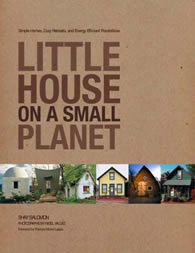
After the lecture author Shay Salomon and photographer Nigel Valdez will do a slide show and talk about their book Little House on a Small Planet.

SurviveLA attended Khan's introductory lecture last month and found it thought provoking and informative. Here is Khan's description of this brief introductory talk:
Using ecology as the basis for designing integrated systems of food, shelter, renewable energy and community. Permaculture is the perfect solution for creating sustainable lifestyles in the city. Learn how to cope with peak oil and the energy descent society of the future. Become the solution! Learn how LA can be a model for sustainable cities.

This Free Introduction to Permaculture Class is an outline of the science and art of Permaculture. It will define the term, its history, its founders and the curriculum of the design course certificate, its ethics and foundations. It will describe the benefits and show some of the most important work undertaken by permaculture designers.
Reservations:

www.sustainablehabitats.org
323.667 1330
info@sustainablehabitats.org

Tuesday, December 12, 2006

Leaf Litter

My people were entirely Nordic, which is to say idiots. Every wrong idea which has ever been expounded was theirs. Among them was the doctrine of cleanliness, to say nothing of righteousness. They were painfully clean. But inwardly they stank. Never once had they opened the door which leads to the soul; never once did they dream of taking a blind leap into the dark. After dinner the dishes were promptly washed and put in the closet; after the paper was read it was neatly folded and laid away on a shelf; after the clothes were washed they were ironed and folded and then tucked away in the drawers. Everything was for tomorrow, but tomorrow never came. The present was only a bridge and on this bridge they are still groaning, as the world groans, and not one idiot ever thinks of blowing up the bridge.
-Henry Miller Tropic of Capricorn
SurviveLA's approach to our small patch of land has been slowly evolving over the past year towards integrating permaculture principles. One of our favorite notions in permaculture is the idea that "work makes work". An example used to be the annual fall cleanup after our two large trees dropped their load of leaves in the back yard. Dave Jacke, author of the massive two volume permaculture guide, Edible Forest Gardens puts it this way,
Simply relinquishing a need for "order" and "tidiness" in your garden will make a huge difference. . Order and tidiness by definition reduce structural diversity in ecosystems. Structural diversity provides shelter for many animals for many purposes.
In short, when it comes to fall leaf raking, just say no, be a slob and be proud of it.

The mulch created by leaf litter serves multiple purposes. All those fallen leaves provide shelter for beneficial insects, reduce water usage by preventing evaporation, prevent weed growth, inhibit soil erosion and may even stop acid rain from penetrating soil. For these reasons SurviveLA says banish your leaf blower! In fact, when planning a garden around permaculture principles you may want to consider plants that produce mulch, and placing them where the mulch will benefit your landscaping. Remember though that some trees such as black walnut and eucalyptus produce so called alleopathic chemicals that kill neighboring plants and hence would not be good candidates for mulch production. With the exception of these alleopathic plants, there is simply no good reason to rake up leaves.

Blow up the bridge, let the leaves fall, let nature do its thing, and join the SurviveLA idleness non-revolution (as the folks at SoapboxLA would say, it would take too much effort to start an idleness revolution).

Wednesday, December 06, 2006

Polyculture


Here at SurviveLA we are experimenting with something called polyculture in the the garden. We read about it first in the worthy permaculture guide, Gaia's Garden, by Toby Hemenway.

Polyculture is the practice of planting a community of interrelated, interdependent plants, mimicking in your garden (in our case a raised vegetable bed) the complex relationships that are found between plants in nature.

In the case of food crops, a polyculture tries to set up conditions where you can eat almost continually out of a garden bed filled with different varieties of plants maturing at different times. The faster growing plants protect the tender ones from the sun. The thickness of the planting virtually eliminates weeds, and also functions as a living mulch, keeping the soil moist and cool beneath a carpet of green. These beds look quite different than the tidy rows of carrots and cabbages one sees ... well, one does not see vegetable gardens anywhere if one lives in LA. One remembers them from illustrations in Peter Rabbit.

Okay, you want specifics? Here is an example of a professional polyculture bed out of Gaia's Garden, one which creates salads, cabbages, and beans. It is written for people who live places with cold winters (as are most gardening books, alas). So Angelinos wanting to follow his plan can start this earlier, perhaps in March. The SurviveLA polyculture that will be described after was started in October.

Polyculture from Gaia's Garden, attributed to Ianto Evan:

After the last frost cover your garden bed evenly with a light broadcasting of the following seeds. Don't mix them before broadcasting because they will fall differently according to their weight., and so separate out in the throwing. Spread one type of seed at a time, aiming for an even distribution of each type of seed all over the bed. Sow: radish, dill, parsnip, calendula and many types of lettuces, late and early harvesting types to extend the length of your season. Cover the seeds with 1/4 inch of soil.

Meanwhile, start cabbages from seeds in containers, early and late maturing varieties.

4 weeks after sowing you can pull some of the first radishes, because they grow fast. As you eat those, put the cabbage seedlings in the holes.

6 weeks after sowing you can eat the lettuce. First as a baby lettuce mix, later in its more mature leafing form. Pull out entire plants to make space, so things don't get too crowded.

Continue this way until the soil warms up. As you eliminate lettuce plants, begin to put bush beans in their place. The dill and calendula will start coming into their own, and the early cabbages. The beans will be ready by midsummer, and the parsnips and the rest of the cabbages will follow in the fall.
So you see, the secret is in choosing plants with staggered harvesting times, so they don't come in all at once, overwhelming you and competing with each other for space, and also in choosing plants that are not all from the same families, so they don't compete for the same nutrients. The beans in the polyculture above help replenish the nitrogen in the soil that the other plants drain out. Very clever. With little effort compared to normal gardening, you will be harvesting veggies from one plot all year long.

SurviveLA's Impetuous Salad Bed

Now the SurviveLA bed is not so well organized, because we don't know as much as these permaculture folks, but it has been very successful so far, meaning no pests, no weeds, low watering, and tons of salad.

This bed was started in October, as soon as the weather had decidedly shifted toward the cool. In LA, it makes sense to grow tender salad greens and the like in the winter, when the the sun is low, the climate is gentle, and our only rains fall. Lettuce loves that kind of thing, and hates hot sun. If you plant lettuce in LA in the summer you are in for a world of sorrow.

As above, we broadcast the following seeds evenly over our 4' x 8' foot raised garden bed. It is set up with fancy new drip emitters for lazy watering. In the past, we've watered this bed with the more casual but quite functional soaker hose. Both are preferable to standing around with a garden hose, and the plants like it a lot better too. FYI, plants prefer occasional deep soakings to brief daily showers. However, while the seeds were sprouting and delicate we did water from above with a hose set on gentle sprinkle.

Not knowing all of the habits of these plants, many of which are from growitalian.com, we just threw them all in to see what would happen. When the coldest nights are over in a couple of months we will plants some beans, as above, for nitrogen fixing. For now, these things are growing in a riotous mix:

Green chicory
Red chicory
Radishes
Carrots
Wild fennel (non-bulbing variety)
Common cress
Arugula
Lettuce mix (various types in one package)
Rapa da Foglia (leaf turnip)
Green onions

We've been eating all of it in its infant form, except the radishes, which have markedly hairy leaves that you don't want in your salad. Just lately the leafy plants have become easily distinguishable from one another, and are taking on their full flavor. To keep up with the thinning which is necessary at this stage SurviveLA must eat at least one salad a day. But it is no hardship to eat greens so fresh and tender--once you grow your own salad, you will feel cheated each time you have to eat salad from a bag.

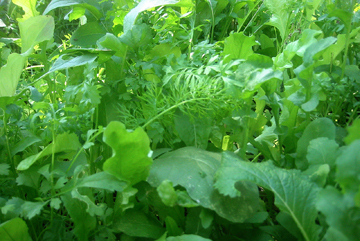
In the photo you will see how tight the planting is in the bed. It is perhaps a tad too tight. We are eating as fast as we can, pulling whole plants for the most part, shooting for the ideal of giving each remaining lettuce and chicory a space about the diameter of a cereal bowl for itself.

When the lettuces are full grown, you can harvest leaves off the individual plants instead of harvesting the whole plant, thus just five or six mature lettuce plants can provide salad for two people a few times a week, leaving lots more room for other plants. Beans will come in the spring, and also some yet to be decided crops which we can expect will do well in the heat of early summer.

Friday, December 01, 2006

Free Permaculture Class

Today SurviveLA passes on an announcement for a free permaculture class taking place tomorrow - hope to see some of you there:

The next Free Introduction to Permaculture Class

Place: Audubon Center at Debs Park (http://www.audubon-ca.org/debs_park.htm)
4700 North Griffin Ave.
Los Angeles, CA 90031
(323) 221-2255

Date: Sat Dec. 2nd 2006

Time: 10:00 AM - 4:00 PM

We are living on a planet in crisis; often individuals feel powerless to effect change but Permaculture offers positive solutions to the problems facing the world; using ecology as the basis for designing integrated systems of food production, housing, technology and community development, you can learn to create a self-sustaining environment, on a farm or in your urban backyard or apartment.

The Permaculture Design Course is for anyone interested in gaining skills and perspective for sustainable living and productivity. A Permaculture Design Course is a way to share
accumulated information with others.

This Introduction to Permaculture Class is an outline of the science and art of Permaculture. It will define the term and its history, its founders, the curriculum of the design course certificate, its ethics and foundations. It will describe the benefits and show some of the most
important work undertaken by permaculture designers.

For More Information contact:
David Kahn 323 667 1330 or info@susltainablehabitats.org

www.sustainablehabitats.org

Monday, October 09, 2006

Beads and Roman Sandals Won't Be Seen

I wouldn't wear a tie-dyed tee shirt unless it was dyed with the urine of Phil Collins and the blood of Jerry Garcia." - Kurt Cobain

After installing the new herb spiral in the backyard a certain member of the SurviveLA compound, commenting on the design, remarked facetiously, "Welcome home brother." For those not in the know, that particular phrase is the greeting at any event sponsored by the Rainbow Family of Light, a group of hippies that have met each year in a different state for the annual "Rainbow Gathering" ever since 1972.

Now the topic of hippies is controversial around the SurviveLA compound, but first things first -- we ain't hippies. In fact at every hippie thing we've been to, including the Rainbow Gathering in Arizona in 1998 (along with art critic and thoughtstylist Doug Harvey), we always hear the word "narc" whispered behind our backs probably due to our short hair and white-bread appearance. But, the fact is we love hippies despite the lentil-filled coolers, naked yoga, dream catchers and tie-dye. We're all trying to make the world a better place, after all.

It's curious though, that when you grow your own vegetables and don't buy into some of the other crap our ever-present consumer culture demands of us somehow you automatically get labeled a hippie. While sadly the original hippie movement went astray, we "dig" the new and more pragmatic kind of hippie stuff happening over at Arthur Magazine. Besides, in the end, we're all untied against the "Man".

Somehow this long winded rant leads us back to the creation of the herb spiral which replaced an overgrown patch of lavender. Built with concrete salvaged from some recent demolition work the spiral also has a set of bamboo poles in the center to grow pole beans in the winter and tomatoes in the summer. The concrete spiral functions as a path to pick the herbs which include thyme, sage, chives, garic chives, tarragon, and chamomile. Our design is a modification of the permacultural herb spiral which is essentially a mound. In the permaculture version the water hungry plants are placed at the bottom of the mound and the dry plants at the top, the idea being that the water collects towards the bottom of the mound shaped spiral. We didn't do the mound thing out of laziness and a lack of materials, and because the herbs we planted don't require much water anyways.

As for the spiral shape itself, we'd like to think that it's our little tribute to Robert Smithson, more than Jerry Garcia.

Thursday, September 14, 2006

Moringa!

One of the big inspirations for starting our front yard urban farming efforts at the SurviveLA compound is a Philippino neighbor of ours who has turned his entire front yard and even the parkway into an edible garden featuring fruits and vegetables from his native land, most of which we have never seen before. This morning, while walking the dog, I found him cutting hundreds of long seed pods off of a small attractive tree. He didn't know the English name of the tree, but he told me that he likes to slice the seed pods and cook them with chicken.

Thanks the the "internets" I was able to figure out that the tree is the "Moringa oleifera", a truly miraculous tree that, in addition to producing edible seed pods, is also used by indigenous people for regulating blood pressure, dealing with joint pain and treating inflammation. The seed pods can be pressed to produce a high quality cooking oil. The leaves are also edible and the plant is drought tolerant and will grow in poor soil. Native to the southern foothills of the Himalayas, the Moringa tree is cultivated in many parts of Asia as well as Mexico and Africa.

Here's what Wikipedia says:

The immature green pods, called “drumsticks” are probably the most valued and widely used part of the tree. They are commonly consumed in India, and are generally prepared in a similar fashion to green beans and have a slight asparagus taste. The seeds are sometimes removed from more mature pods and eaten like peas or roasted like nuts. The flowers are edible when cooked, and are said to taste like mushrooms. The roots are shredded and used as a condiment in the same way as horseradish, however it contains the alkaloid spirochin, a potentially fatal nerve paralyzing agent, so such practices should be strongly discouraged.

The leaves are highly nutritious, being a significant source of beta-carotene, Vitamin C, protein, iron and potassium. The leaves are cooked and used as spinach. In addition to being used fresh as a substitute for spinach, its leaves are commonly dried and crushed into a powder, and used in soups and sauces.

The seeds may be crushed and used as a flocculant to purify water. The Moringa seeds yield 38–40% edible oil (called Ben oil, from the high concentration of behenic acid contained in the oil) that can be used in cooking, cosmetics, and lubrication. The refined oil is clear, odorless, and resists rancidity at least as well as any other botanical oil. The seed cake remaining after oil extraction may be used as a fertilizer.

The bark, sap, roots, leaves, seeds, oil and flowers are used in traditional medicine in several countries. In Jamaica, the sap is used for a blue dye.

The flowers are also cooked and relished as a delicacy in West Bengal and Bangladesh, especially during early spring. There it is called Sojne ful and is usually cooked with green peas and potato.

Some organizations are promoting this miracle plant as a way to deal with malnutrition, since its ability to tolerate drought while still producing edible leaves makes it highly desirable.

We like plants like this that have multiple purposes, since in addition to food and medicine the attractive Moringa tree also provides shade. The goal that we have set for the new SurviveLA landscaping is that every plant must have multiple uses with priority given to stuff that is edible. We suspect there may be a Moringa Tree in our future.